

When Art Sparks Change
Can project acquittals be repurposed to show the value of arts projects for Australian communities?
Creative Australia commissioned us to collate a selection of local CACD case studies to share their stories and showcase the inspiring work led by community artists. Explore the digital resource to learn more.
All around Australia, artists are sparking social change, working with communities to tell their stories, tackle big issues and create common ground.
Community arts and cultural development (CACD) is a specialist art form, where professional artist facilitators work with communities to co-create projects with purpose.
Here, you can read the stories of local CACD artists and their projects.
As Australia grapples with a 'civic crisis', their work has never been more needed.

Image: Georges Riverkeeper, STARTTS & Jiva Parthipan’s The River Project
UNESCO says that culture is an under-utilised resource for building social cohesion, with 'a high capacity to stimulate effective engagement of local communities across all generations in public life.'
In 2023, social cohesion in Australia was the lowest it’s been since measurement began in 2007, according to the Scanlon Institute’s Social Cohesion Index.
The Australian Government is aware that the country is facing a crisis in terms of civic engagement.
"We've seen a collapse in the number of people volunteering and a decline in the share of people who are donating to charities. Compared with the mid-1980s, Australians have half as many close friends, and know half as many of their neighbours. We have become more disconnected."
Andrew Leigh, Assistant Minister for Competition, Charities and Treasury
Engaging in arts, culture and creativity are shown to have powerful social and emotional effects.
One study by the University of Western Australia found that people engaging with arts and creative activities for two or more hours a week had significantly better wellbeing, after controlling for a range of other behavioural and demographic factors.
Creative arts practices can also help alleviate social challenges by addressing disadvantages and bringing people together.
According to Creative Australia’s Towards Equity report, CACD is ‘a specific type of socially engaged arts practice where, as a group, community members and professional artists collaborate to create art that is reflective of that place and community.'
Key examples:
Milk Crate Theatre used devised theatre to facilitate social inclusion for people at risk of, or experiencing, homelessness
All The Queens Men curated a lavish party to facilitate pride, celebration and visibility for LGBTIQ+ elders
Carclew addressed isolation amongst youth in regional South Australia through facilitating the opportunity for emerging young writers to develop their own monologues
Jiva Parthipan and the NSW Service for the Treatment and Rehabilitation of Torture and Trauma Survivors (STARTTS) engaged with place-making and cross-cultural understanding through a creative experience along the Georges River in Casula NSW
The impacts are profound.
Download the PDF to read their stories.
“Art is powerful. It can change things: perspectives, politics, people. Humans have an inherent need to be creative, to express themselves beyond the practical; we have an inherent right to be creative.”
CACD was pioneered in the 1960s and 1970s during a period of social upheaval, and it remains distinct from other art forms, guided by the principle of cultural democracy.
Author of ‘A Restless Art’, François Matarasso, describes community art as ‘the creation of art as a human right, by professional and non-professional artists, co-operating as equals, for purposes and to standards they set together, and whose processes, products and outcomes cannot be known in advance.’
In 2016, 14% of Australians were involved in CACD activities, which actively engaged community members in decision-making and the co-creation of art with professional artists (National Arts Participation Survey, Creative Australia).
Participation rates in CACD were higher among people in regional Australia (13%) that year, along with Australians aged 15 to 24 years (28%), those with disability (31%), those from CALD backgrounds (26%); and First Nations people (55%).
These strong engagement figures show that the CACD sector is a leader in the use of the arts to support social inclusion and cohesion, enabling diverse voices to be heard and stories to be shared through creating art.
However, of all the surveyed artforms, Australians had a particularly limited understanding of the benefits of CACD. In 2022, after two years of the pandemic, participation had fallen to 9% of Australians.
Authors

Peta Petrakis, Senior Research Analyst

Melanie Raveendran, Digital Marketing Coordinator

Tandi Palmer Williams, Managing Director

Categories
Archive
- Research 99
- Audience development 79
- Innovation 78
- Evaluation 75
- Arts 73
- Culture 72
- COVID-19 70
- Data culture 69
- About Patternmakers 35
- Project updates 25
- 2022 23
- 2023 21
- Thought leadership 16
- Tips & Tricks 13
- 2018 12
- 2019 11
- Career Advice 9
- 2017 8
- Beyond the Bio 8
- 2021 7
- Tandi Palmer Williams 7
- Privacy 6
- Resources 6
- Year in review 6
- 2016 5
- Performing Arts 5
- Strategic Planning 5
- Toolkit 5
- Accessibility 4
- Digital art 4
- Opportunities 4
- Our services 4
- Visual arts 4
- Youth 4
- 2020 3
- Capacity building 3
- Dance 3
- First Nations 3
- Interviews 3
- Touring 3
- Trends 3
- Case Studies 2
- Coronavirus 2
- Data art 2
- Education 2
- Indigenous 2
- Top 5 2
- 2024 1
- Culture Panel 1
- Manifesto 1
If you’re a CACD practitioner, artist or arts organisation looking to create your own case studies, check out our template for some recommendations on format and flow.
If you have any thoughts or questions about this resource, or about how digital storytelling can spread the message about good causes, get in touch with us via info@thepatternmakers.com.au
Image: Robert Catto, Milk Crate Theatre’s DUST.
Acknowledgements
These resources are dedicated to CACD practitioners everywhere, working to address disadvantage and bring Australians together.
They have been created by research agency Patternmakers, with assistance from the Australian Government through Creative Australia, its principal arts investment and advisory body.
Thank you to the practitioners who participated in the creation of this resource and to the many partners involved in each of the projects profiled.

Dance Sector Uplift
When we were invited to help distill the findings from a sector recovery project, we weren’t expecting to find a bigger, bolder ambition.
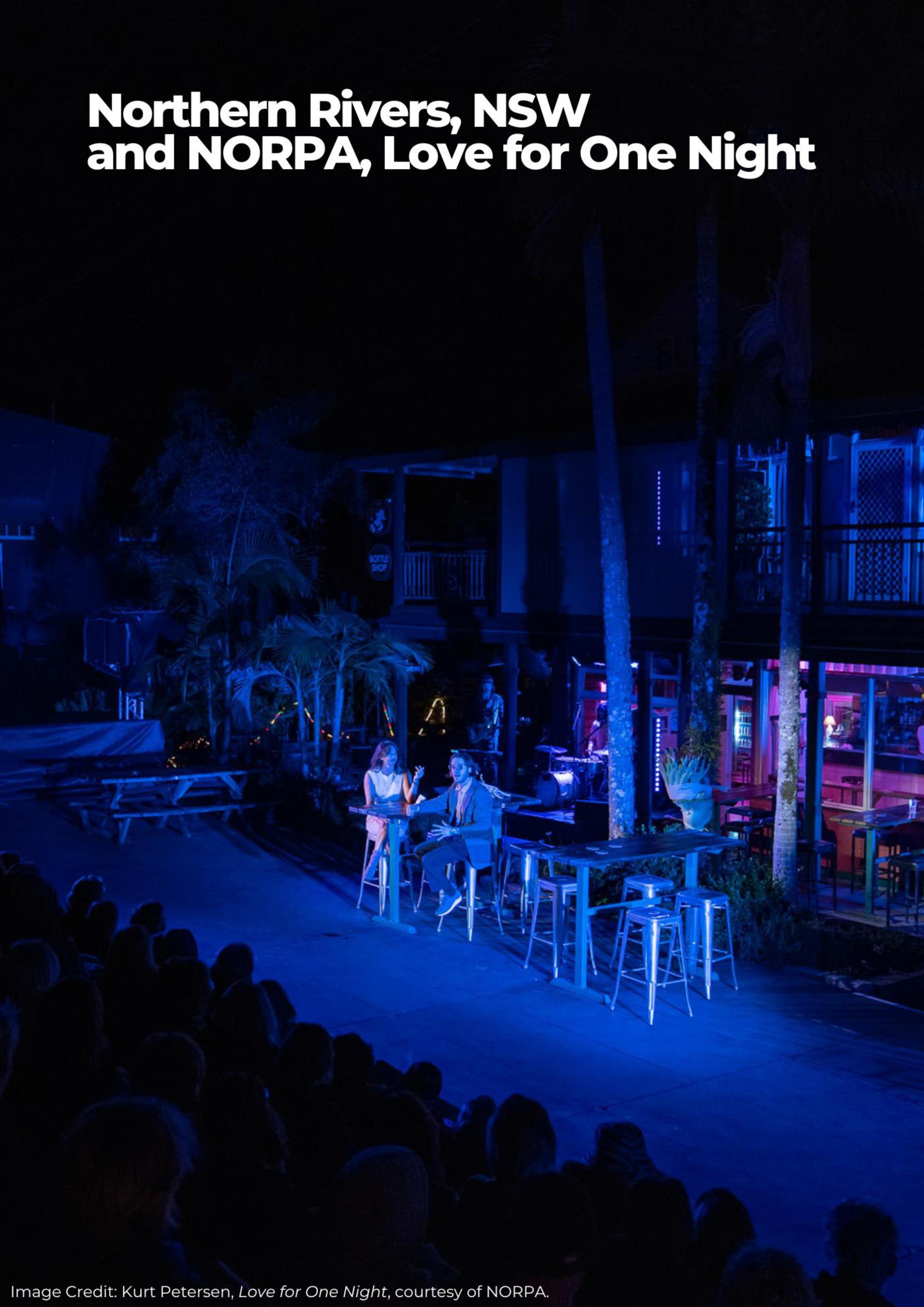
Following the flood and storm events of 2022, Dance Sector Uplift set out to reactivate dance, physical theatre and experimental performance across the Northern Rivers. Beyond simply rebuilding, the report captures a vision for a new regional hub for dance.
In 2023, Arts Northern Rivers commissioned Patternmakers to assist with the Dance Sector Uplift project, designed to reactivate dance, physical theatre and experimental performance across the region.
This partnership stretches back to the Creative Industries Recovery Forum in 2022, which we attended and developed a report to identify sector priorities in order for the creative industries to flourish again after the severe storms and flooding hit communities across Northern NSW and Southern QLD.
Arts Northern Rivers undertook three streams of focus to support the region’s activation, recovery and renewal, identified as Public Art, First Nations Arts, and Dance/Physical Theatre.
In consultation with local artists, Arts Northern Rivers was committed to stimulating the region with a revitalisation of the dance sector by supporting activities which nourish and promote the region as a creative, thriving and growing centre of diverse embodied practice.
Local dance maker and producer, Philip Channells managed the delivery of the project. Philip works across art forms including dance/theatre, film, performance installation, community art projects, site-specific work and artist residencies with collaborators who value, challenge, redefine and inform our different perspectives of contemporary life.
“Approaching the Dance Sector Uplift (DSU) research project through a broad lens of diversity and inclusion enabled conversations amongst the sector, acknowledging the diverse cultural influences, creative practices and lived experiences of practising artists.
This conversational approach led us to realise the need for various stages of research to ensure a broad set of important voices were caught in the process.”
This project was informed by a multiplicity of consultation methodologies with members of the Northern Rivers performing arts sector, including local Bundjalung, Yaegl and Gumbaynggirr leaders, knowledge keepers of dance, dance makers and performers and global Indigenous and CALD artists living in the region.
Arts Northern Rivers conducted a survey inviting all artists working across an embodied practice to contribute to the research and design process for the reactivation of dance.
We analysed and compiled the results of these surveys and consultations into a full report in order to inform the direction and outcomes of the project. The report identifies the strengths and challenges, supported with evidence and data, and recommendations on how to plan ahead, to create a vision, and help independent artists realise their creative potential while working collectively within the community.

Download the Dance Sector Uplift report below for the full story.
Click below to watch the webinar where the findings from the report were delivered to all the participants from the local dance sector.
Image | Dancers: Omer Backley-Astrachan, Kirsty Kiloh, Charemaine Seet in The Draw IN by Geraldine Balcazar. Photograph by Shane Rozario.
About the Author
Tandi Palmer Williams
Managing Director

Categories
Archive
- Research 99
- Audience development 79
- Innovation 78
- Evaluation 75
- Arts 73
- Culture 72
- COVID-19 70
- Data culture 69
- About Patternmakers 35
- Project updates 25
- 2022 23
- 2023 21
- Thought leadership 16
- Tips & Tricks 13
- 2018 12
- 2019 11
- Career Advice 9
- 2017 8
- Beyond the Bio 8
- 2021 7
- Tandi Palmer Williams 7
- Privacy 6
- Resources 6
- Year in review 6
- 2016 5
- Performing Arts 5
- Strategic Planning 5
- Toolkit 5
- Accessibility 4
- Digital art 4
- Opportunities 4
- Our services 4
- Visual arts 4
- Youth 4
- 2020 3
- Capacity building 3
- Dance 3
- First Nations 3
- Interviews 3
- Touring 3
- Trends 3
- Case Studies 2
- Coronavirus 2
- Data art 2
- Education 2
- Indigenous 2
- Top 5 2
- 2024 1
- Culture Panel 1
- Manifesto 1
Be in the loop

City lights to red dirt: Connecting with audiences across Australia
Audiences in big cities, outer suburbs and the regions have vastly different contexts, and they behave differently when it comes to attending cultural events.
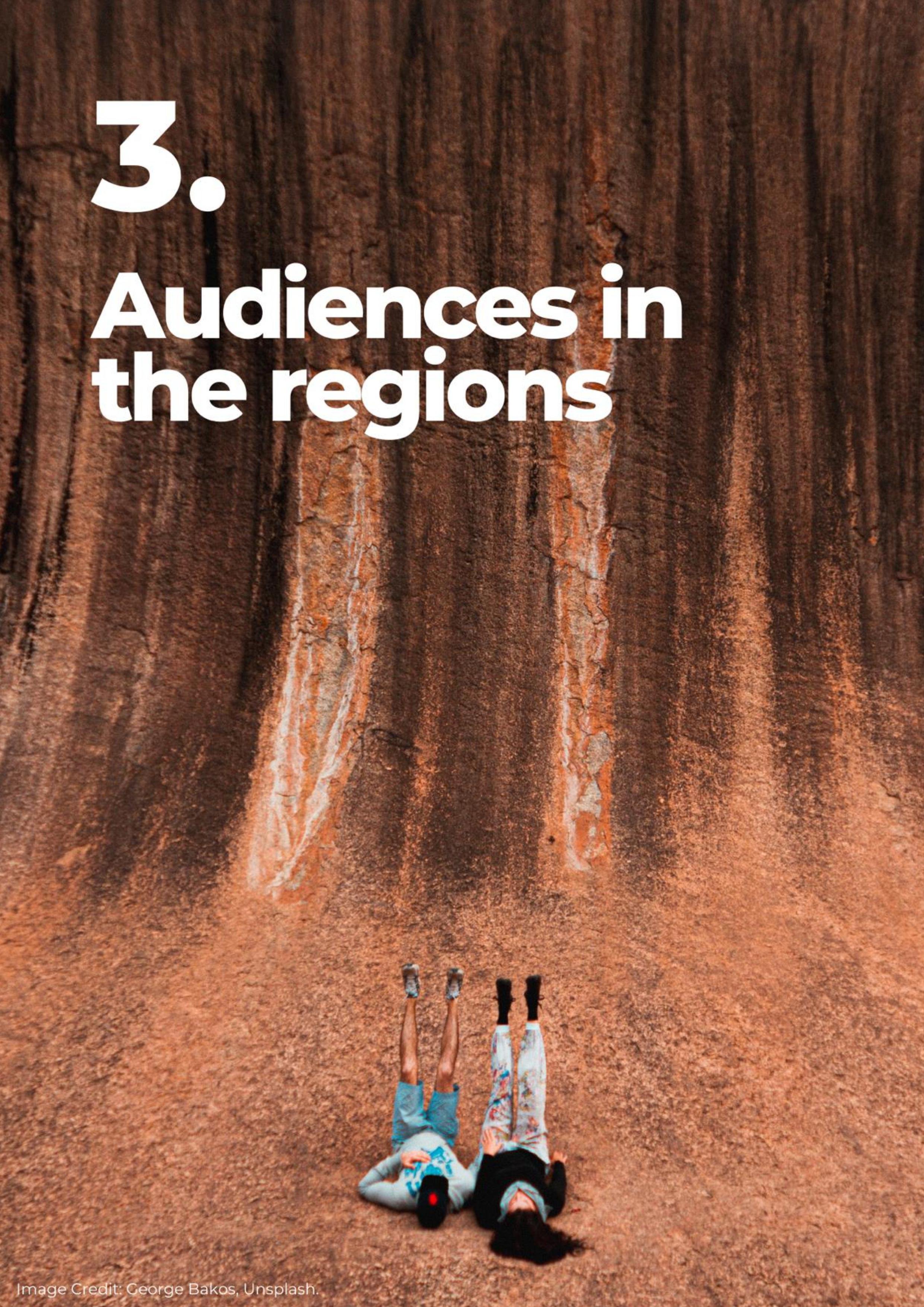
In this Audience Outlook Monitor report, ‘City Lights to Red Dirt’, we look at the geographic trends in data collected from past attendees. If Australia is to achieve equity of access for audiences, regardless of location, there are insights for programming, marketing and strategy.
Our cities, suburbs and regions are different places today and audiences are responding in interesting ways.
Attendees of arts and cultural events are feeling the pressure of the housing crisis, changing work and commuting patterns, navigating weather events and approaching travel and leisure differently.
In this new report, ‘City Lights to Red Dirt’, we look at the geographic trends in data collected from past audiences of cultural events.



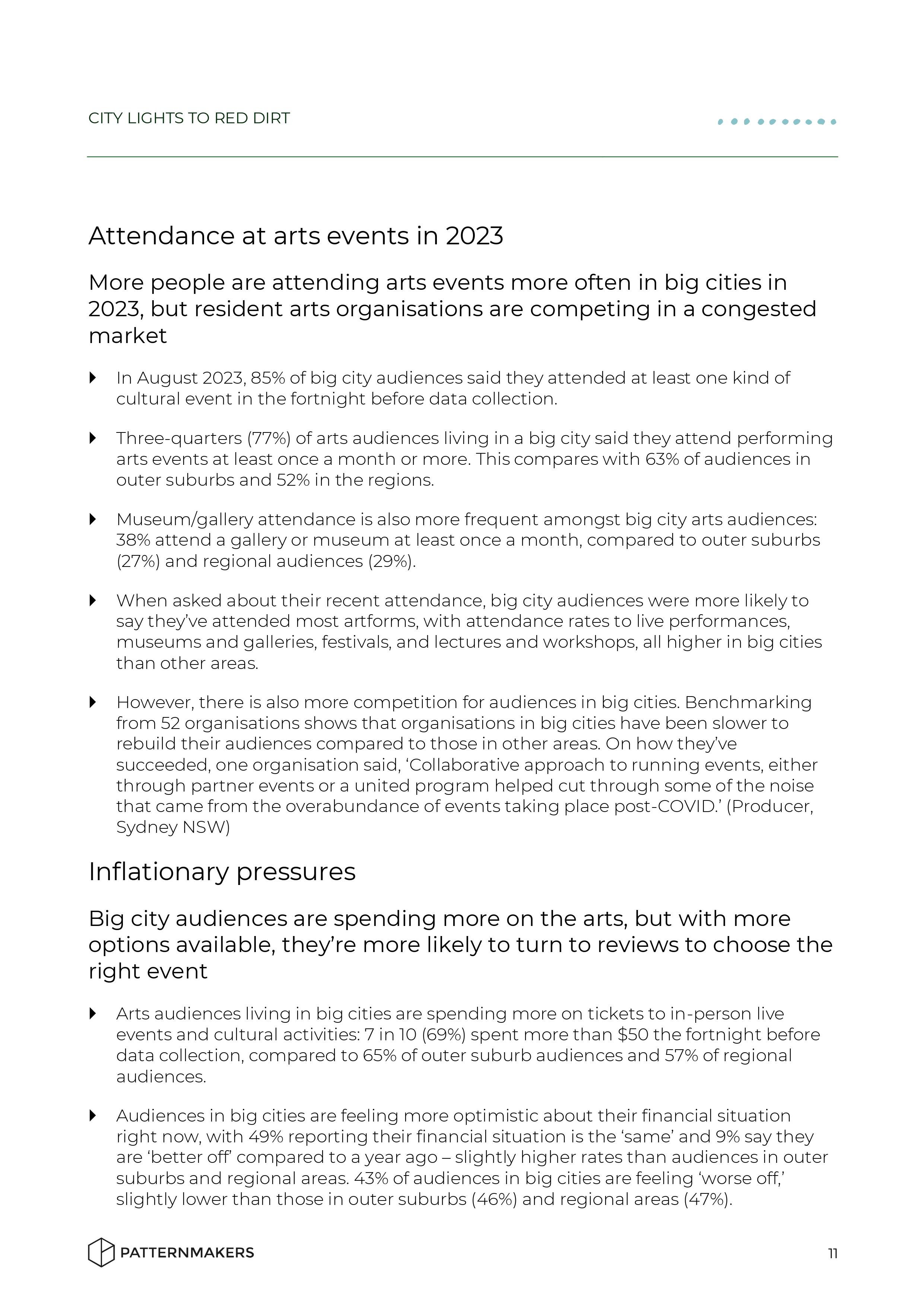
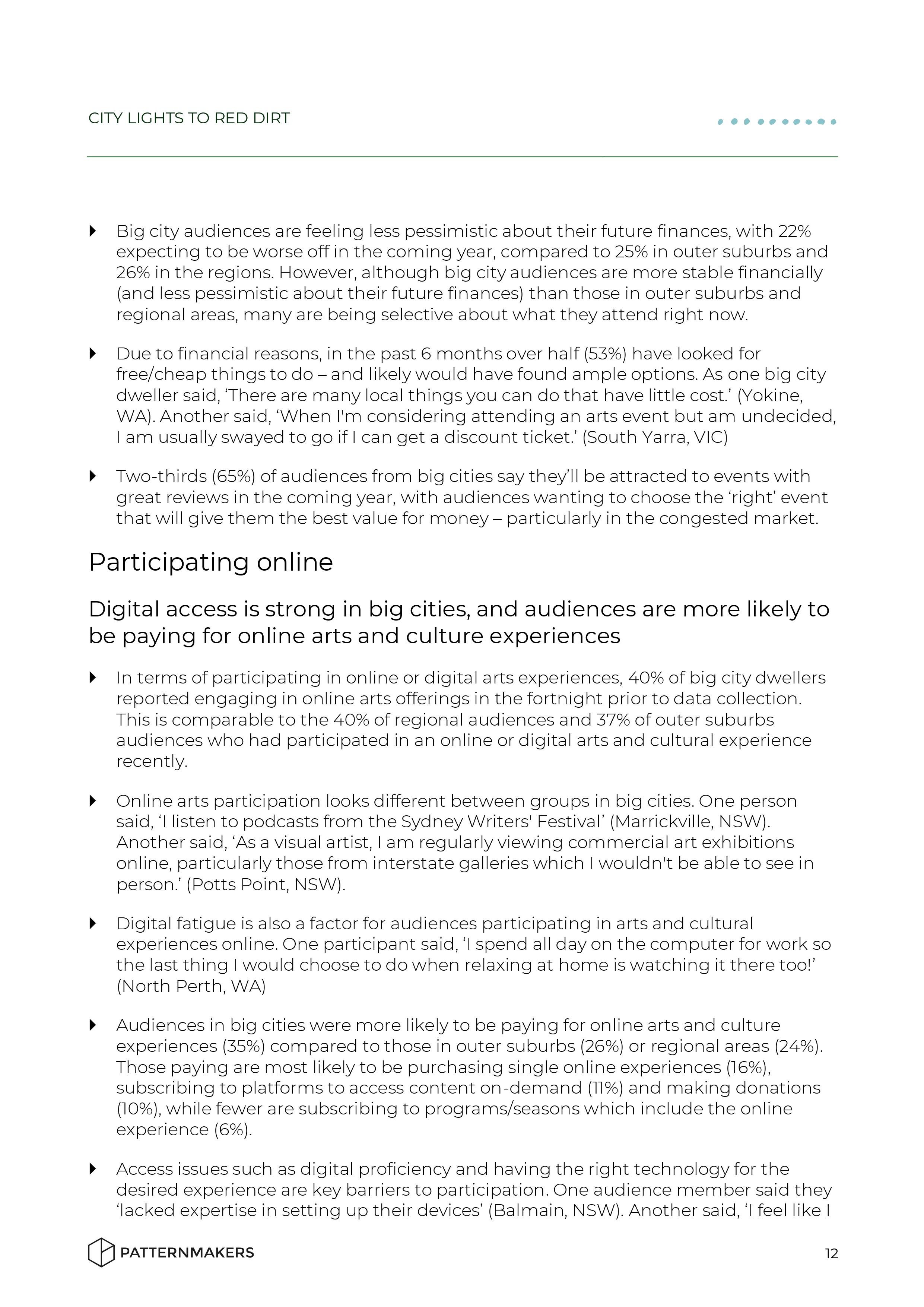
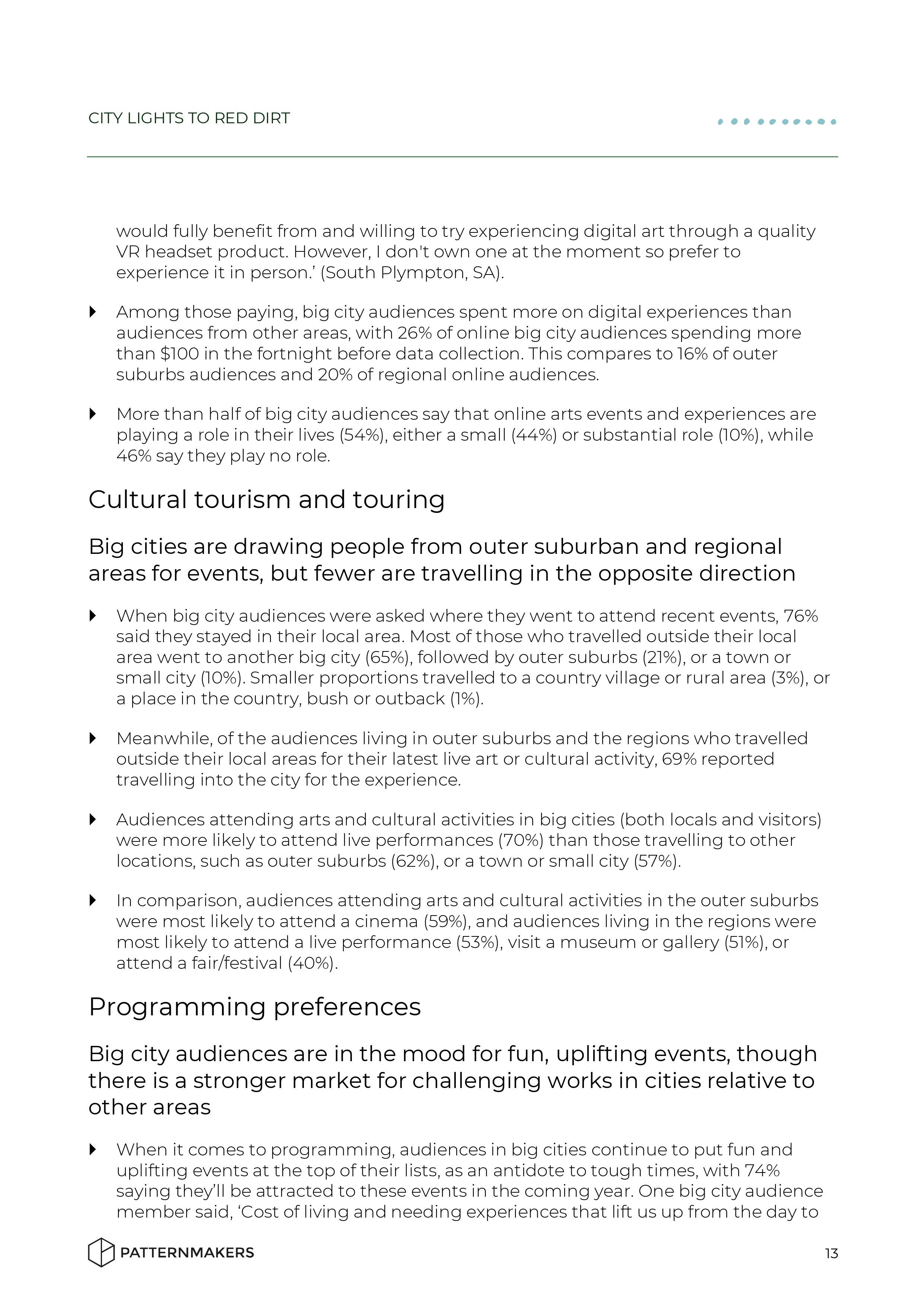

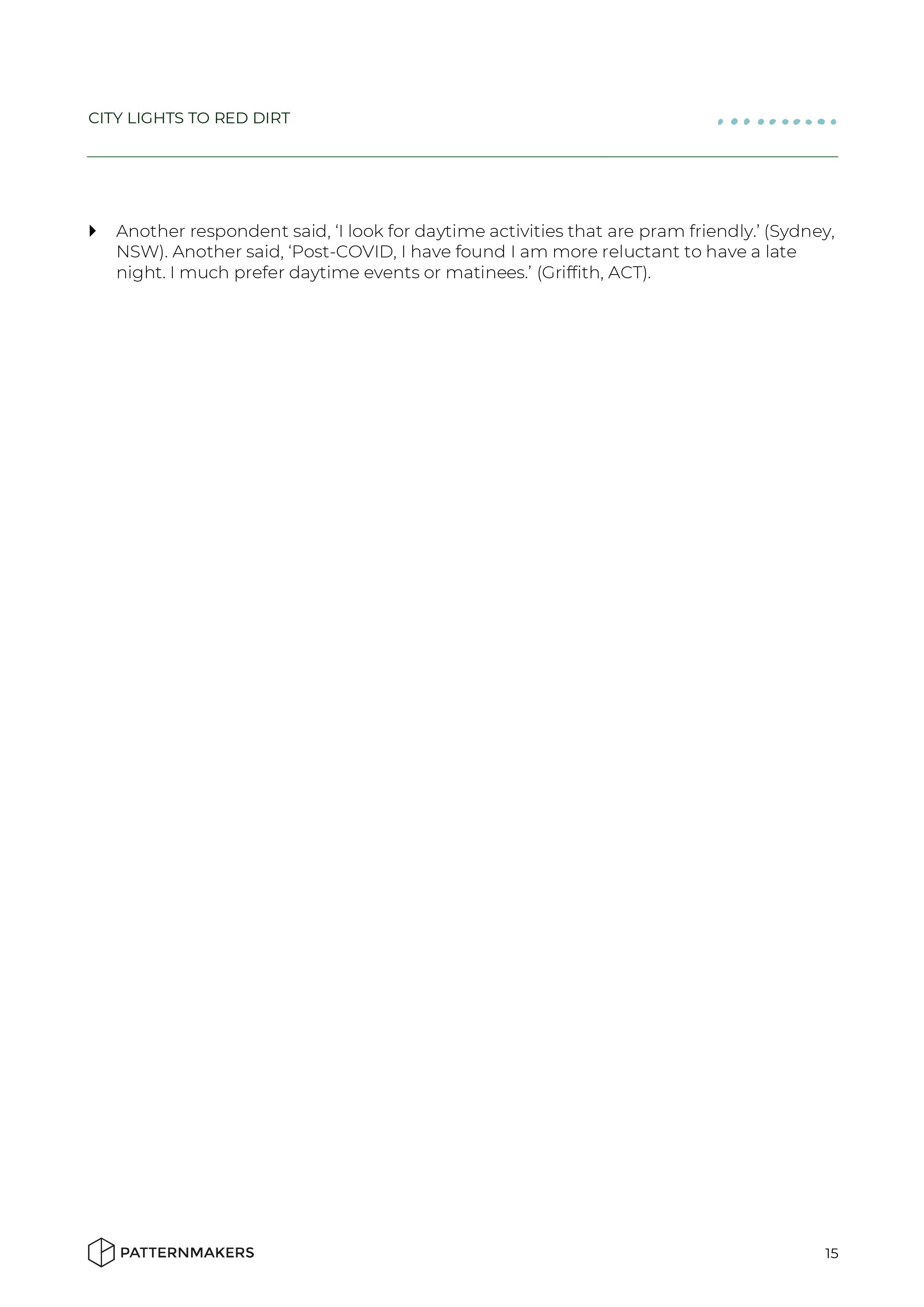
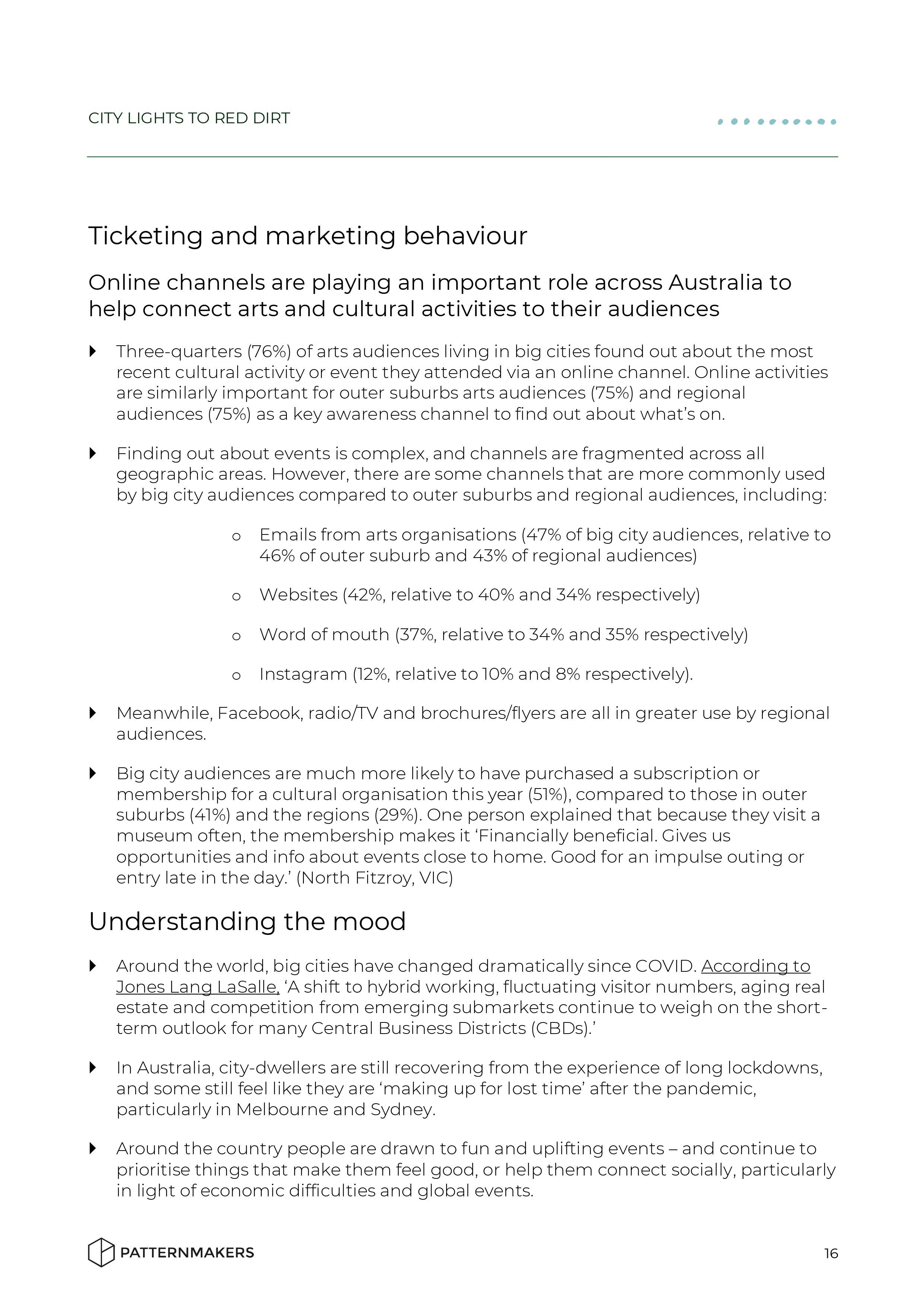


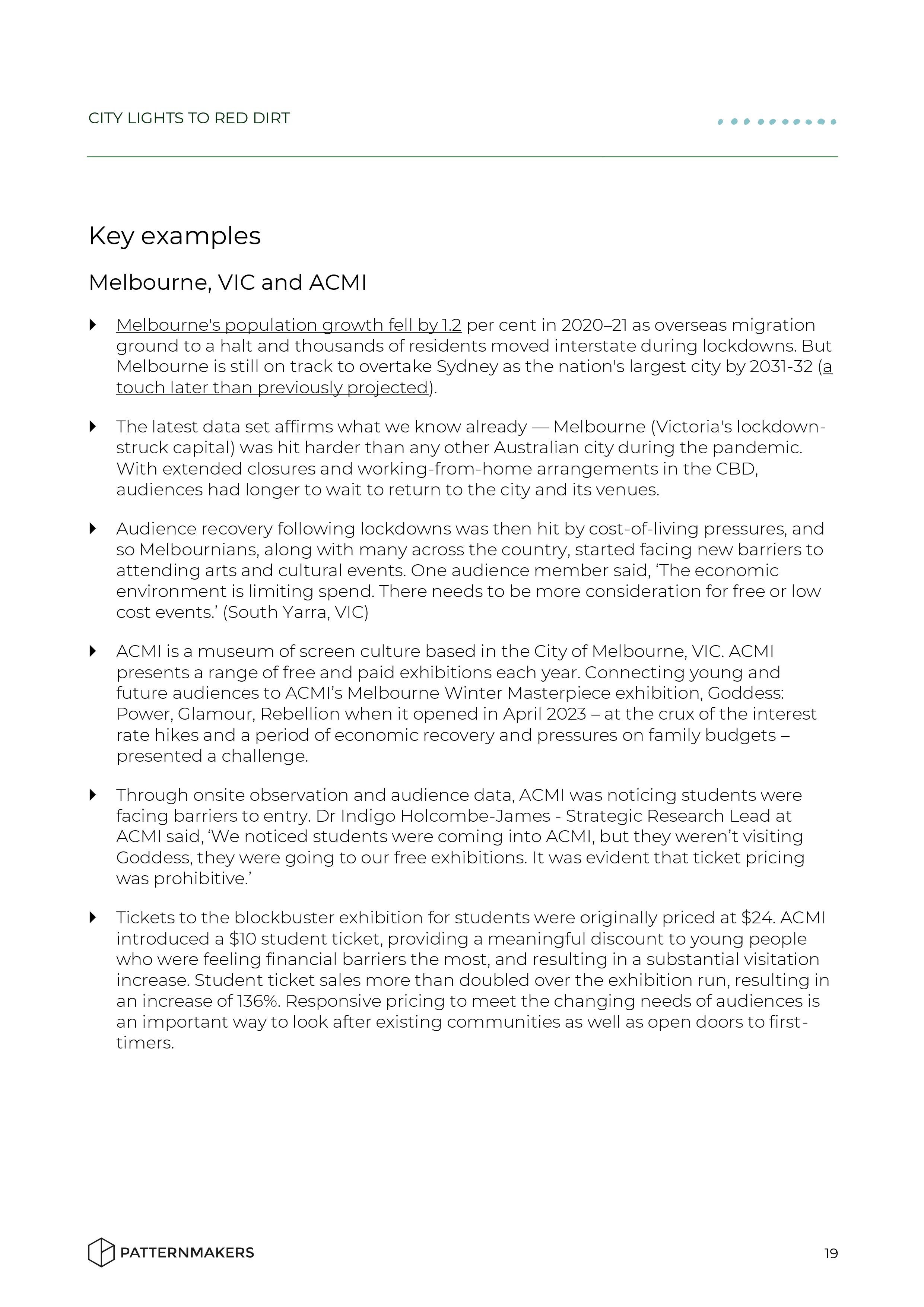
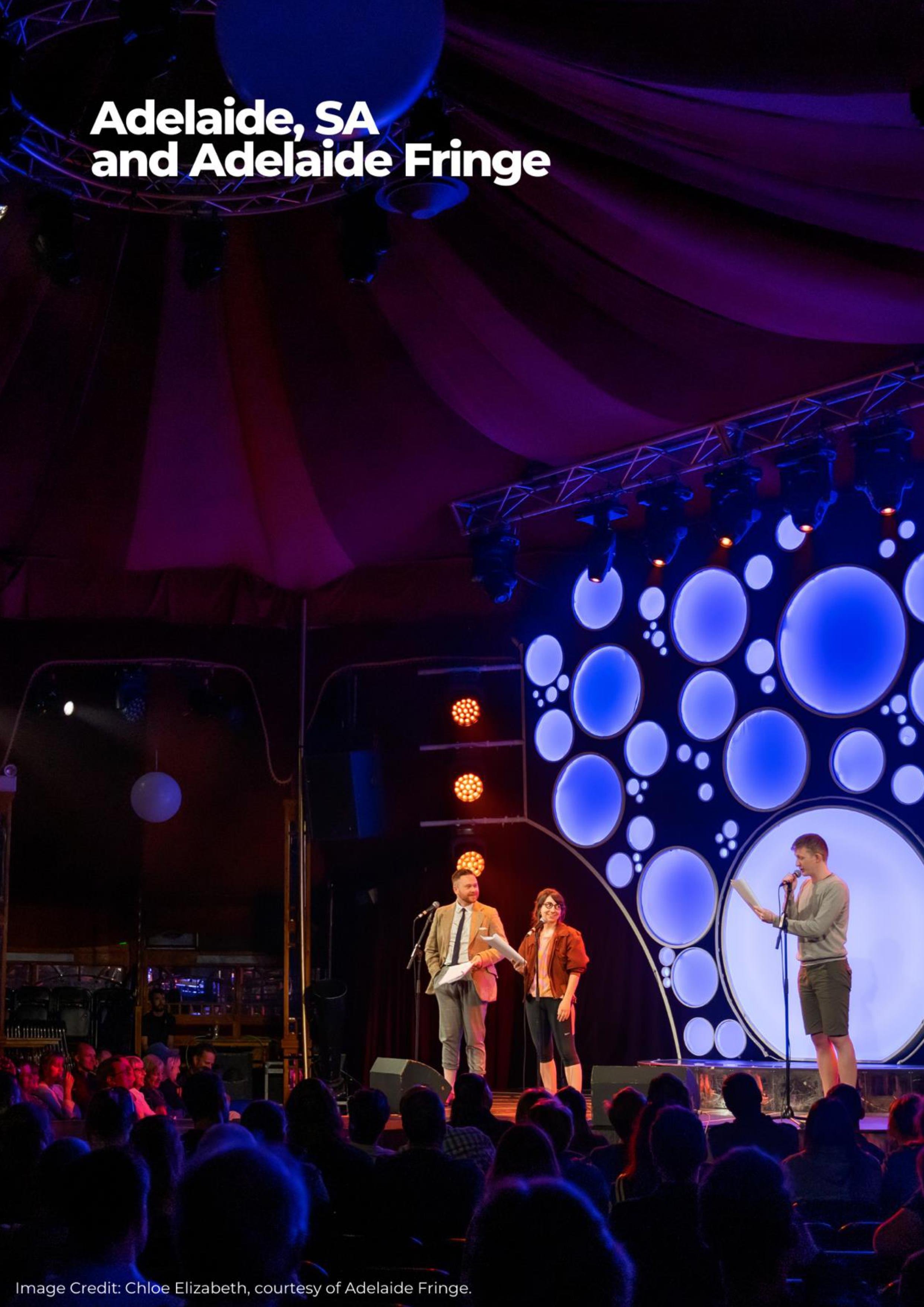


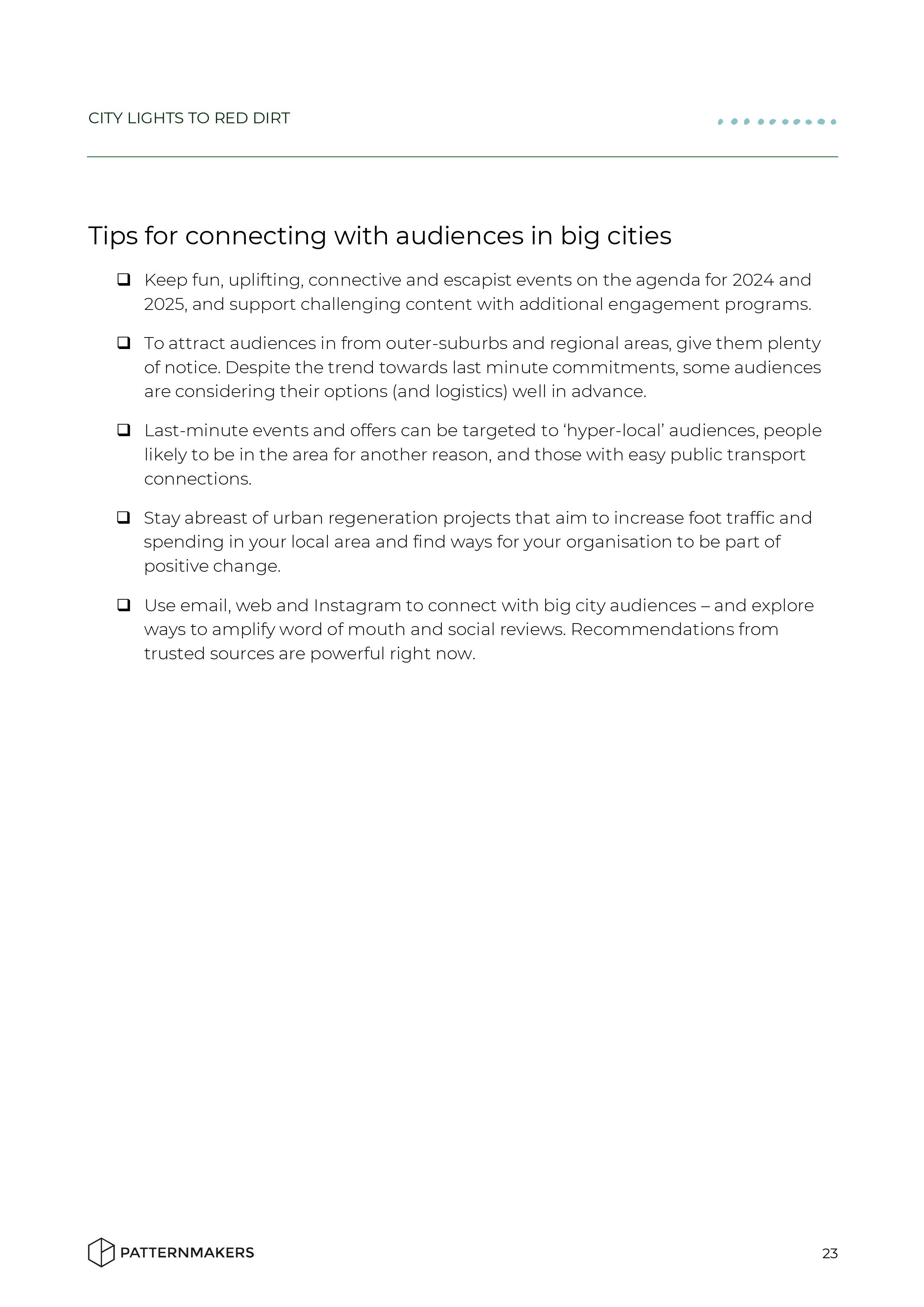



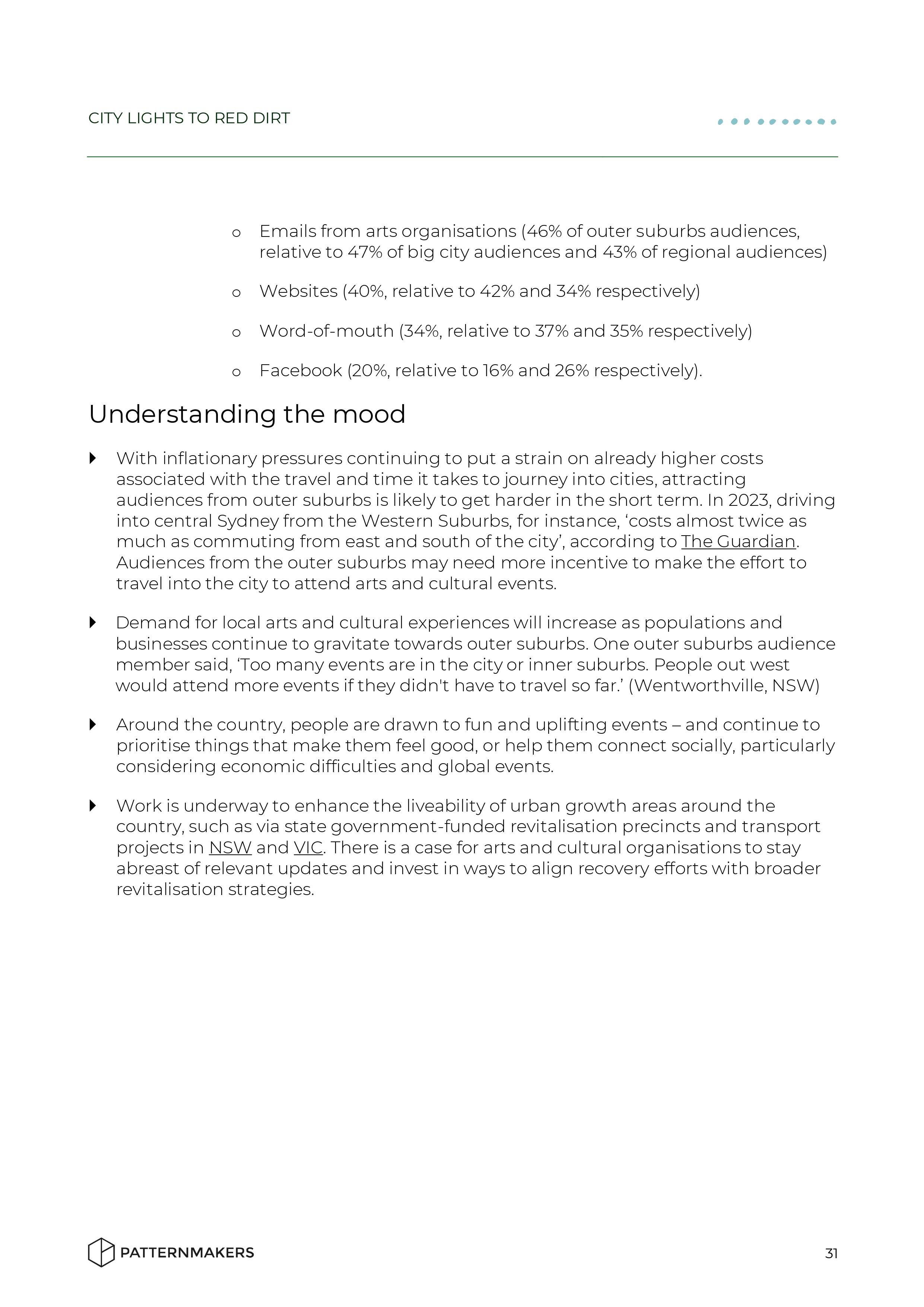
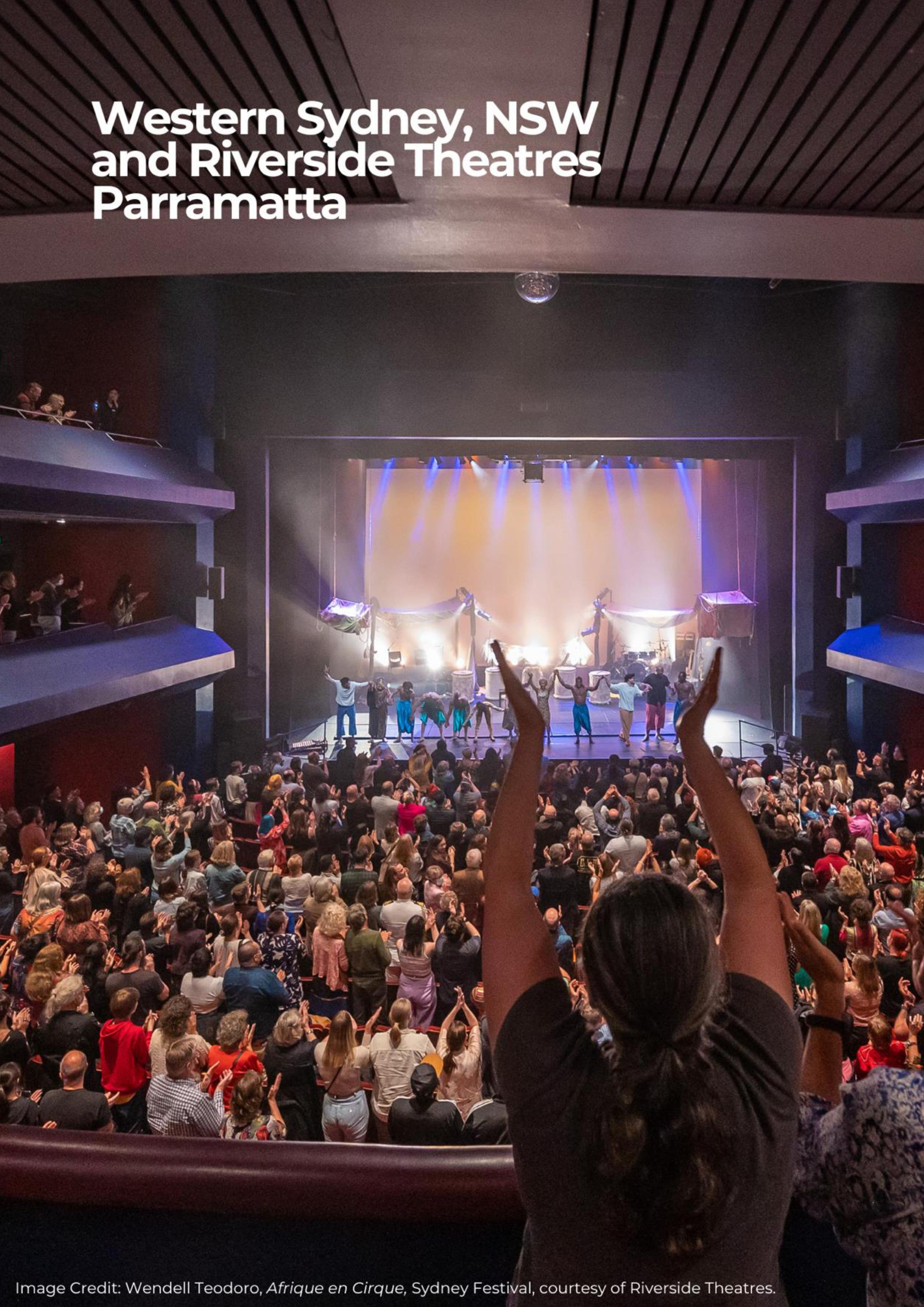
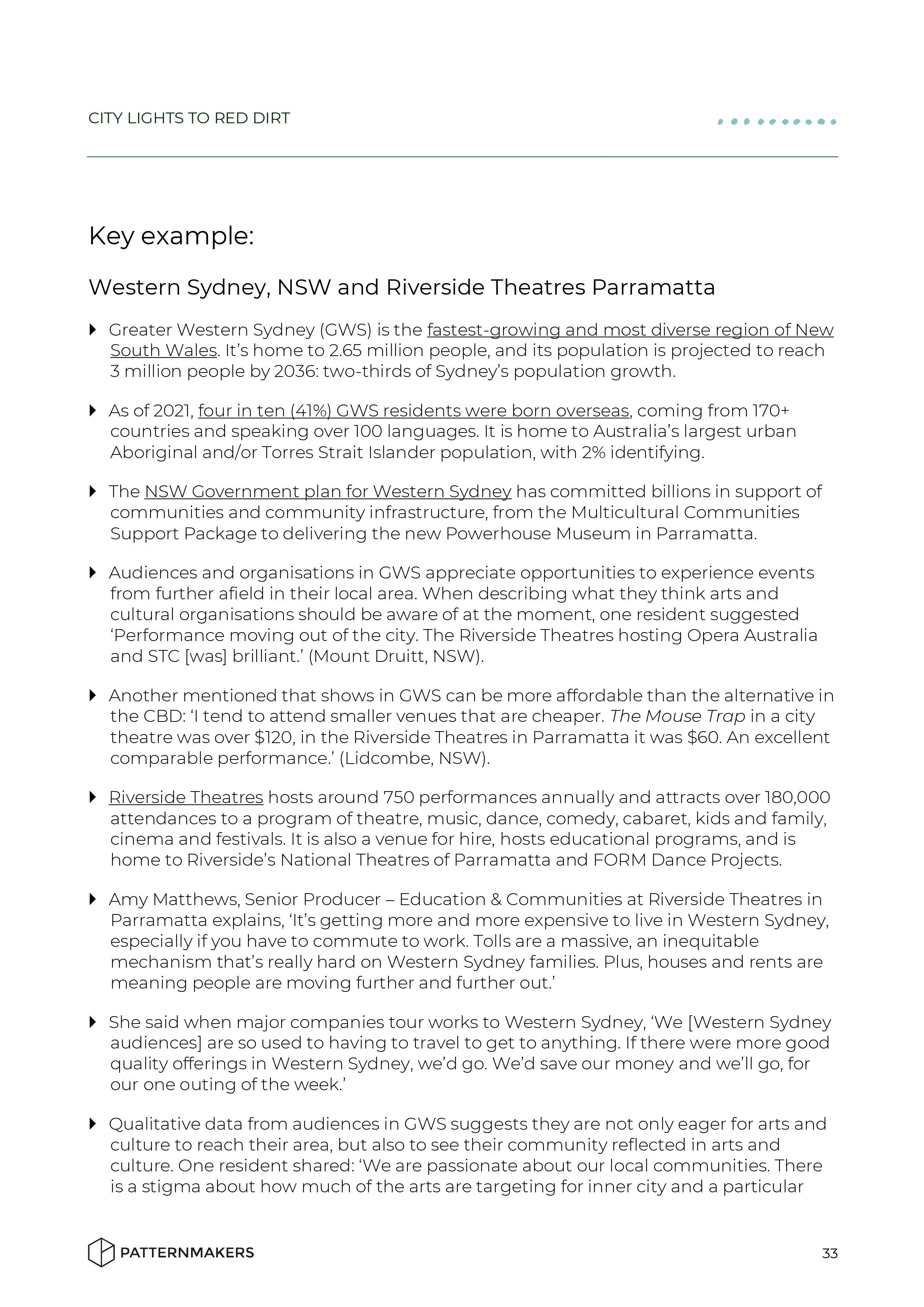

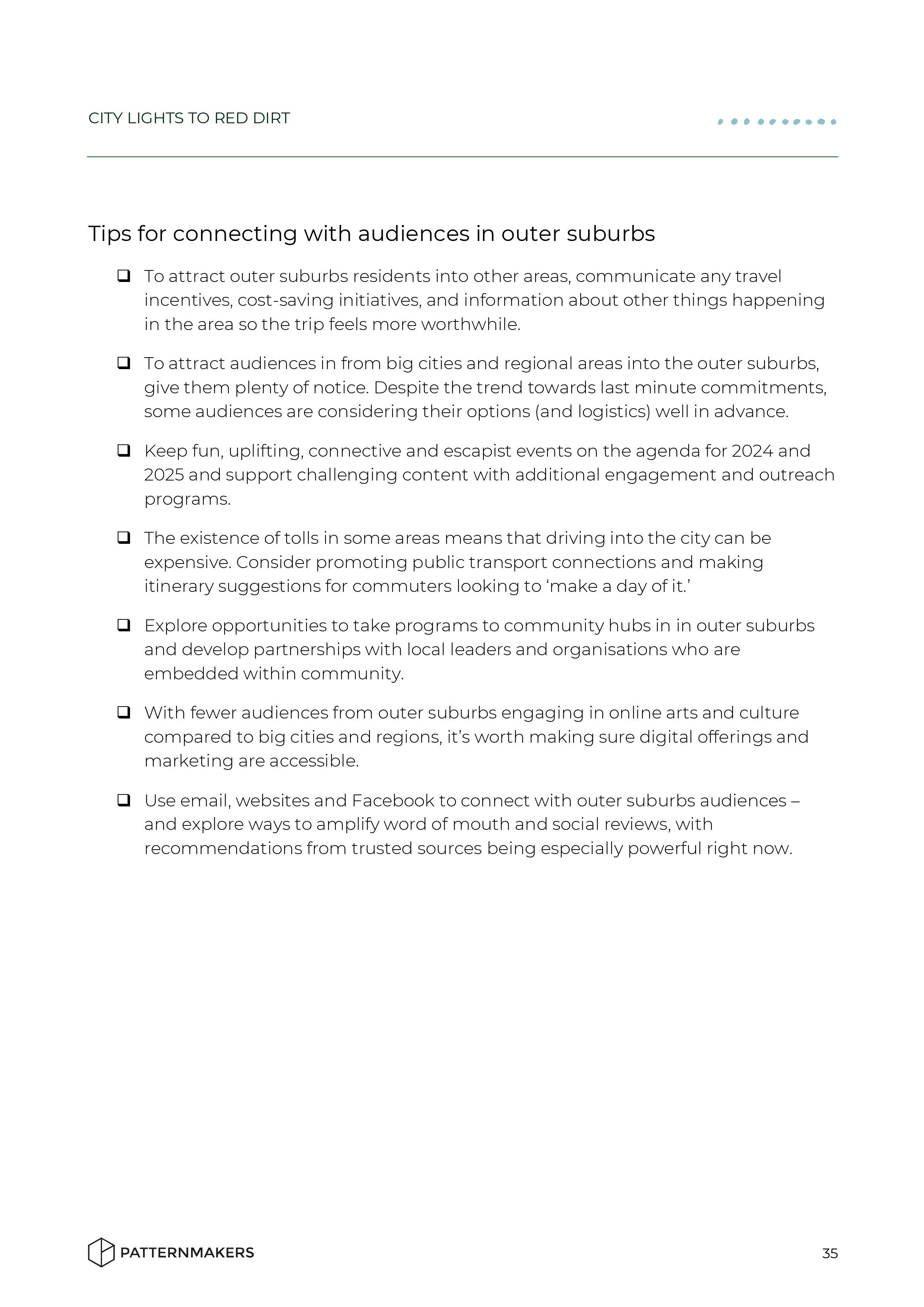


Click the buttons below to download the report, as a PDF or accessible Word version, or read on for more of the findings.
Three chapters, three geographic audience segments
The report compares audiences in three main geographic areas, providing insights for connecting people with culture where they live and the places they visit.
Download the chapters as separate fact sheets below.
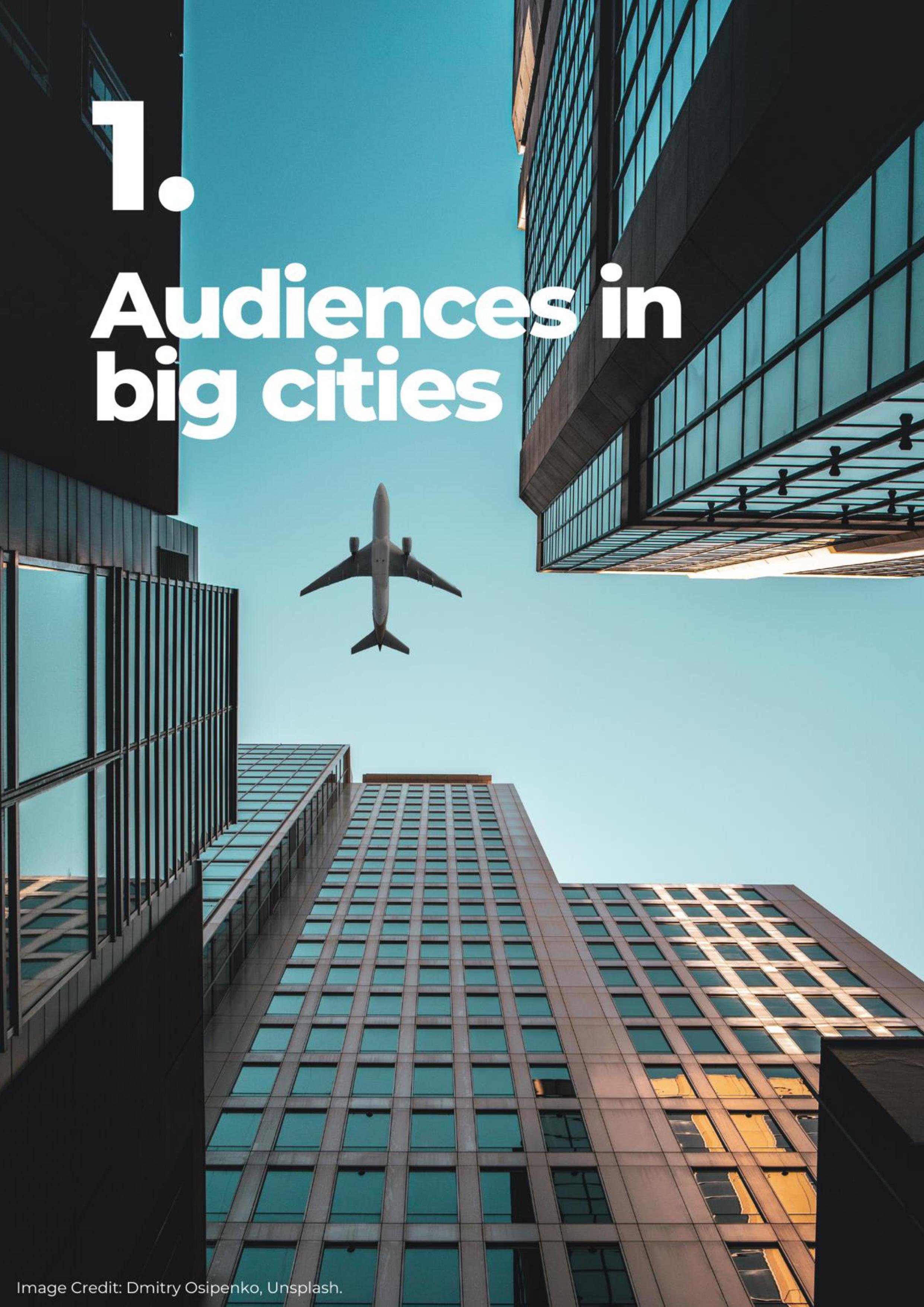
Audiences in Big Cities
Arts audiences in big cities are experiencing the arts at high levels, but with market saturation and the shifting dynamics of Australia's CBDs post-pandemic, new challenges have emerged for organisations to cut through.
-
In Australia’s big cities, more people are attending arts events more often, but resident arts organisations are competing in a congested market. The data from past attendees shows that:
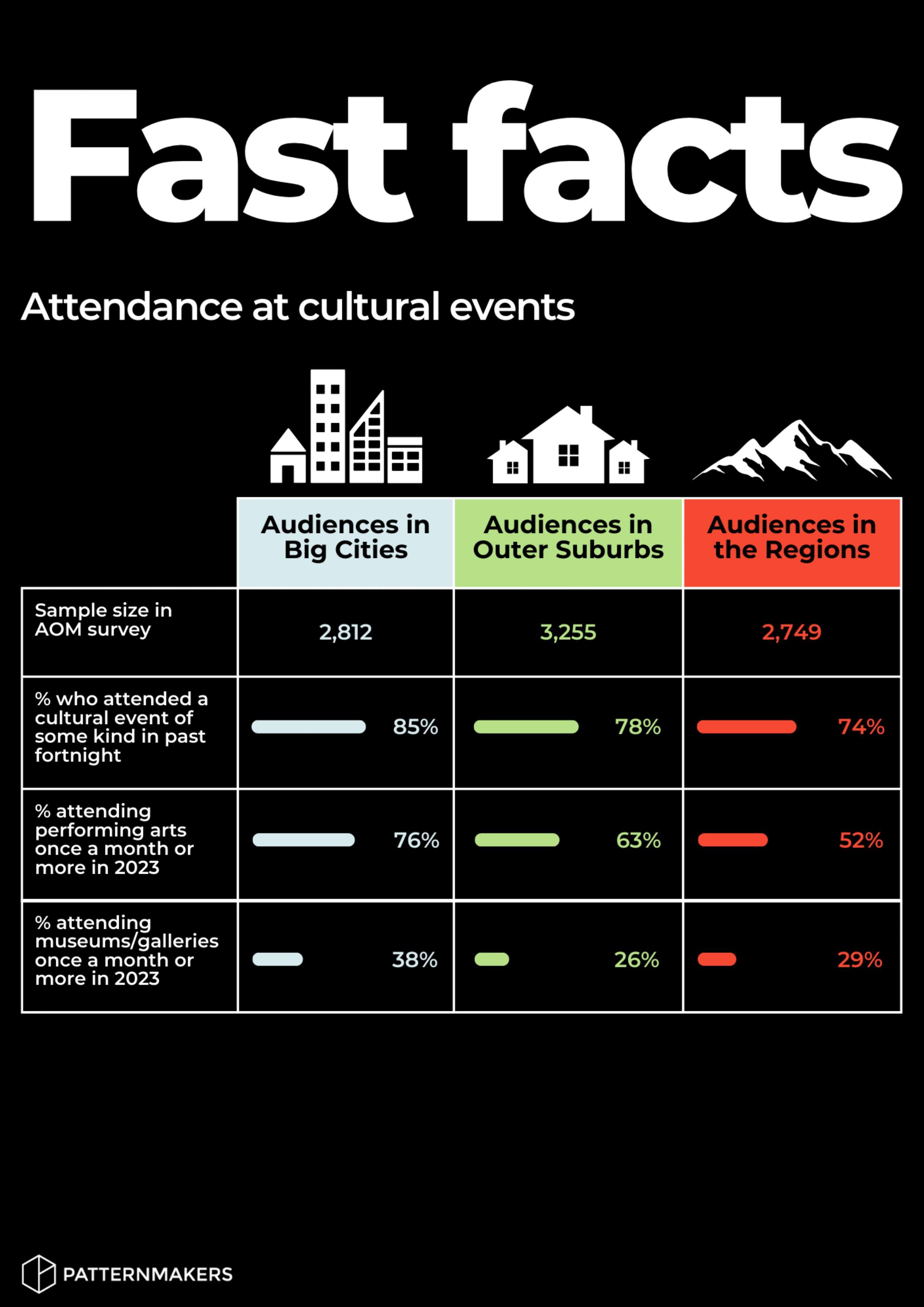
85% of big city audiences said they attended at least one kind of cultural event in the fortnight before data collection. Attendance is also more frequent amongst big city arts audiences: 38% attend a gallery or museum at least once a month, compared to outer suburbs (27%) and regional audiences (29%).
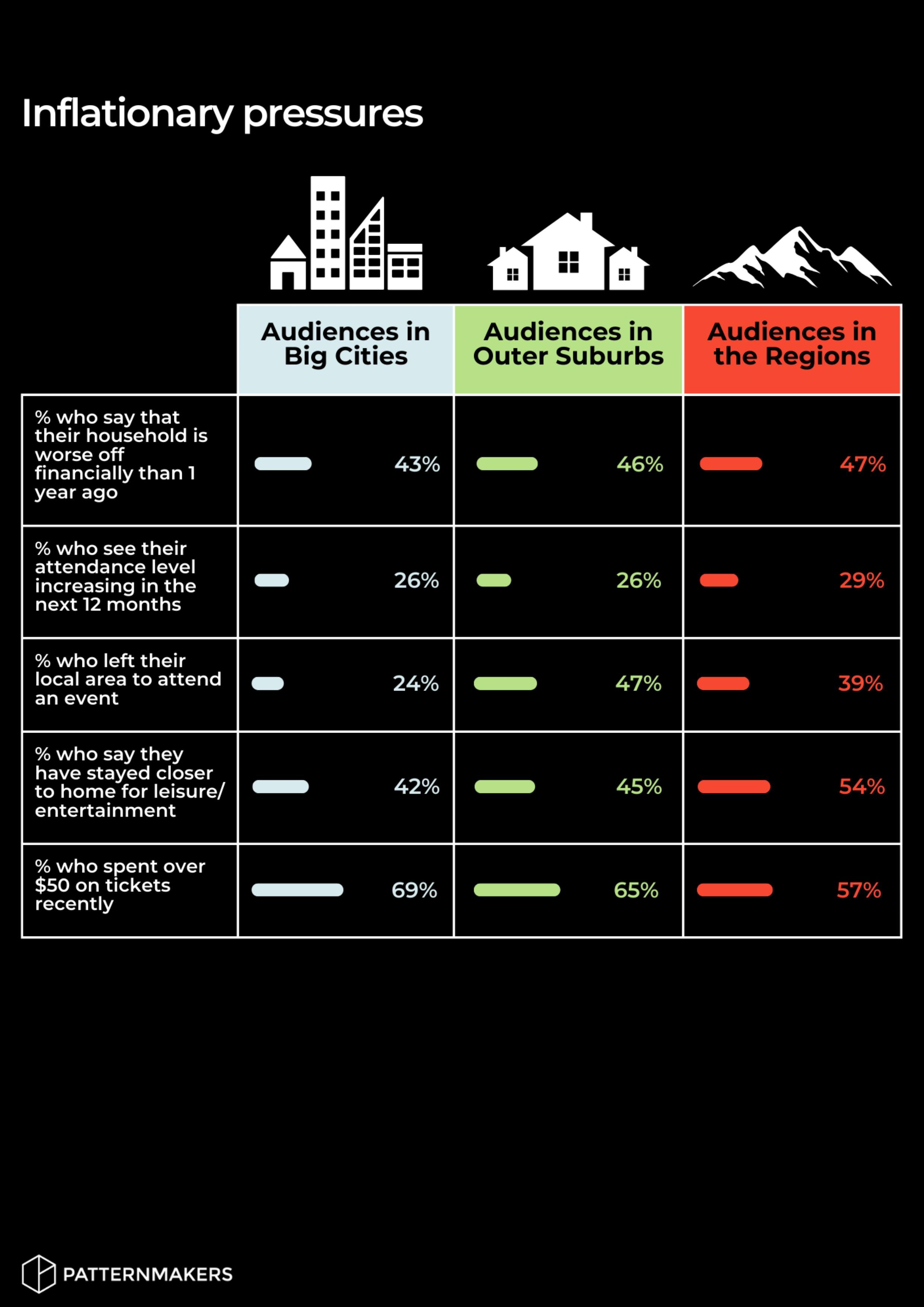
Arts audiences living in big cities are spending more on tickets to in-person live events and cultural activities: 7 in 10 spent more than $50 the fortnight before data collection (69%), compared to 65% of outer suburb audiences and 57% of regional audiences.
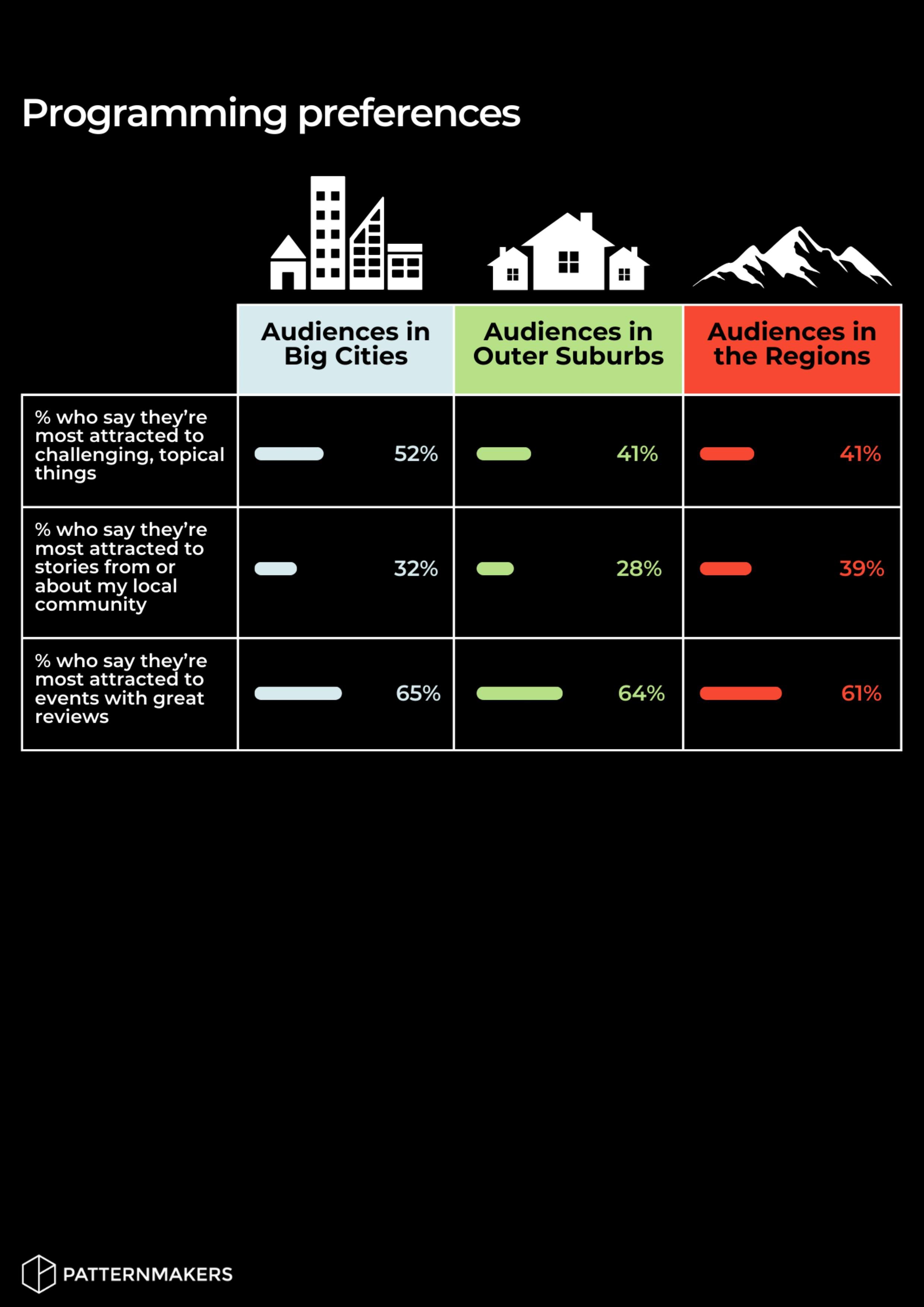
While most audiences are drawn to fun, uplifting and even escapist content right now, big city audiences are showing a greater appetite for challenging, topical content in the next 12 months (52%), compared to audiences living in outer suburbs and regional areas (both 41%). With more options on offer, they are also more likely to tune into reviews when considering what to attend.

Audiences in Outer Suburbs
Outer suburbs are the biggest growth areas in Australia right now, and have an expanding arts audience looking for more cultural experiences closer to home — but don't yet have enough venues nearby to accommodate.
-
In the outskirts and outer suburbs of big cities, the rate and frequency of attendance are slightly lower than big cities, but the market is growing, as more people move to more affordable areas where families can enjoy different lifestyles. The data from past attendees of events shows:
Audiences in outer suburbs are feeling slightly more pessimistic than optimistic about their financial situation, with almost half (46%) say they’re worse off than they were a year ago, and 25% expect to be financially worse off in the coming year.
Audiences in outer suburbs (combining both residents and visitors) were most likely to attend a cinema locally (59%), whereas big city audiences were comparatively more likely to attend a local live performance. Audiences in the regions were most likely to attend a fair/festival locally (40%) or visit a museum or gallery (51%).
Audiences in outer suburban areas are the least likely to be participating in online events right now. Half of outer suburbs residents say online arts events and experiences are playing a small (43%) or substantial role (8%) in their life, while another 49% say they play no role.

Audiences in the Regions
Across Australia's diverse regions, audiences are experiencing access to arts and culture differently. Factoring in extra time and travel costs means heightened barriers in 2023, but with a decentralising trend, more options could be on the cards.
-
Regional Australia is changing, with demographic shifts seeing some regional places grow dramatically in recent years – but rising costs of travel are leaving some isolated. There are different patterns for large towns, smaller villages and bush or outback areas, but on average, the data shows that:
Regional audiences indicated feeling less stable financially and more pessimistic about their future finances than those in outer suburbs and big cities, and many are being selective about what they attend right now. Almost half (47%) say they are ‘worse off’ financially than they were one year ago, and 26% expect to be ‘worse off’ in the coming year.
Regional audiences have lower levels of access to some types of events, like live performances, and therefore attend less often: 52% of audiences in the regions said they attend performing arts events at least once a month or more, lower than proportions in big cities (77%) and outer suburbs (63%).
Some art forms appear to reach audiences in regional areas better than others. For instance, in the past 12 months, 51% of regional audiences have attended contemporary music and 57% have attended libraries, which are similar to attendance rates in urban areas.
Four in ten regional audience members say that in the coming year, they’ll be most attracted to stories that are ‘about or from my local community’ (39%), slightly higher than the rate in big cities (32%) and outer suburbs (28%).


Get the data at a glance
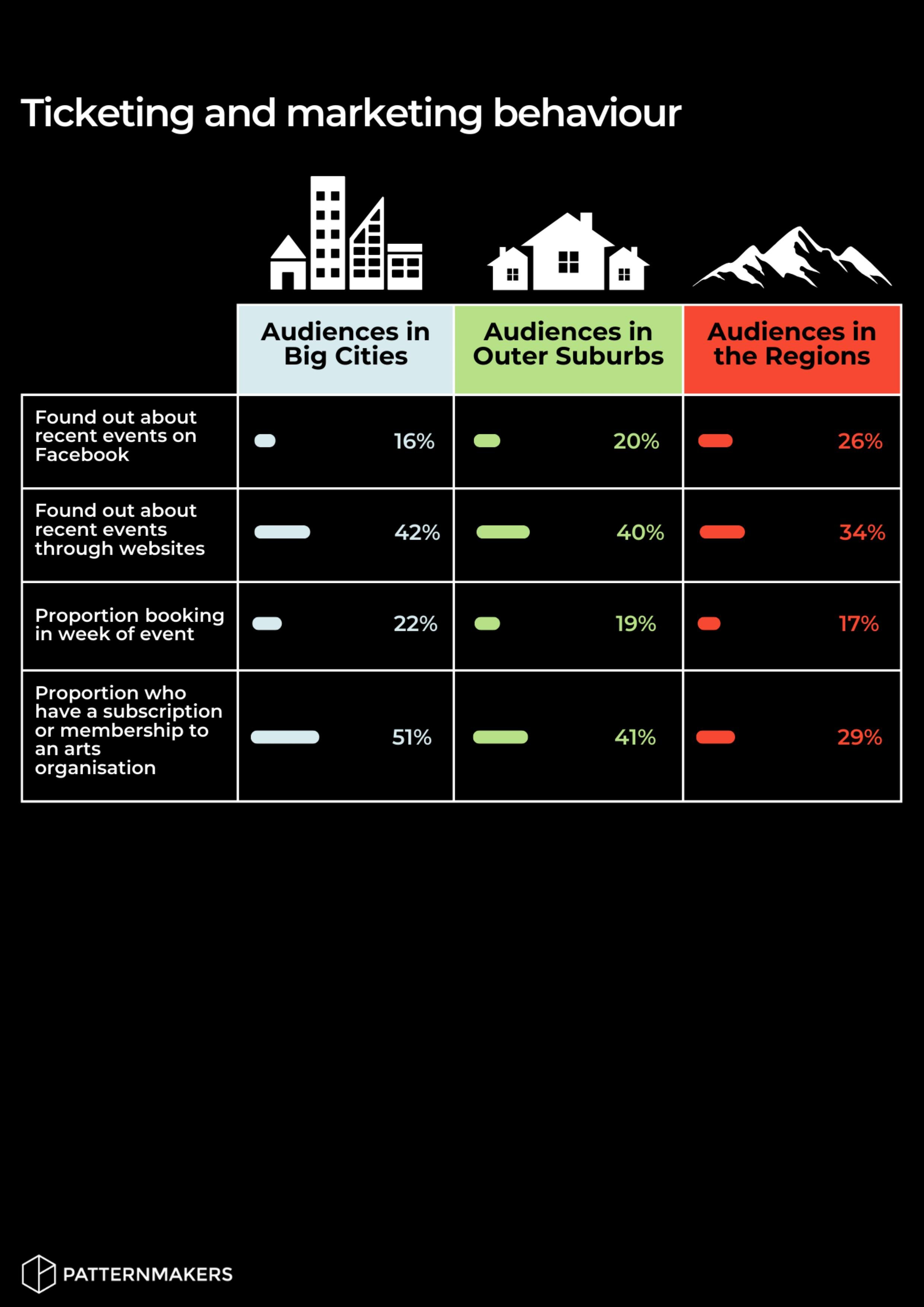
Click the button below to download our Fast Facts for attendance, inflationary pressures, programming preferences and ticketing and marketing behaviour.

Read the ‘Audiences 2023+’ report
In case you missed it, click the button below for the key insights from the August 2023 National Snapshot.
Use the dashboard to get results for your artform and region
Survey data from Phase 9, which heard from over 8,800 respondents, has been uploaded to the dashboard, which now contains insights from over 100,000 Australian participants.
You can use the dashboard to explore the findings by state/territory, artform and audience segment.
It’s freely available to access, just click the image below and use the login details provided on the dashboard page.

About the Audience Outlook Monitor
The Audience Outlook Monitor provides the results of a study that has tracked audience sentiment over the course of the COVID-19 pandemic.
Data was collected in six phases throughout 2020-2022 and is again being tracked in 2023.
Government agencies across Australia are collaborating with research agencies Patternmakers (Sydney) and WolfBrown (USA) to produce this resource. The dashboard is freely accessible and designed to help artists and cultural organisations of all kinds to make the best possible decisions.


How to find out more
To receive new releases directly into your inbox, as soon as they are available, you can opt in to receive updates below.
If you have a question, or an idea for using this data, please contact Patternmakers at info@thepatternmakers.com.au

About the Author
Peta Petrakis
Research Analyst

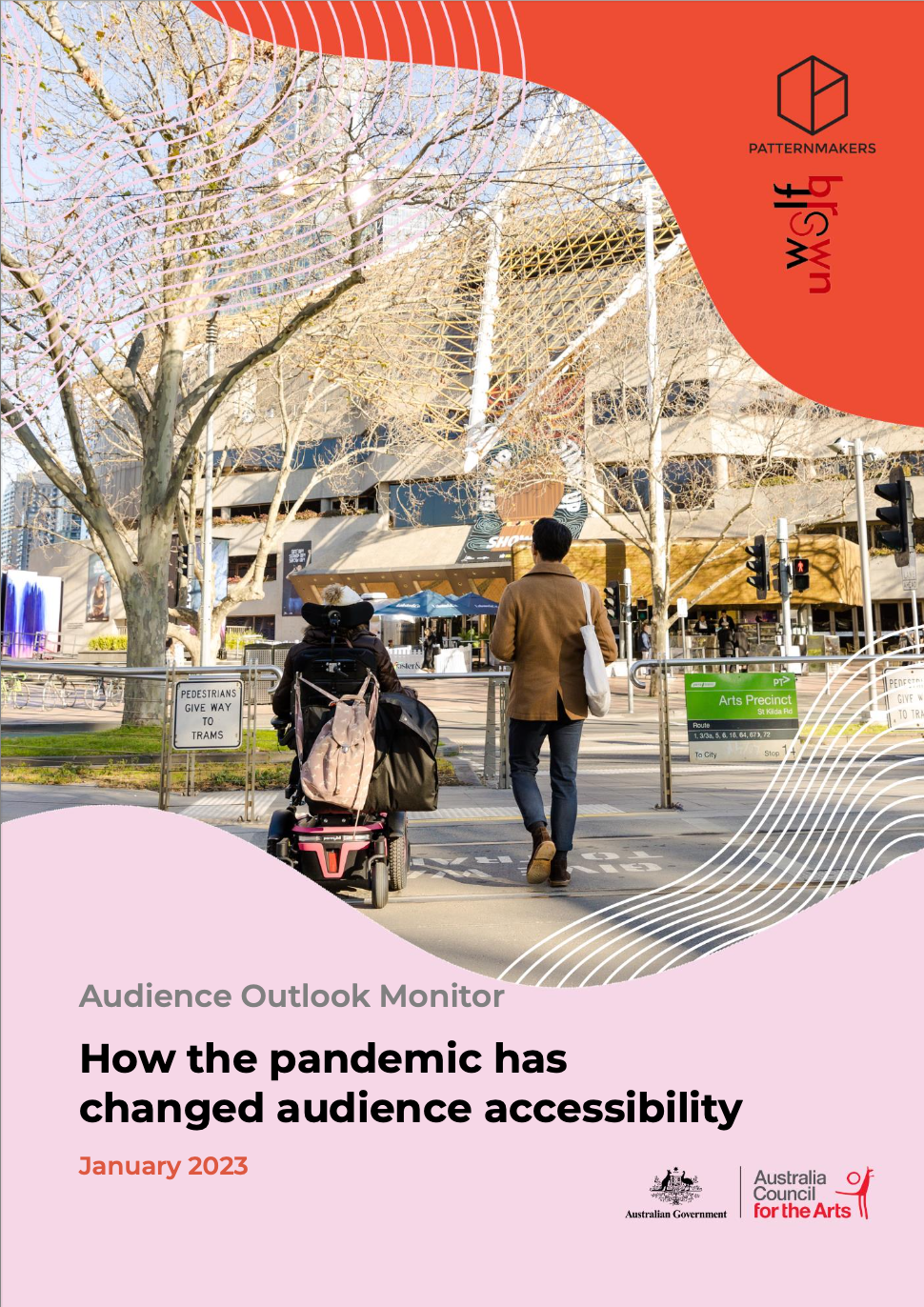
How the pandemic has changed audience accessibility
Download the Access Report to find out more about how the state of access in our sector has changed, case studies to demonstrate the data through lived experience, and resources and tips to prioritise the access needs of audiences.
Attendance by audiences with access needs is recovering – but at a slower rate than average
In our latest Audience Outlook Monitor publication, we take a look at the attendance insights and barriers for audiences affected by access issues, including the return of crowds, the cost of living crisis and the success and sustainability of digital events.
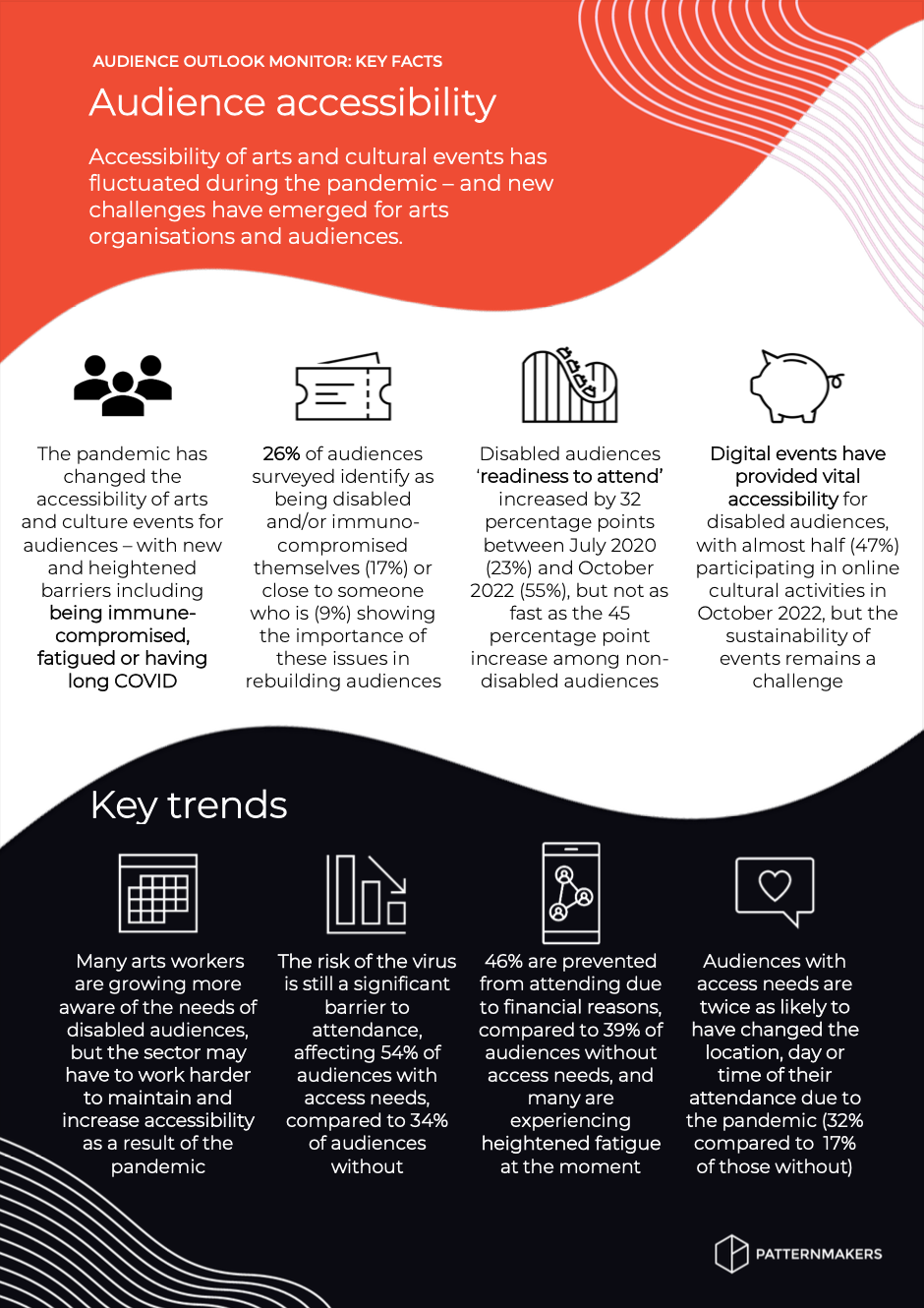
Click the images below to download a PDF of the full report and an infographic of the key facts:
The findings are also available in the following accessible versions:

Read on for the key insights:
Attendance levels among audiences with access needs have fluctuated during the pandemic. Data from October 2022 shows that 7 in 10 (69%) disabled audience members attended a cultural event recently – more than three times the level seen in July 2020 (19%). However, these attendance levels are increasing at a slower rate than average.
The fact that arts spaces, including museums, have been less busy has offered some disabled and immunocompromised audiences improved access to cultural activities at certain points in the pandemic.
The availability of digital events dramatically improved access for some segments. In October, 47% said they participated online recently, compared to 39% of those without access needs, though some note a dramatic reduction in the availability of online events.
Attendance has yet to return to pre-pandemic levels – and may take longer than audiences without access needs. 6 in 10 (58%) audiences with access needs are attending performing arts less than they used to, pre-pandemic, compared to 41% of audiences without access needs.
This report highlights insights from the Audience Outlook Monitor surveys, along with four case studies of audiences with access needs. They show that access needs continue to vary widely – and that more work is needed to address continuing and new barriers.

Audiences with access needs are changing their behaviour and require updated strategies
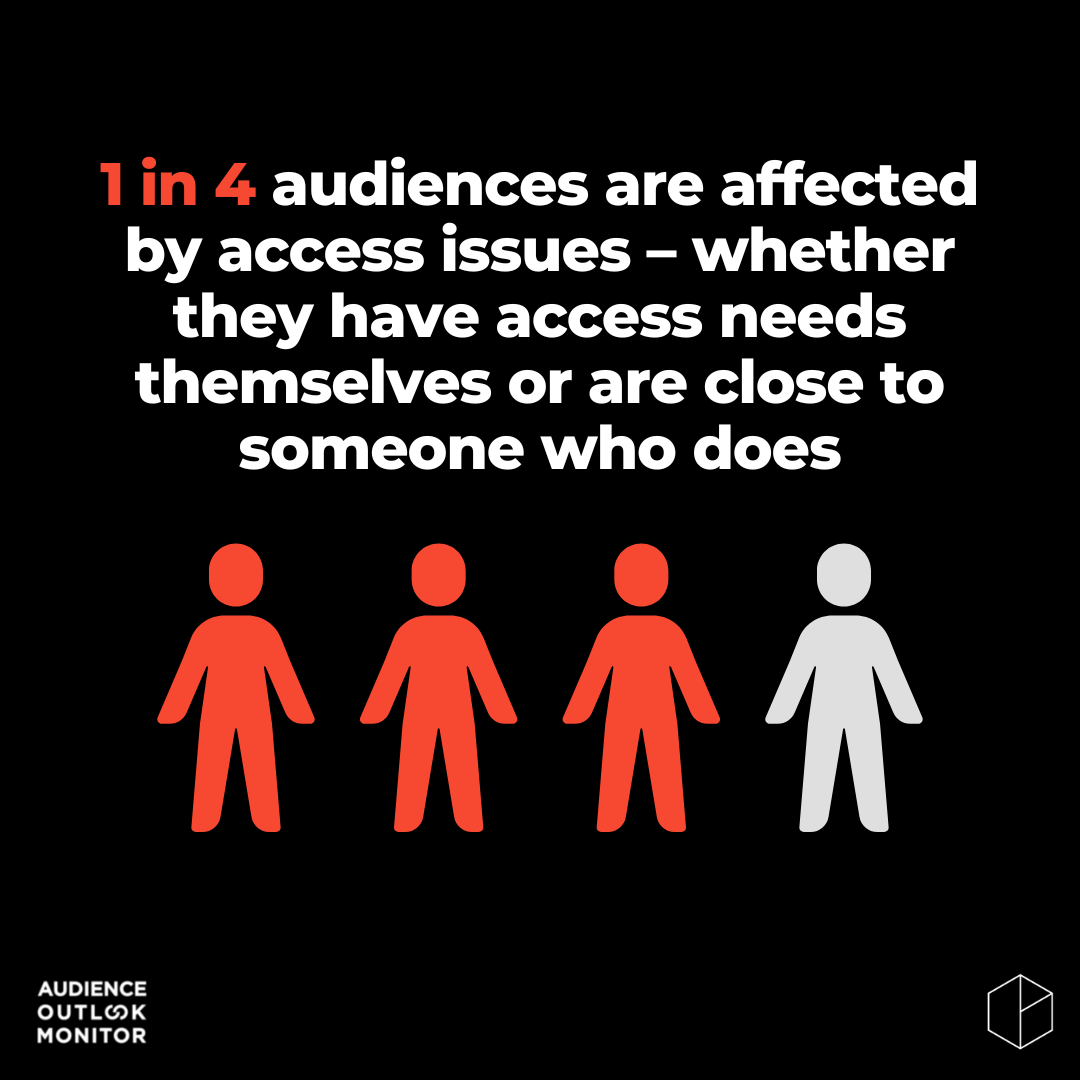
While in general disabled audiences are more likely to face barriers to attending cultural events, the pandemic has led to new and heightened access needs. 26% of audiences surveyed identify as being disabled (10%) or immuno-compromised themselves (10%), or close to someone who is (9%), showing the impact of these issues.
There are signs that more people may be experiencing access challenges due to factors such as long COVID, reduced energy levels and re-entry anxiety.
Audiences with access needs are twice as likely to say their scheduling preferences have changed in light of the pandemic . 1 in 3 (32%) say there has been a change in the time, day or location of events, compared to 17% of audiences without access needs.
Some audiences say that they’re now more likely to attend during the daytime and/or weekdays to avoid crowded times or places, minimise fatigue, and consider the availability of public transport when planning their attendance.
Financial pressures disproportionally affect audiences with access needs. The proportion citing financial reasons as a barrier to attendance is larger among audiences with access needs (49%), compared to those without (39%).
Although digital events can help to overcome barriers to live attendance, their availability is changing, and they are not for everyone. 75% of audiences with access needs see a role for digital events in their lives, but many are eager for opportunities to reconnect with the arts in-person, especially after times of isolation.


The pandemic has shown it’s possible to challenge the status quo to make the arts more accessible
In some senses, the pandemic made the needs and experiences of people with disability more visible. Collective harm minimisation strategies, like lockdowns, encouraged the public to consider the needs of immunocompromised individuals and those at risk of serious health outcomes from COVID-19.
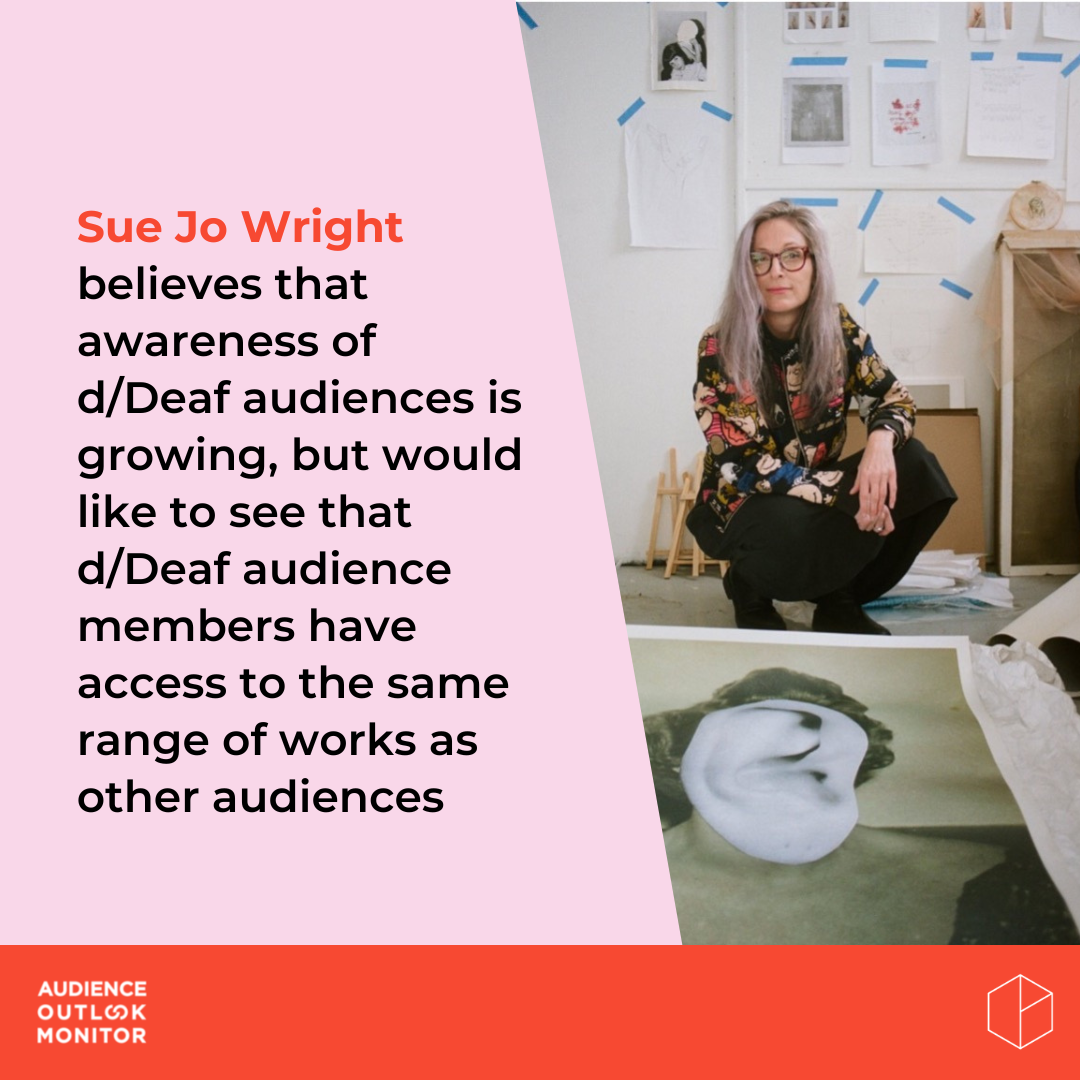
There are signs that work by d/Deaf and disabled artists and disability activists is contributing to a greater cultural awareness of disability and organisational capacity for access. Deaf artist Sue Jo Wright suggests even the presence of Auslan Interpreters at daily press conferences during lockdowns helped bring more exposure to the d/Deaf community.
After being advocated for by people with disability for many years, the livestreaming of arts events became a central part of cultural life during lockdowns – although there’s still work to be done to find sustainable models for digital events.
Some people with disability will be limited in their ability to participate in public life while the virus continues to circulate, and the arts has an essential role to play in maintaining social connection and reflecting these experiences.
The pandemic showed us that it’s possible to reorganise existing social practices for the collective good, especially where accessibility is concerned. Vital conversations, led by people with disability, have taken place – and the lessons learned mean the sector is better-equipped to take action to ensure the arts are accessible and inclusive.
There is an opportunity to review and update Disability Action Plans to capitalise on what has been learned and explore new strategies.
This report also includes four case studies to augment data with lived experience
A series of structured qualitative interviews were undertaken with audience members who identify as d/Deaf or disabled. Hearing from people with lived experience of inaccessibility highlights some of the challenges and opportunities for the arts and culture sector.




Opportunities exist for improving access on-site, online and organisationally
Together, the Audience Outlook Monitor and case study research reveal some practical suggestions that are relevant at this time:
On-site
Provide as much information as possible, ahead of events, whether it’s about venue accessibility, COVID-safety measures or ticketing policies, or the performance or venue itself. Providing information up-front about what to expect will help individuals with access needs plan their attendance on-site.
Check whether all Front of House staff have received Disability Awareness Training, and/or appoint a dedicated roving staff member before, during and after live events to proactively offer support. As we return to in-person events, it’s important to recognise that encountering untrained staff can have an emotional toll for audiences with disability.
With the use of QR codes becoming commonplace during the pandemic, venues might think about using this technology to offer alternative options for ordering food and drink, audio descriptions or Auslan interpretation.
Restore and increase sensory-friendly options such as relaxed performances, noise-cancelling headphones and quiet spaces to ensure audiences with sensory needs are able to fully participate. Tactile experiences weren’t possible during some stages, but most audiences say it’s now time to offer these again.
Review seating options as attendance numbers increase. Find ways to make seating available in most spaces of the event or venue – such as foyers and queuing areas – as well as performance and exhibition spaces. In addition to audiences with mobility needs, 30% of audiences say they need seating to enjoy attending.
Online
Websites:
When welcoming disabled audiences back, look into having a dedicated accessibility page on your website, so that audiences with access needs can simply and easily find the information they need. This avoids placing the ‘burden of asking’ on audiences with access needs and demonstrates a commitment to inclusivity.
Digital productions:
Now that in-person events have returned to a regular schedule, continue investing in digital work that is sustainable for your organisation. The pandemic taught us that digital events play a vital role in accessibility and overcoming barriers to participating in cultural experiences – and many want them to continue.
Hybrid events are one option, but sometimes digital attendees can feel sidelined compared to in-person attendees. Consider digital-only events, or appointing a digital facilitator to ensure people tuning in from home are given the opportunity to engage with performers/speakers and ask questions during Q&A’s.
Marketing/communications:
Use inclusive language and accessible formats in digital advertising, communications and booking systems to let potential attendees know that an event or venue is accessible to all. This includes Plain English resources or Auslan interpretation, audio descriptions, image descriptions and alternative text.
Organisationally
As we look to the next chapter, the conversation about accessibility is evolving. Consider reviewing and updating your Disability Inclusion Action Plan to address the heightened needs of audiences with access requirements.
Incorporate accessibility early, for example when planning and decision-making. Add an accessibility line to your budget templates and develop a checklist for accessibility considerations when conducting important tasks like selecting venues, programming and commissioning works, advertising opportunities, launching major marketing campaigns and ticketing major events.
Involve disabled and immunocompromised people in the planning process of your major programs and projects. This can assist in fostering allyship and creating opportunities for people without access needs to collaborate with disabled and immunocompromised people on access strategies.
With cost of living pressures disproportionately affecting disabled audiences, explore revenue models that address financial barriers such as subsidised ticketing policies, accessibility funds supported through grants, donations or fundraising, or partnering with advocacy groups and support networks.
Further resources
Below is a list of additional resources, with guidance on improving accessibility for audiences.
Accessible Arts resources: https://aarts.net.au/arts-resources/
Arts Hub Artists Essentials Toolkit #9: Accessibility for your arts project: https://www.artshub.com.au/news/career-advice/accessibility-for-your-arts-project-artists-essentials-toolkit-9-2501288/
Melbourne Fringe, Producer’s Guide to Access: https://melbournefringe.com.au/wp-content/uploads/2022/08/Producers-Guide-to-Access-1.pdf
Morwenna Collett Consulting resources: https://www.morwennacollett.com/resources
National Endowment for the Arts, Design for Accessibility: A Cultural Administrator’s Handbook: https://www.arts.gov/about/publications/design-accessibility-cultural-administrators-handbook
Smithsonian Guide for Accessible Exhibition Design: https://www.sifacilities.si.edu/sites/default/files/Files/Accessibility/accessible-exhibition-design1.pdf
Use the dashboard to get results for your artform and region
Survey data from over 5,400 respondents has been uploaded to the dashboard, which now contains insights from 100,000 Australian participants.
You can use the dashboard to explore the findings by state/territory, artform and audience segment.
It’s freely available to access, just click the image below and use the login details provided on the dashboard page.
About the Audience Outlook Monitor
The Audience Outlook Monitor provides the results of a study that has tracked audience sentiment over the course of the COVID-19 pandemic.
Data was collected in six phases throughout 2020-2022. A new approach will be taken in 2023.
Government agencies across Australia are collaborating with research agencies Patternmakers (Sydney) and WolfBrown (USA) to produce this resource. The dashboard is freely accessible and designed to help artists and cultural organisations of all kinds to make the best possible decisions.
How to find out more
To receive new releases directly into your inbox, as soon as they are available, you can opt in to receive Audience Outlook Monitor news below.
Subscribers to our regular Culture Insight & Innovation Updates will need to update their preferences to receive all updates about the Audience Outlook Monitor. Just enter your email below and follow the instructions provided.
If you have a question, or an idea for using this data, please contact Patternmakers at info@thepatternmakers.com.au
Subscribe for updates

About the Author
Bianca Mulet
Senior Research Analyst
Delivery partners

Supporting partners

Past posts on this blog
- 2016 5
- 2017 8
- 2018 12
- 2019 11
- 2020 3
- 2021 7
- 2022 23
- 2023 21
- 2024 1
- About Patternmakers 35
- Accessibility 4
- Arts 73
- Audience development 79
- Beyond the Bio 8
- COVID-19 70
- Capacity building 3
- Career Advice 9
- Case Studies 2
- Coronavirus 2
- Culture 72
- Culture Panel 1
- Dance 3
- Data art 2
- Data culture 69
- Digital art 4
- Education 2
- Evaluation 75
- First Nations 3
- Indigenous 2
- Innovation 78
- Interviews 3
- Manifesto 1
- Opportunities 4
- Our services 4
- Performing Arts 5
- Postcode Analysis 1
- Privacy 6
- Project updates 25
- Publications 1
- Research 99
- Resources 6
- Strategic Planning 5
- Tandi Palmer Williams 7
- Theory of Creativity Podcast 1
- Thought leadership 16
- Tips & Tricks 13
- Toolkit 5
- Top 5 2
- Touring 3
- Trends 3

The Power of Youth Arts
Arts participation provides socio-emotional benefits for young people that can act as protective factors against mental illness.
In 2022, the Patternmakers team worked in collaboration with the Australian Theatre for Young People on a new research resource about the power of youth arts. Here’s what else we discovered.
What the research tells us about the benefits of performing arts participation for children and young people.

Image Credit: Tracey Schramm, courtesy of ATYP.
What do we know?
As human beings we are drawn to arts and culture - for entertainment, fun, and vibrancy in our lives.
But there is growing body of evidence indicating that arts have powerful health, social and educational benefits – for individuals, communities and our society as a whole.
The research shows there are important applications across our lifespans: with a role to play in everything from early childhood education, to aged care, to intergenerational bonding.
For young people in particular, arts appear to have a special power. However, insights from research are not well known – even among those involved in it on a daily basis.
The Australian Theatre for Young People (ATYP) and Patternmakers identified an opportunity for this evidence to be consolidated and shared – and this publication is the result.

Image Credit: Tracey Schramm, courtesy of ATYP.
5 things we know about young people and arts, supported by the literature:
Youth arts provides a platform for young people to explore important ideas - and boosts civic engagement.
Arts participation provides socio-emotional benefits for young people that can act as protective factors against mental illness.
Arts can be used therapeutically or ‘on prescription’ to fight depression, anxiety, and PTSD in young people.
Arts participation is associated with better educational outcomes for students, including stronger academic performance.
Arts-rich education improves students’ motivation, engagement, attendance, and school enjoyment

Image Credit: Tracey Schramm, courtesy of ATYP.
Why was it created?
This document is designed to highlight some of the striking insights that have been gathered through quality research – and real-life examples of the insights in practice.
For decades, researchers in Australia and around the world have completed detailed and rigorous work exploring and quantifying the benefits of arts participation.
However, the insights are often located within academic journals, conference papers and government websites. We don’t always have the time, resources, or prior knowledge to find it, access it, or understand it.
The same applies to the many examples of impact being generated by arts organisations and youth companies making work by, with, and for children and young people. Some of the most exciting stories are not heard by the people that search for them.

Image Credit: Clare Hawley, courtesy of ATYP.
How should it be used?
The purpose of this guide is to help you navigate your way around different studies and sources, so you can find what’s relevant to you – whether you’re a policy-maker, stakeholder, arts manager, practitioner, or parent.
We hope this guide will be used as a point of connection with the literature. It is not intended to be exhaustive, but rather to highlight what stands out from some of the highest quality, most relevant studies.
We hope you will follow the links, read the studies, examine their strengths and limitations, and understand how they relate to you and your work.
Ultimately, we want to shine a light on the robust evidence for youth participation in arts – with the hope that young people across Australia will benefit as a result.
Click to download the guide:

Click to download the summary:

Header Image Credit: Brett Boardman, courtesy of ATYP.

About the Author
Holly Davison
Senior Research Analyst
Categories
- 2016 5
- 2017 8
- 2018 12
- 2019 11
- 2020 3
- 2021 7
- 2022 23
- 2023 21
- 2024 1
- About Patternmakers 35
- Accessibility 4
- Arts 73
- Audience development 79
- Beyond the Bio 8
- COVID-19 70
- Capacity building 3
- Career Advice 9
- Case Studies 2
- Coronavirus 2
- Culture 72
- Culture Panel 1
- Dance 3
- Data art 2
- Data culture 69
- Digital art 4
- Education 2
- Evaluation 75
- First Nations 3
- Indigenous 2
- Innovation 78
- Interviews 3
- Manifesto 1
- Opportunities 4
- Our services 4
- Performing Arts 5
- Postcode Analysis 1
- Privacy 6
- Project updates 25
- Publications 1
- Research 99
- Resources 6
- Strategic Planning 5
- Tandi Palmer Williams 7
- Theory of Creativity Podcast 1
- Thought leadership 16
- Tips & Tricks 13
- Toolkit 5
- Top 5 2
- Touring 3
- Trends 3

What's next in terms of flood recovery for the creative industries?
What happens to regional arts communities after natural disasters?
In 2022, the Patternmakers team worked with Arts Northern Rivers to assist with creative industries flood recovery. Here, we share the 5 top areas of need, and 6 recommendations for intervention, to ensure the creative industries flourishes again after the disaster.
In late 2022, the Patternmakers team has been working with Arts Northern Rivers on a project to assist with creative industries flood recovery. Here, we share the 5 top areas of need, and 6 recommendations for intervention, to ensure the creative industries flourish again after the disaster.

The Northern Rivers Creative Industries Recovery Forum was held on 28 and 29 July 2022, five months after severe storms and flooding hit communities across Northern NSW and Southern QLD.
Over 200 artists and arts workers gathered in Lismore, NSW, to connect and discuss the question: ‘What’s next in terms of creative industries recovery?’. We were excited to be in good company with Arts Northern Rivers and Creative Plus Business leading the proceedings.
After two big days following the Open Space methodology, a total of 45 topics were raised and documented in a ‘Book of Proceedings’.
This week, Patternmakers and Arts Northern Rivers are pleased to share our report on the Forum and sector priorities. It is based on an analysis of the Book of Proceedings, a series of interviews following the Forum, and a desktop review of relevant data, including Northern Rivers demographic information, recovery funding information, and the NSW Government’s 2022 Flood Inquiry report.
It summarises the areas of need and makes recommendations for the priority interventions required for recovery of the region’s creative industries.

Areas of need
There are 5 interrelated areas of need in the region’s creative industries following the 2022 floods:
REPAIR: Supporting artists and organisations to replace losses and rebuild their practices by ensuring functional and safe studio spaces for both Indigenous and non-Indigenous artists, in addition to replacing lost equipment and materials, communicating opportunities for assistance and administering mental health first aid.
PREPARE: Helping artists and organisations disaster-proof their practice and strengthen resilience by building disaster management capacity, sharing learnings and insights through events and resources, creating new roles to support preparedness and developing flood-proof practices for all art-forms.
INFLUENCE: Advocating for the creative industries and ensuring artists are central to recovery by finding creative solutions to ‘build back better’, ensuring Council’s allocate space for creative work, ensuring the creative industries have a strong voice in policy and investment decisions, prioritising diverse voices and improving funding processes.
WORK: Creating opportunities for artists to work, generate earnings and support community recovery including exploring a wide variety of models, facilitating residencies, enabling diverse public art projects to take place, bringing artists together to support one another and harnessing the arts to heal parts of the community in need.
THRIVE: Working towards a more equitable, vibrant and newly flourishing arts sector, by stimulating ambitious creative activities like major events and festivals, ensuring there are trajectories for emerging artists, putting First Nations first, increasing the reach of Northern Rivers arts and changing perceptions of regional arts.

Intervention is needed to remove barriers and stimulate the recovery process
Some people and groups have been disproportionately affected, and some face risks and barriers in the recovery process – particularly in the context of the ongoing housing crisis.
Working with Arts Northern Rivers we identified six ecommendations for intervention by peak bodies, government agencies, businesses, and other stakeholders.
1. SPACE
Many creative spaces were damaged and lack access to space is a major impediment to recovery. Identifying suitable properties, liaising with stakeholders and sourcing funding for spaces is an urgent priority for all artforms and all areas of the region, but particularly in Lismore and for First Nations artists.
2. CAPACITY
Much has been learned about disaster recovery and a range of new skills are needed. Investing in professional development opportunities and knowledge sharing is vital to spur creative recovery and ensure preparedness.
3. FUNDING
Loss of economic opportunity is hugely problematic. Funding and partnerships are needed for residencies, commissions and projects. Opportunities are needed for short-, medium- and long-term horizons, from levels of government across a range of portfolio areas, and private sources.
4. FIRST NATIONS
The region’s First Nations artists and cultural workers have been hit hard, and may not have equal access to space or support. Investing in specific forms of support for the region’s First Nations artists and cultural workers is essential, including Indigenous-led spaces, programs and events.
5. ACCESS
Some people and organisations have not been able to access recovery initiatives, due to disability, language barriers and socio-economic disadvantage. It’s important to review and improve accessibility of support for people from all backgrounds and ensure there are specific strategies in place to address inequities.
6. COMMUNICATION
The disaster has heightened isolation and it’s vital there are ongoing opportunities for the creative industries to connect, share information and exchange ideas related to the recovery process.
Many of these interventions will deliver benefits for the creative industries and the wider community. If designed with care, there is potential to rebuild a sector that is thriving and generates artistic, social and economic benefits across the region and for Australia as a whole.

Get in touch
The issues, needs and opportunities identified in the report are not exhaustive. While an effort has been made to speak to and reflect the perspectives of a broad range of stakeholders and representatives from the Northern Rivers community, the situation is constantly changing. People recover at different rates and new needs will continue to reveal themselves.
If the report has raised any questions, suggestions or ideas, or you’d like to offer your feedback, you can fill out the feedback form here: https://survey.alchemer.com/s3/7081267/Creative-Industries-Flood-Recovery-Report-Feedback
We’d love to hear from you. This report is the product of conversations and collaborations of artists and arts workers from across the Northern Rivers and beyond. It’s vital that we continue hearing from the voices of those affected, working together to deliver the changes the region needs
Image Credit: Kate Holmes, courtesy of Arts Northern Rivers.

About the Author
Tandi Palmer Williams
Managing Director
Tandi is Founder and Managing Director of Patternmakers. She’s an arts research specialist and leader of the agency’s research projects.
Categories
- 2016 5
- 2017 8
- 2018 12
- 2019 11
- 2020 3
- 2021 7
- 2022 23
- 2023 21
- 2024 1
- About Patternmakers 35
- Accessibility 4
- Arts 73
- Audience development 79
- Beyond the Bio 8
- COVID-19 70
- Capacity building 3
- Career Advice 9
- Case Studies 2
- Coronavirus 2
- Culture 72
- Culture Panel 1
- Dance 3
- Data art 2
- Data culture 69
- Digital art 4
- Education 2
- Evaluation 75
- First Nations 3
- Indigenous 2
- Innovation 78
- Interviews 3
- Manifesto 1
- Opportunities 4
- Our services 4
- Performing Arts 5
- Postcode Analysis 1
- Privacy 6
- Project updates 25
- Publications 1
- Research 99
- Resources 6
- Strategic Planning 5
- Tandi Palmer Williams 7
- Theory of Creativity Podcast 1
- Thought leadership 16
- Tips & Tricks 13
- Toolkit 5
- Top 5 2
- Touring 3
- Trends 3