Patternmakers' Privacy Policy
Privacy is important to us. This page sets out our Privacy Policy. Last reviewed on 15 October 2026.
Patternmakers Pty Ltd (ABN 97 627 469 649)
First published: 09 August 2022
Last reviewed: 16 October 2026
Effective date: 15 October 2026
Introduction
Patternmakers Pty Ltd (ABN 97 627 469 649) respects and upholds your rights under the Australian Privacy Principles contained in the Privacy Act 1988 (Cth) ("Privacy Act"). Patternmakers Pty Ltd also adheres to the Privacy (Market and Social Research) Code 2021 (“Code”). For more information about the Privacy Act and the Australian Privacy Principles click here.
This Privacy Policy for Patternmakers Pty Ltd (“Patternmakers”) lets you know what personal information of yours we hold, what we do with it, who we will disclose it to and how you can access the personal information we hold about you. You can also find out here how to change inaccurate personal information and how to opt out of receiving communications from us.
What personal information about you does Patternmakers collect and hold?
The information Patternmakers collect could include name, email address, IP address, age, gender, postcode, household income, opinions and feedback in relation to cultural experiences. When providing personal information you have the option of remaining anonymous or to use a pseudonym to be identified by. However, in certain circumstances, such as where we receive your contact details from a third party or where the research data itself may potentially allow for identification, this may not be practicable.
Depending on the nature of the research we conduct, we may also collect sensitive information from you, including country of birth, health and family information.
Where we collect sensitive information for research purposes, we do so only with consent and where reasonably necessary for the relevant research project. Sensitive information may be collected in identifiable, confidential or de-identified form depending on the research design and ethics requirements.
How does Patternmakers collect and hold your personal information?
Patternmakers will generally collect your personal information directly from you in the course of you participating in our research and/or online surveys. However, we may also from time to time collect personal information about you from third parties, such as supporting partners. If so, we will inform you as soon as practicable of this collection and the circumstances of this collection.
If you are a respondent to a survey, Patternmakers will generally collect your personal information via Checkbox Survey at www.checkbox.com , Web Survey Creator at www.websurveycreator.com or via Alchemer (formerly SurveyGizmo) at www.alchemer.com. The information collected is only for research purposes, and no personally identifiable information will ever be used for marketing.
Checkbox Survey data is stored securely on servers hosted in Australia. You can read more about Checkbox Privacy Policy here: www.checkbox.com/privacy_policy/ and their data hosting in AWS centres here.
Web Survey Creator data is stored securely on servers hosted in Australia. You can read more about Web Survey Creator Privacy Policy here: www.websurveycreator.com/privacy_policy.aspx.
Alchemer survey data is stored securely on servers hosted in the USA. Alchemer is committed to complying with international regulations including GDPR. You can read more about Alchemer’s Privacy Policy here: www.alchemer.com/privacy/.
We may also collect personal information in Brevo (previously Sendinblue at www.brevo.com, MailChimp at www.mailchimp.com and Beehiiv at www.beehiiv.com if you opt-in to join our database of research participants or if you subscribe to a newsletter from our website, www.thepatternmakers.com.au.
You can read more about Brevo’s Privacy Policy here: https://www.brevo.com/legal/privacypolicy/ Brevo upholds your privacy rights and comply with privacy regulations under the GDPR.
You can read more about MailChimp’s Privacy Policy here: www.mailchimp.com/legal/privacy/. MailChimp complies with Australian Privacy Law (Privacy Act 1988 (Cth) for its storage of customer data.
You can read more about Beehiiv’s Privacy Policy here: https://www.beehiiv.com/privacy.
If you register to attend a Patternmakers event your information may be collected via EventBrite, www.eventbrite.com.au.
What are the purposes for which Patternmakers use, handle and disclose your personal information?
We will only use and disclose your personal information for the purpose of conducting our research and in accordance with this Privacy Policy. We will not use or disclose your personally identifiable information provided for research for the purpose of advertising, promotions or direct marketing activities. If you declined to participate in our research, there are limited circumstances where we may use your personal information to re-contact you for a research purpose, but only if we have valid reasons to believe a genuine research concern warrants such re-contact. If you have participated in our research, we will only re-contact you if you were informed of this, opt-ed in, or we have valid reasons to believe a genuine research concern warrants such re-contact.
Patternmakers may also collect personal information (name, email address or postal address) when you provide it to receive specific services, such as contracting us to deliver research services, or buying a ticket to an event. This information is stored in secure databases. As a customer of Patternmakers, your email address may be added to a mailing list, as purchasing from us is an indication that you want to hear about our services. However, you can unsubscribe at any time. The information you provide will not be used for any other purpose without your consent. You can choose not to receive such information.
Who will Patternmakers disclose your personal information to?
We will not disclose any personally identifiable research information we collect from you unless we have your express prior consent and will only report the information you provide in an aggregate form that will not personally identify you. We will not disclose any personal information or personally identifiable research information to a third party for a purpose other than conducting our research unless we have your express prior consent or are required to do so by an Australian law or court/tribunal order.
Personal information may be stored or processed in Australia, the United States and other countries where our service providers operate. In the course of conducting our research we may rely on third party service providers to host or store the data we collect who are located overseas. While we take reasonable steps to ensure service providers maintain appropriate privacy safeguards, information transferred overseas may be subject to the laws of the relevant jurisdiction.
The names and locations of key suppliers are:
Checkbox Survey Inc., based in the U.S., data stored on servers hosted in Australia.
Alchemer LLC, based in the U.S.
WolfBrown LLC, based in the U.S.
Brevo Inc, based in Europe.
MailChimp, The Rocket Science Group LLC, based in the U.S.
Microsoft, based in the U.S.
We will also take reasonable steps to ensure any service providers (and their employees and contractors) comply with relevant privacy regulations in their jurisdiction, as well as this Privacy Policy.
Data retention
We retain personal information only for as long as reasonably necessary for research, contractual, legal and business purposes. When personal information is no longer required, it is securely deleted or de-identified.
Data security
We take reasonable steps to protect personal information from misuse, interference, loss, unauthorised access, modification or disclosure. Security measures may include password protection, encryption, access controls, secure cloud storage and staff confidentiality obligations.
Notifiable data breaches
If we become aware of a data breach involving personal information that is likely to result in serious harm, we will comply with our obligations under the Notifiable Data Breaches scheme, including notifying affected individuals and the Office of the Australian Information Commissioner where required.
Research with children
Where research involves children or young people under 16, consent will be obtained from a parent, guardian or authorised representative where required by law or research ethics standards.
Young people over 16 may be invited to participate in research, with consent processes designed in plain English
Openness
You have the right to request access to any personal information we hold about you. You can request this information by contacting the Privacy Officer at the details listed below. Where we hold information that you are entitled to access, we will respond to your request in a reasonable time and endeavour to provide you with a suitable range of choices as to how access is provided (e.g, emailing or mailing it to you). A fee may be charged to cover the cost of retrieval. However this fee will not be excessive and will only apply to the facilitation of your request.
If at any time you believe that personal information we hold about you is incorrect, incomplete or inaccurate, then you may request amendment of it and we will either amend the information or make a record of your comment, as we think appropriate.
Questions and complaints
If you have any questions about this Privacy Policy or believe that we have at any time failed to keep one of our commitments to you to handle your personal information in the manner required by the Privacy Act, the APPs or the Code, then we ask that you contact us immediately using the following email: info@thepatternmakers.com.au
We will respond and advise whether we agree with your complaint or not. If we do not agree, we will provide reasons. If we do agree, we will advise what (if any) action we consider it appropriate to take in response. If you are still not satisfied after having contacted us and given us a reasonable time to respond, then we suggest that you contact the Office of the Australian Information Commissioner by:
Phone: 1300 363 992 (local call cost, but calls from mobile and pay phones may incur higher charges). If calling from overseas:+61 2 9284 9749
TTY: 1800 620 241 (this number is dedicated to the hearing impaired only, no voice calls)
TIS: Translating and Interpreting Service: 131 450 (If you don’t speak English or English is your second language and you need assistance and ask for the Office of the Australian Information Commissioner)
Post: GPO Box 2999 Canberra ACT 2601
Fax: +61 2 9284 9666
Email: enquiries@oaic.gov.au
We aim to acknowledge privacy complaints within 7 business days and respond substantively within 30 days where practicable.
Patternmakers Website
When you visit our website, we may collect information about your use of the site through cookies and similar technologies.
We use Google Analytics to help us understand how visitors use our website, improve performance and enhance the user experience. Google Analytics may collect information such as:
IP address (which may be anonymised by Google Analytics settings)
Device type and operating system
Browser type
Pages viewed and time spent on pages
Referring websites and search terms
General geographic location
This information is collected in aggregated form and is not used by Patternmakers to personally identify individual visitors.
Google Analytics may store information on servers located outside Australia. For more information about how Google handles personal information, please refer to Google's Privacy Policy.
Most web browsers allow you to control cookies through browser settings. You can choose to disable cookies, although some website functionality may be affected.
Be in the loop

When Art Sparks Change
Can project acquittals be repurposed to show the value of arts projects for Australian communities?
Creative Australia commissioned us to collate a selection of local CACD case studies to share their stories and showcase the inspiring work led by community artists. Explore the digital resource to learn more.
All around Australia, artists are sparking social change, working with communities to tell their stories, tackle big issues and create common ground.
Community arts and cultural development (CACD) is a specialist art form, where professional artist facilitators work with communities to co-create projects with purpose.
Here, you can read the stories of local CACD artists and their projects.
As Australia grapples with a 'civic crisis', their work has never been more needed.

Image: Georges Riverkeeper, STARTTS & Jiva Parthipan’s The River Project
UNESCO says that culture is an under-utilised resource for building social cohesion, with 'a high capacity to stimulate effective engagement of local communities across all generations in public life.'
In 2023, social cohesion in Australia was the lowest it’s been since measurement began in 2007, according to the Scanlon Institute’s Social Cohesion Index.
The Australian Government is aware that the country is facing a crisis in terms of civic engagement.
"We've seen a collapse in the number of people volunteering and a decline in the share of people who are donating to charities. Compared with the mid-1980s, Australians have half as many close friends, and know half as many of their neighbours. We have become more disconnected."
Andrew Leigh, Assistant Minister for Competition, Charities and Treasury
Engaging in arts, culture and creativity are shown to have powerful social and emotional effects.
One study by the University of Western Australia found that people engaging with arts and creative activities for two or more hours a week had significantly better wellbeing, after controlling for a range of other behavioural and demographic factors.
Creative arts practices can also help alleviate social challenges by addressing disadvantages and bringing people together.
According to Creative Australia’s Towards Equity report, CACD is ‘a specific type of socially engaged arts practice where, as a group, community members and professional artists collaborate to create art that is reflective of that place and community.'
Key examples:
Milk Crate Theatre used devised theatre to facilitate social inclusion for people at risk of, or experiencing, homelessness
All The Queens Men curated a lavish party to facilitate pride, celebration and visibility for LGBTIQ+ elders
Carclew addressed isolation amongst youth in regional South Australia through facilitating the opportunity for emerging young writers to develop their own monologues
Jiva Parthipan and the NSW Service for the Treatment and Rehabilitation of Torture and Trauma Survivors (STARTTS) engaged with place-making and cross-cultural understanding through a creative experience along the Georges River in Casula NSW
The impacts are profound.
Download the PDF to read their stories.
“Art is powerful. It can change things: perspectives, politics, people. Humans have an inherent need to be creative, to express themselves beyond the practical; we have an inherent right to be creative.”
CACD was pioneered in the 1960s and 1970s during a period of social upheaval, and it remains distinct from other art forms, guided by the principle of cultural democracy.
Author of ‘A Restless Art’, François Matarasso, describes community art as ‘the creation of art as a human right, by professional and non-professional artists, co-operating as equals, for purposes and to standards they set together, and whose processes, products and outcomes cannot be known in advance.’
In 2016, 14% of Australians were involved in CACD activities, which actively engaged community members in decision-making and the co-creation of art with professional artists (National Arts Participation Survey, Creative Australia).
Participation rates in CACD were higher among people in regional Australia (13%) that year, along with Australians aged 15 to 24 years (28%), those with disability (31%), those from CALD backgrounds (26%); and First Nations people (55%).
These strong engagement figures show that the CACD sector is a leader in the use of the arts to support social inclusion and cohesion, enabling diverse voices to be heard and stories to be shared through creating art.
However, of all the surveyed artforms, Australians had a particularly limited understanding of the benefits of CACD. In 2022, after two years of the pandemic, participation had fallen to 9% of Australians.
Authors

Peta Petrakis, Senior Research Analyst

Melanie Raveendran, Digital Marketing Coordinator

Tandi Palmer Williams, Managing Director

Categories
Archive
- Research 99
- Audience development 79
- Innovation 78
- Evaluation 75
- Arts 73
- Culture 72
- COVID-19 70
- Data culture 69
- About Patternmakers 35
- Project updates 25
- 2022 23
- 2023 21
- Thought leadership 16
- Tips & Tricks 13
- 2018 12
- 2019 11
- Career Advice 9
- 2017 8
- Beyond the Bio 8
- 2021 7
- Tandi Palmer Williams 7
- Privacy 6
- Resources 6
- Year in review 6
- 2016 5
- Performing Arts 5
- Strategic Planning 5
- Toolkit 5
- Accessibility 4
- Digital art 4
- Opportunities 4
- Our services 4
- Visual arts 4
- Youth 4
- 2020 3
- Capacity building 3
- Dance 3
- First Nations 3
- Interviews 3
- Touring 3
- Trends 3
- Case Studies 2
- Coronavirus 2
- Data art 2
- Education 2
- Indigenous 2
- Top 5 2
- 2024 1
- Culture Panel 1
- Manifesto 1
If you’re a CACD practitioner, artist or arts organisation looking to create your own case studies, check out our template for some recommendations on format and flow.
If you have any thoughts or questions about this resource, or about how digital storytelling can spread the message about good causes, get in touch with us via info@thepatternmakers.com.au
Image: Robert Catto, Milk Crate Theatre’s DUST.
Acknowledgements
These resources are dedicated to CACD practitioners everywhere, working to address disadvantage and bring Australians together.
They have been created by research agency Patternmakers, with assistance from the Australian Government through Creative Australia, its principal arts investment and advisory body.
Thank you to the practitioners who participated in the creation of this resource and to the many partners involved in each of the projects profiled.

From stadium gigs to screen-time: Looking back at the top audience moments of 2023
What changed for Australian audiences in 2025?
In this article, we cast our mind back to the sell-out stadiums, packed movie theatres, and record-breaking festivals of 2023, to bring you the biggest moments shared by Australian audiences.
We cast our mind back to the sell-out stadiums, packed movie theatres, and record-breaking festivals of 2023, to bring you the biggest moments shared by Australian audiences.
As 2023 was nearing its close, our team got chatting about the top audience moments of the year — and what we learned along the way.
It seems obvious but it’s actually pretty special: many of us have loved being in crowds again. After the awkwardness and isolation of the pandemic, 2023 was about having that collective experience: the feeling of being 100% in the moment alongside thousands of other people.
In this article, we take a look back at a year marked by sell-out stadium performances, shock cancellations, packed movie theatres, and record-breaking festivals.
The Matildas didn’t win the World Cup but, instead, changed women’s sport for good
The Matildas drew in record-breaking viewership for their incredible run at the Women’s World Cup - capturing the hearts of audiences around the globe but especially here at home.
Our team has some insight into the complex funding decisions behind major events (hint: they ain’t cheap), but this one set a new precedent for the enormous intangible value that results from hosting global events like the World Cup.
Cost-benefit ratios aside, the iconic semi-finals shootout cemented Sam Kerr’s legendary status, and the Matildas keen following saw the team become Australia’s most valuable brand in sports. The start of a new chapter, not just for women in sport, but for Australian society, period.

Barbenheimer brought us back to the cinema, on the double!
Perhaps the biggest comeback in 2023 saw audiences returning to the big screen in swathes, driven by Barbie and Oppenheimer’s competing release dates (as well as an unprecedented marketing effort and press tour by Warner Bros.).
Like other kinds of cultural events, cinema attendances took a big hit during the pandemic, but things began looking a lot rosier as these two films approached our shores.
Fuelled by the viral ‘Barbenheimer’ meme, a new phenomenon emerged, leading audiences across the globe to purchase tickets to both films as a double feature. This unlikely combo showed that, when done right, audiences are up for both uplifting and challenging stories.
We loved seeing people dressing up again for a new release (who doesn’t love an excuse to wear head-to-toe pink?) and sharing their experience on socials. It was also interesting to see movie-goers purchasing tickets pre-release. Some research showed that 43% of Barbie audiences were infrequent moviegoers, meaning they hadn’t been to the movies in the last 6 months.

Blockbuster stadium tours showed us how to make friends with strangers
After a patchy 2022, demand for concert tickets was back in full force, with international acts taking centre stage (and emptying wallets everywhere).
There are signs this hasn’t been good news for everyone – with indie gigs hurting at box offices across the country – and continuing the tough times for many small and medium companies.
Most newsworthy was the internet-breaking presales for Taylor Swift’s 2024 ERAS Tour (some of our team were lucky to snap up tickets).
Beyoncé’s Renaissance World Tour was her highest-grossing tour yet, and Swift’s revenue surpassed the billion-dollar mark.
Putting the market distortion aside, we’ve been amazed by the stadium experiences these acts are putting on for the crowds – and how adorable is the friendship bracelet trend? Swifties are bringing new levels of sweet to concerts, and heralding in a new era of connection through shared experiences.

Disability activism inspired new levels of access at events
It’s been a long time coming but in 2023, it was great to see some incredible examples of accessibility at events.
We’ve watched as events outdid each other with new access and inclusion initiatives, welcoming broader audiences than ever before.
Our friend Morwenna Collett reported back from Ability Fest: ‘There were Auslan interpreters on both stages all day (including the incredible Mikey Webb), captioning on the Main Stage, Bindi Maps for site navigation, a nicely kitted out sensory room, a chill out space, two accessible viewing platforms, ample first aid, a well-being tent, a service animal toileting area, accessible buggies to move people between the two stage areas, loads of helpful volunteers, a fab access liaison contact officer with lived experience, good signage, loads of track matting, shaded areas, strobe warnings, an awesome disabled photographer documenting the event and of course multiple disabled musicians on the bill.’ Wow.
We’re seeing more and more great initiatives popping up, like Auslan Santa at Westfield – and amazing acts by disabled artists at festivals around the country.
In January, our team launched a new research report – showing that its not just disabled and immunocompromised audiences who benefit from these changes, but the friends, families, support workers and groups that accompany them, so hear hear!
A big thank you to all the tireless advocates who have championed change for a long time.

Festivals brought the fun (and crowds) back into cities
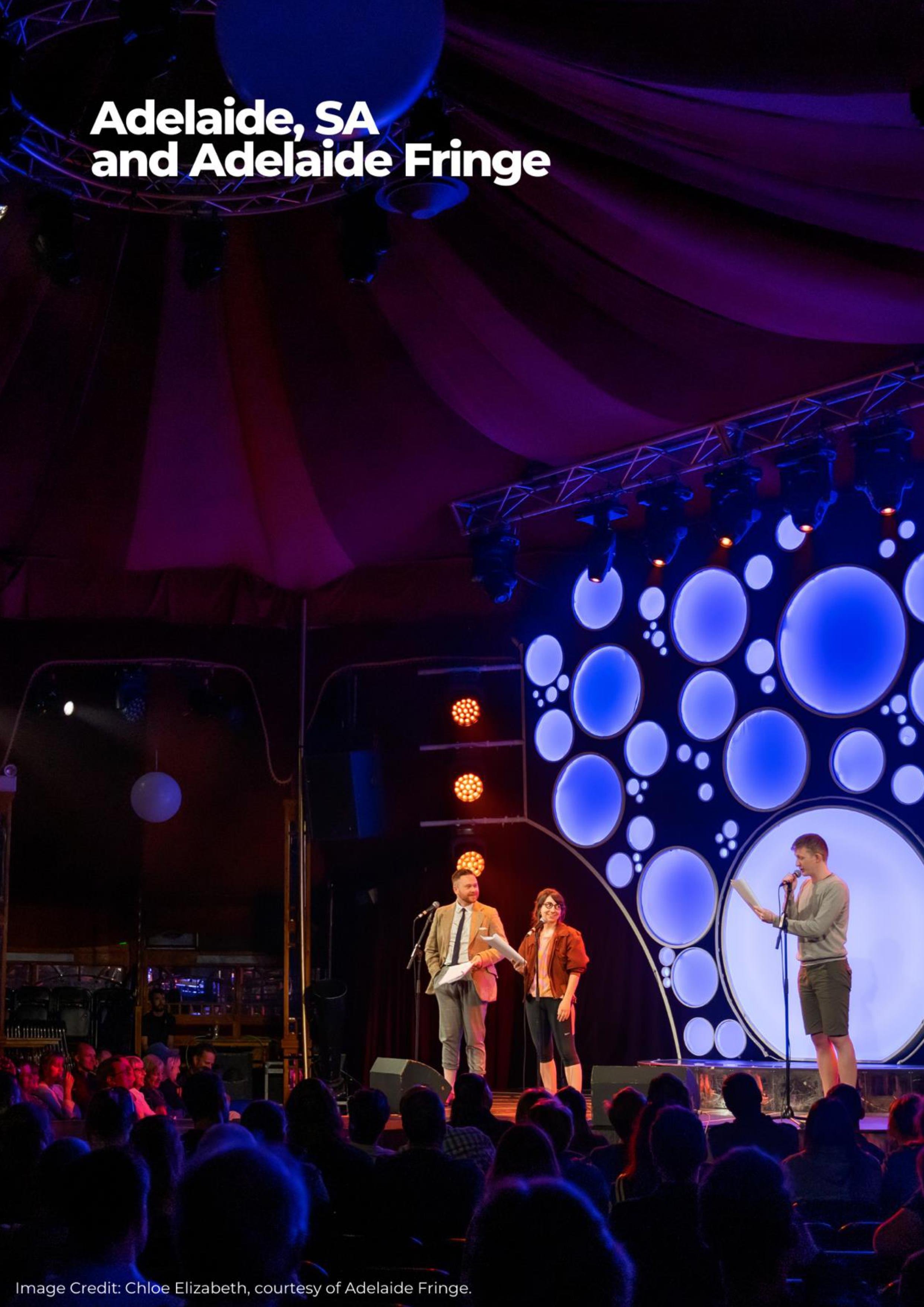
We’re still talking about Adelaide Fringe’s huge achievement in selling 1 million tickets for their 2023 festival and topping their pre-COVID ticket sales from 2019. In possibly the biggest ticketing comeback of 2023, Adelaide Fringe was able to swing a miracle through strategic coordination across updated databases, a healthy mix of free and cheap offerings, an optimised box office experience and a sponsor-backed ticket flash sale.
Sydney WorldPride 2023 drew over 1 million audience members to the festival (double what was expected), with around 70,000 people coming to NSW especially to attend. It was the first time WorldPride, the largest LGBTQIA+ festival in the world, was hosted in the Southern Hemisphere. This history-making event was the biggest in Sydney since the 2000 Olympics!
It’s not all roses in festival world, with Dark Mofo breaking news as they announced a fallow year in 2024. They say absence makes the heart grow fonder so we’ll be watching with interest to see what audiences do when it returns to Hobart in 2025.

Major institutions turned up the volume on free events
In August, our major report Audiences 2023+ showed that cost is now the top barrier limiting people’s attendance at cultural events. Luckily, the arts sector is responding with an amazing array of free events.
The beloved Sydney Opera House celebrated it’s 50th birthday in 2023, and hosted a month-long Birthday Festival in October where audiences were treated to a broad range of ticketed and free events from theatre to contemporary music and lectures. They produced ‘Play It Safe’, a 50th Anniversary film showcasing dance, music and theatre, and shared 50 iconic Sydney Opera House film recordings for free over 3 months to celebrate 5 iconic decades.
The history-making Melbourne Now returned for the first time since 2013 at The Ian Potter Centre: NGV Australia. The exhibition took over NGV’s Fed Square gallery and included more than 200 Victorian practitioners across disciplines. The exhibition and programming saw audience attendance records break, with success factors from the unique mix of local creatives on show as well as the breadth of public programming – all enjoyed for free!

Thank you to all of the amazing artists, event organisers and cultural venues that worked so hard to make 2023 such a special year for audiences.
May the good times roll in 2024!

About the Author
Peta Petrakis
Research Analyst
Categories
Archive
- Research 99
- Audience development 79
- Innovation 78
- Evaluation 75
- Arts 73
- Culture 72
- COVID-19 70
- Data culture 69
- About Patternmakers 35
- Project updates 25
- 2022 23
- 2023 21
- Thought leadership 16
- Tips & Tricks 13
- 2018 12
- 2019 11
- Career Advice 9
- 2017 8
- Beyond the Bio 8
- 2021 7
- Tandi Palmer Williams 7
- Privacy 6
- Resources 6
- Year in review 6
- 2016 5
- Performing Arts 5
- Strategic Planning 5
- Toolkit 5
- Accessibility 4
- Digital art 4
- Opportunities 4
- Our services 4
- Visual arts 4
- Youth 4
- 2020 3
- Capacity building 3
- Dance 3
- First Nations 3
- Interviews 3
- Touring 3
- Trends 3
- Case Studies 2
- Coronavirus 2
- Data art 2
- Education 2
- Indigenous 2
- Top 5 2
- 2024 1
- Culture Panel 1
- Manifesto 1
Be in the loop

Dance Sector Uplift
When we were invited to help distill the findings from a sector recovery project, we weren’t expecting to find a bigger, bolder ambition.
Following the flood and storm events of 2022, Dance Sector Uplift set out to reactivate dance, physical theatre and experimental performance across the Northern Rivers. Beyond simply rebuilding, the report captures a vision for a new regional hub for dance.
In 2023, Arts Northern Rivers commissioned Patternmakers to assist with the Dance Sector Uplift project, designed to reactivate dance, physical theatre and experimental performance across the region.
This partnership stretches back to the Creative Industries Recovery Forum in 2022, which we attended and developed a report to identify sector priorities in order for the creative industries to flourish again after the severe storms and flooding hit communities across Northern NSW and Southern QLD.
Arts Northern Rivers undertook three streams of focus to support the region’s activation, recovery and renewal, identified as Public Art, First Nations Arts, and Dance/Physical Theatre.
In consultation with local artists, Arts Northern Rivers was committed to stimulating the region with a revitalisation of the dance sector by supporting activities which nourish and promote the region as a creative, thriving and growing centre of diverse embodied practice.
Local dance maker and producer, Philip Channells managed the delivery of the project. Philip works across art forms including dance/theatre, film, performance installation, community art projects, site-specific work and artist residencies with collaborators who value, challenge, redefine and inform our different perspectives of contemporary life.
“Approaching the Dance Sector Uplift (DSU) research project through a broad lens of diversity and inclusion enabled conversations amongst the sector, acknowledging the diverse cultural influences, creative practices and lived experiences of practising artists.
This conversational approach led us to realise the need for various stages of research to ensure a broad set of important voices were caught in the process.”
This project was informed by a multiplicity of consultation methodologies with members of the Northern Rivers performing arts sector, including local Bundjalung, Yaegl and Gumbaynggirr leaders, knowledge keepers of dance, dance makers and performers and global Indigenous and CALD artists living in the region.
Arts Northern Rivers conducted a survey inviting all artists working across an embodied practice to contribute to the research and design process for the reactivation of dance.
We analysed and compiled the results of these surveys and consultations into a full report in order to inform the direction and outcomes of the project. The report identifies the strengths and challenges, supported with evidence and data, and recommendations on how to plan ahead, to create a vision, and help independent artists realise their creative potential while working collectively within the community.

Download the Dance Sector Uplift report below for the full story.
Click below to watch the webinar where the findings from the report were delivered to all the participants from the local dance sector.
Image | Dancers: Omer Backley-Astrachan, Kirsty Kiloh, Charemaine Seet in The Draw IN by Geraldine Balcazar. Photograph by Shane Rozario.
About the Author
Tandi Palmer Williams
Managing Director

Categories
Archive
- Research 99
- Audience development 79
- Innovation 78
- Evaluation 75
- Arts 73
- Culture 72
- COVID-19 70
- Data culture 69
- About Patternmakers 35
- Project updates 25
- 2022 23
- 2023 21
- Thought leadership 16
- Tips & Tricks 13
- 2018 12
- 2019 11
- Career Advice 9
- 2017 8
- Beyond the Bio 8
- 2021 7
- Tandi Palmer Williams 7
- Privacy 6
- Resources 6
- Year in review 6
- 2016 5
- Performing Arts 5
- Strategic Planning 5
- Toolkit 5
- Accessibility 4
- Digital art 4
- Opportunities 4
- Our services 4
- Visual arts 4
- Youth 4
- 2020 3
- Capacity building 3
- Dance 3
- First Nations 3
- Interviews 3
- Touring 3
- Trends 3
- Case Studies 2
- Coronavirus 2
- Data art 2
- Education 2
- Indigenous 2
- Top 5 2
- 2024 1
- Culture Panel 1
- Manifesto 1
Be in the loop

City lights to red dirt: Connecting with audiences across Australia
Audiences in big cities, outer suburbs and the regions have vastly different contexts, and they behave differently when it comes to attending cultural events.
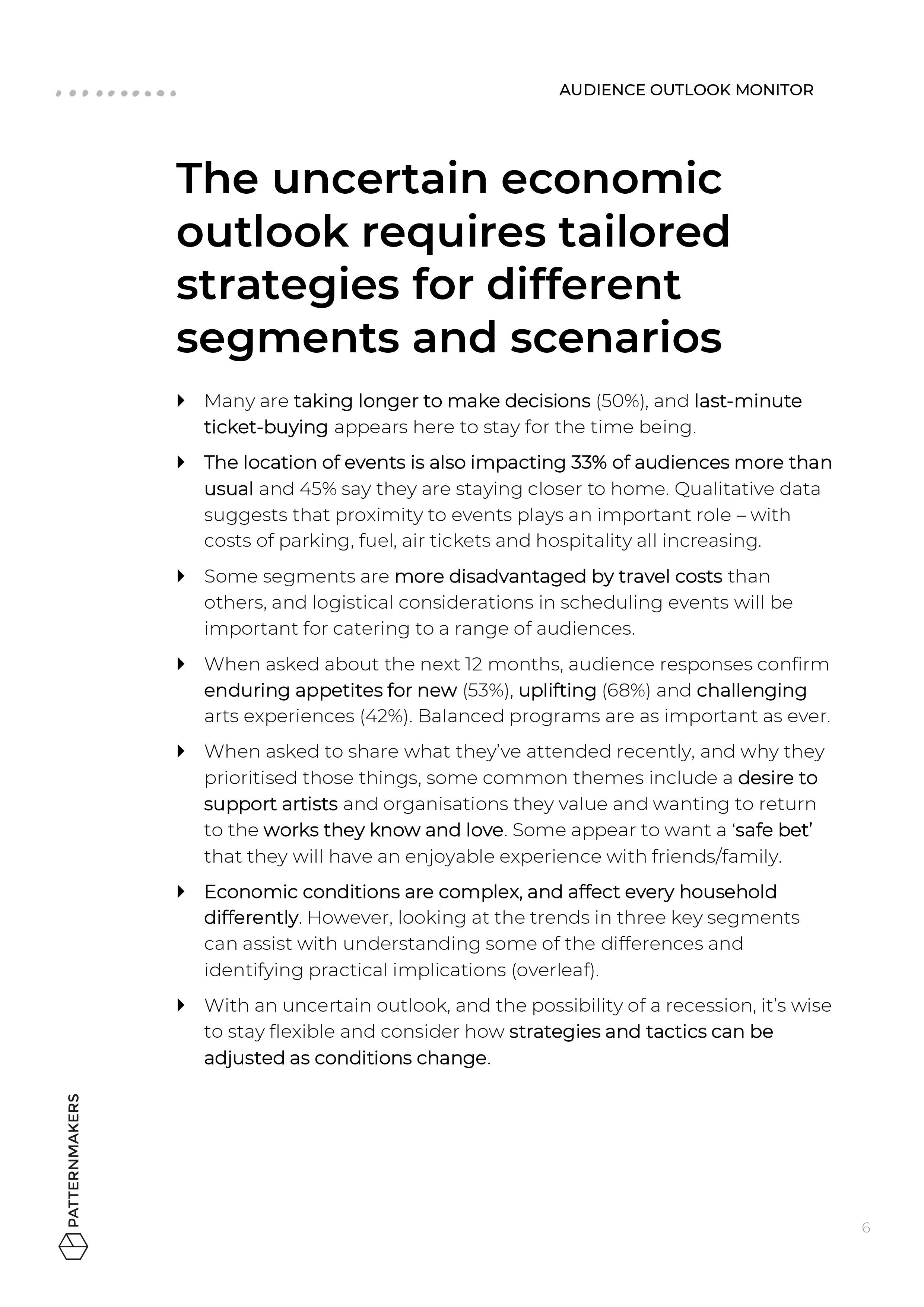
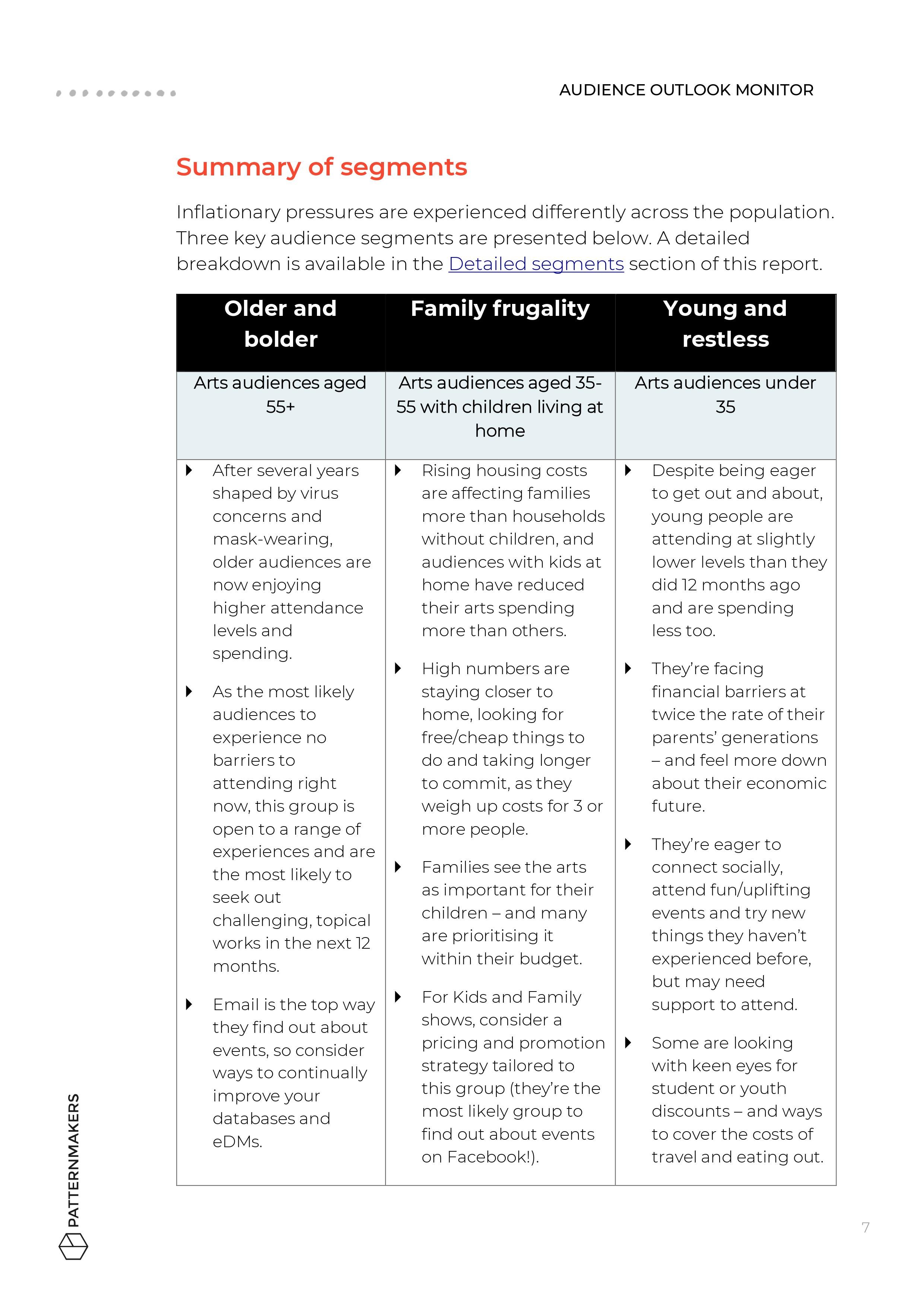
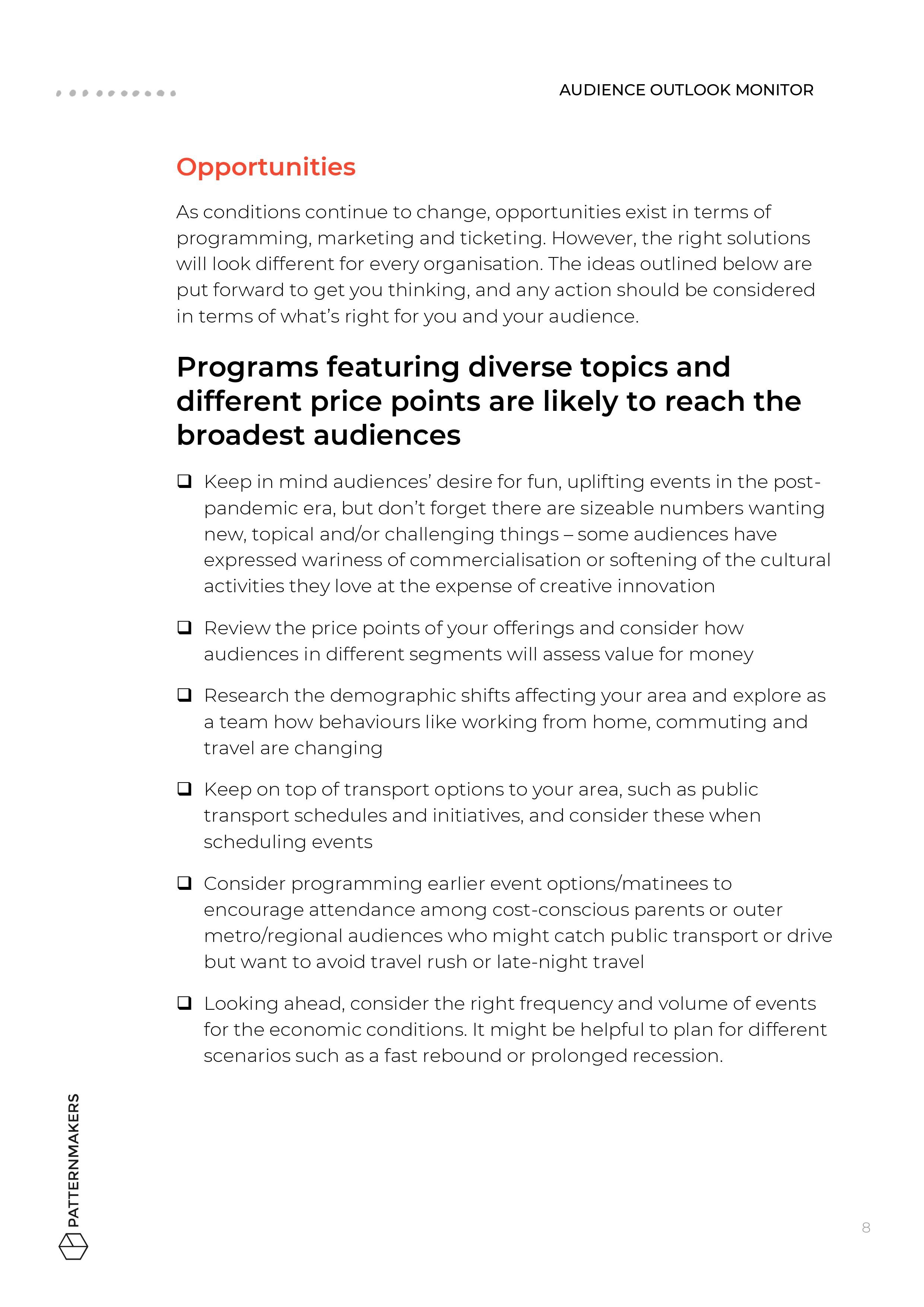
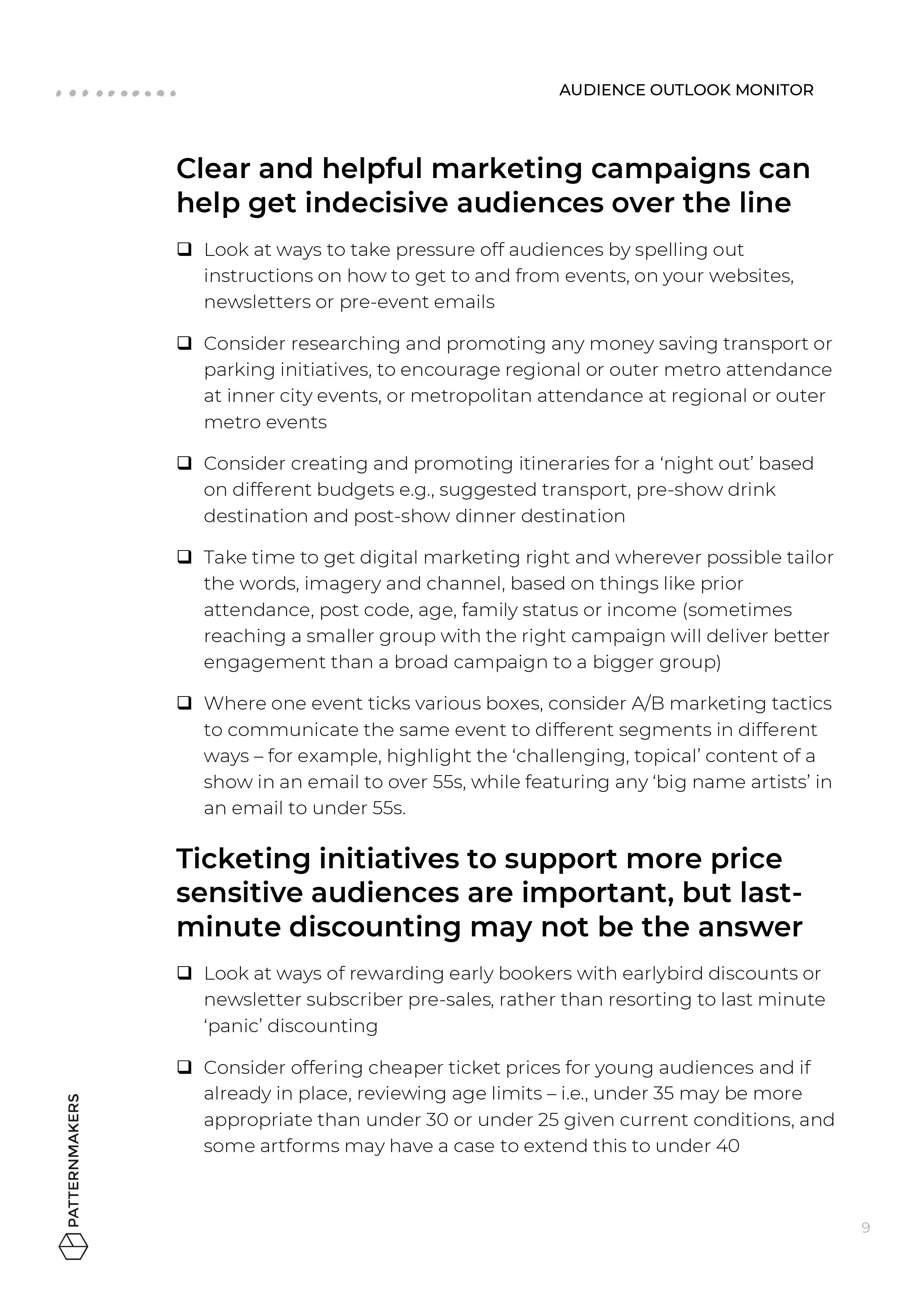
In this Audience Outlook Monitor report, ‘City Lights to Red Dirt’, we look at the geographic trends in data collected from past attendees. If Australia is to achieve equity of access for audiences, regardless of location, there are insights for programming, marketing and strategy.
Our cities, suburbs and regions are different places today and audiences are responding in interesting ways.
Attendees of arts and cultural events are feeling the pressure of the housing crisis, changing work and commuting patterns, navigating weather events and approaching travel and leisure differently.
In this new report, ‘City Lights to Red Dirt’, we look at the geographic trends in data collected from past audiences of cultural events.

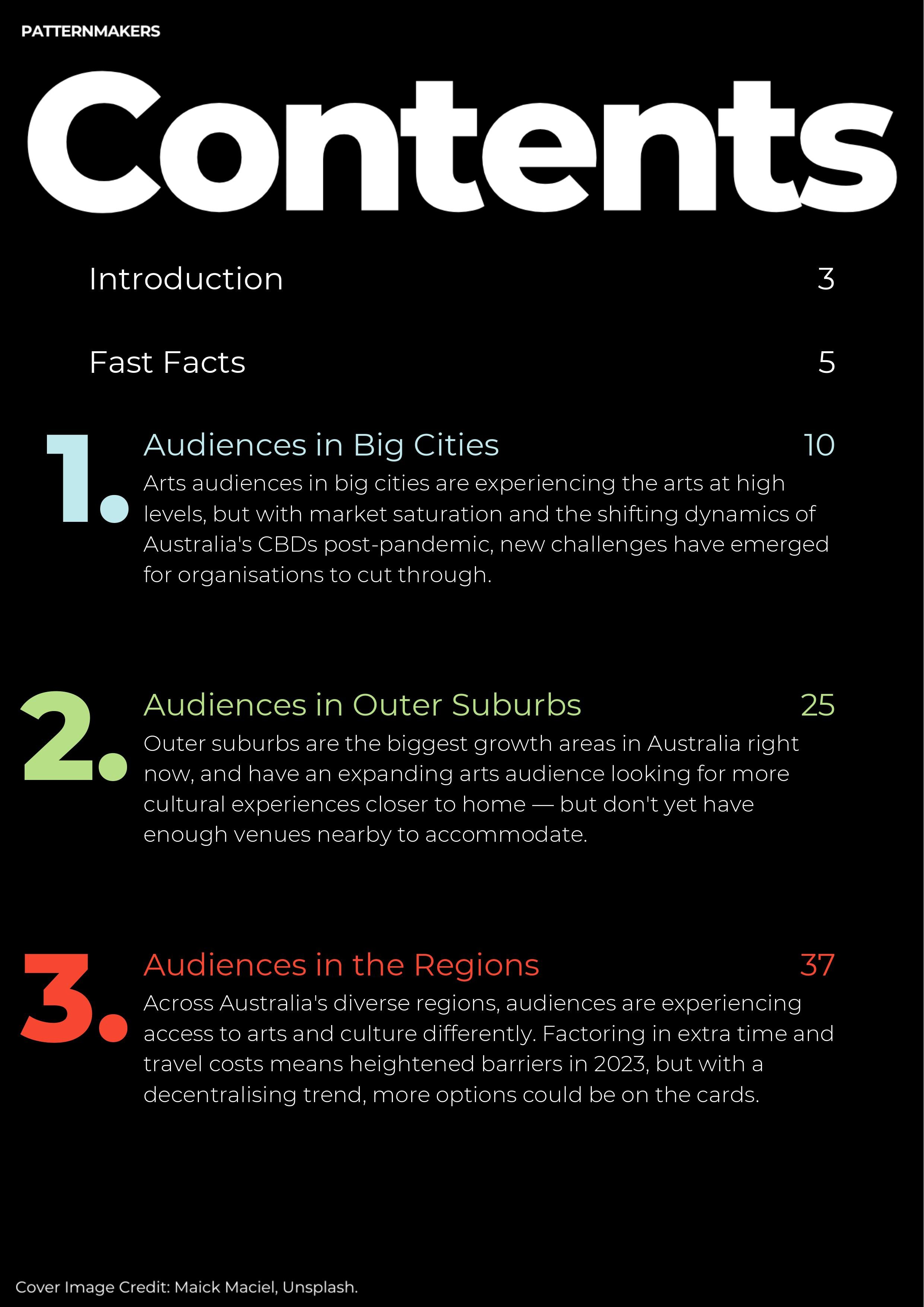








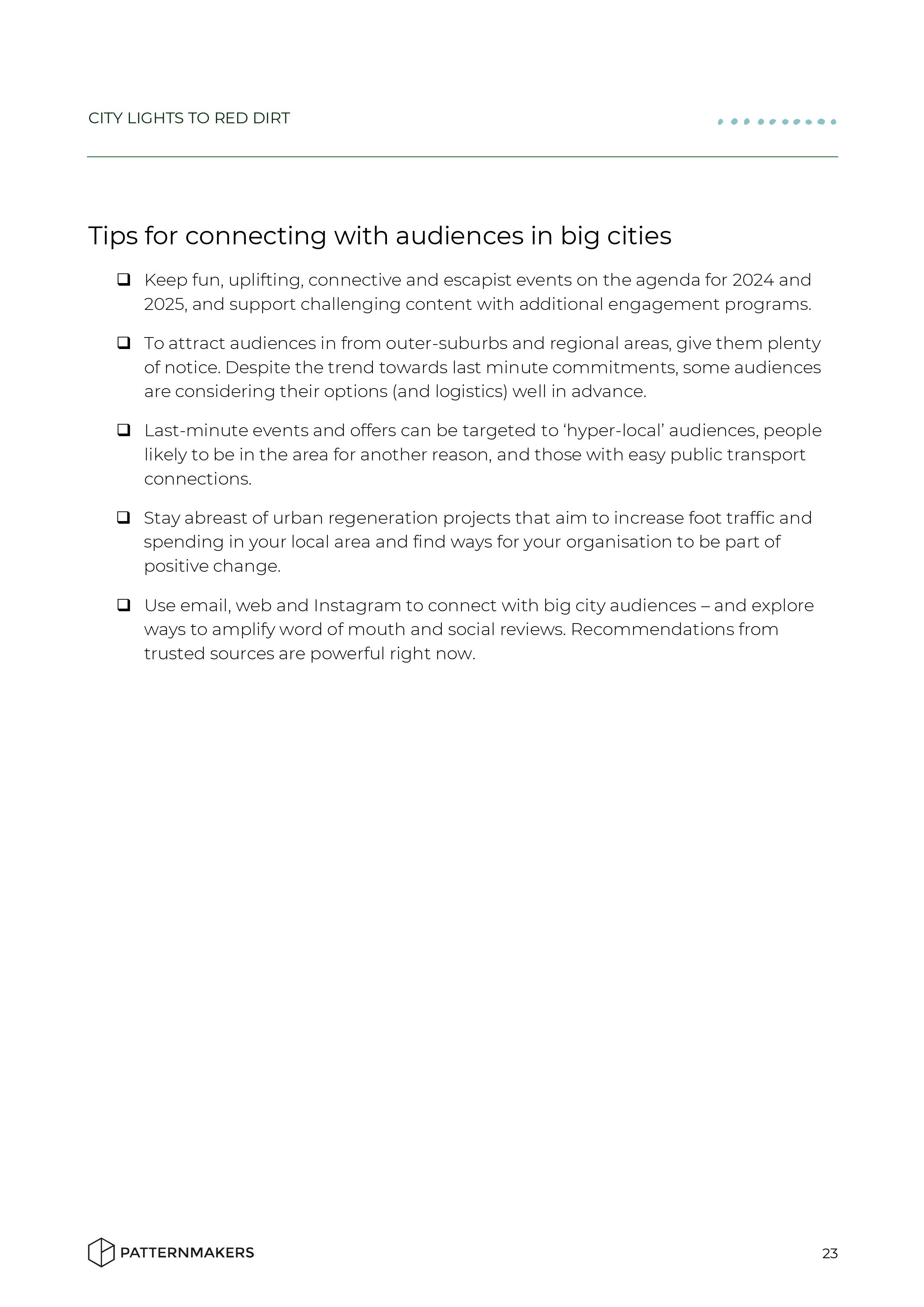

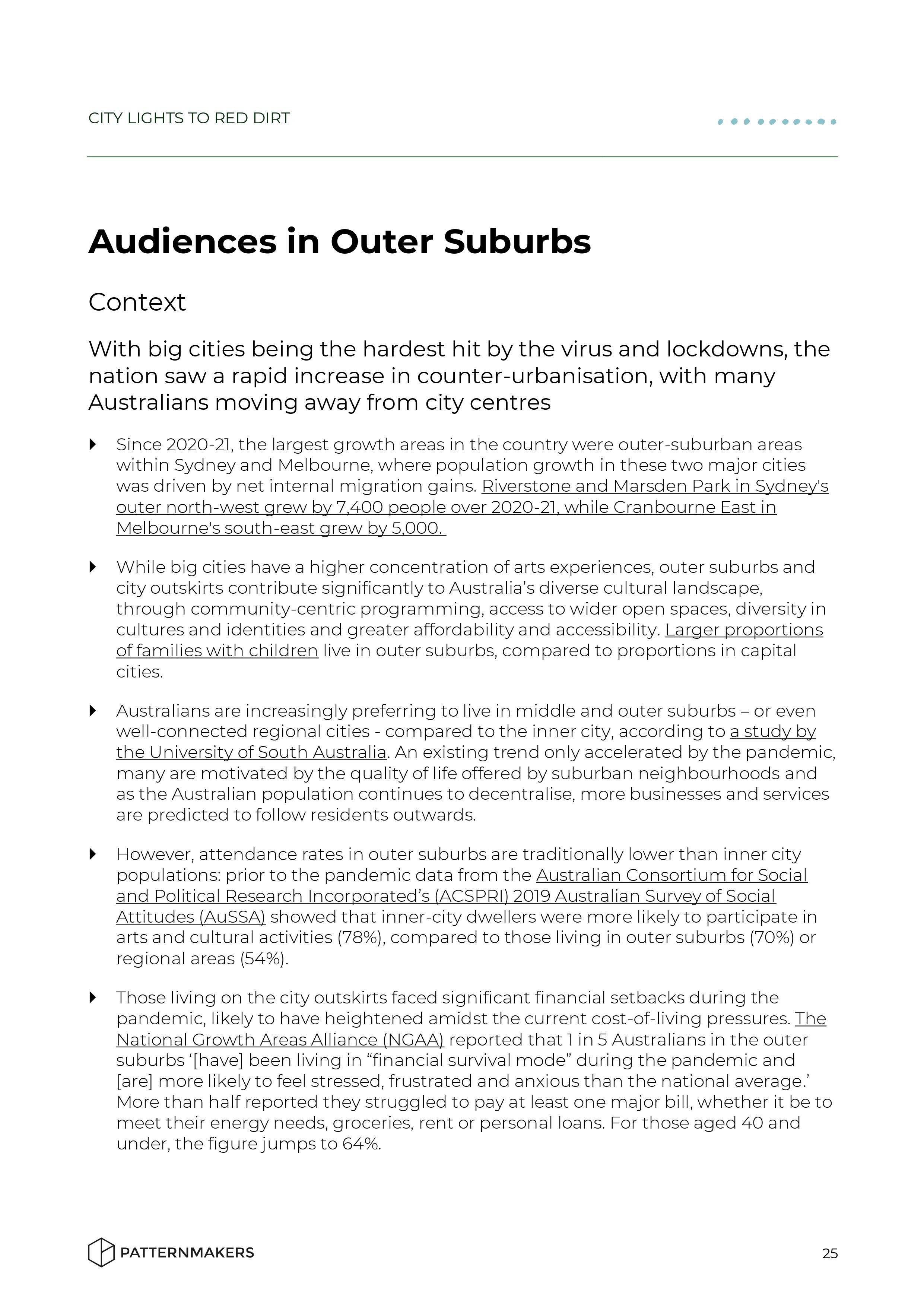
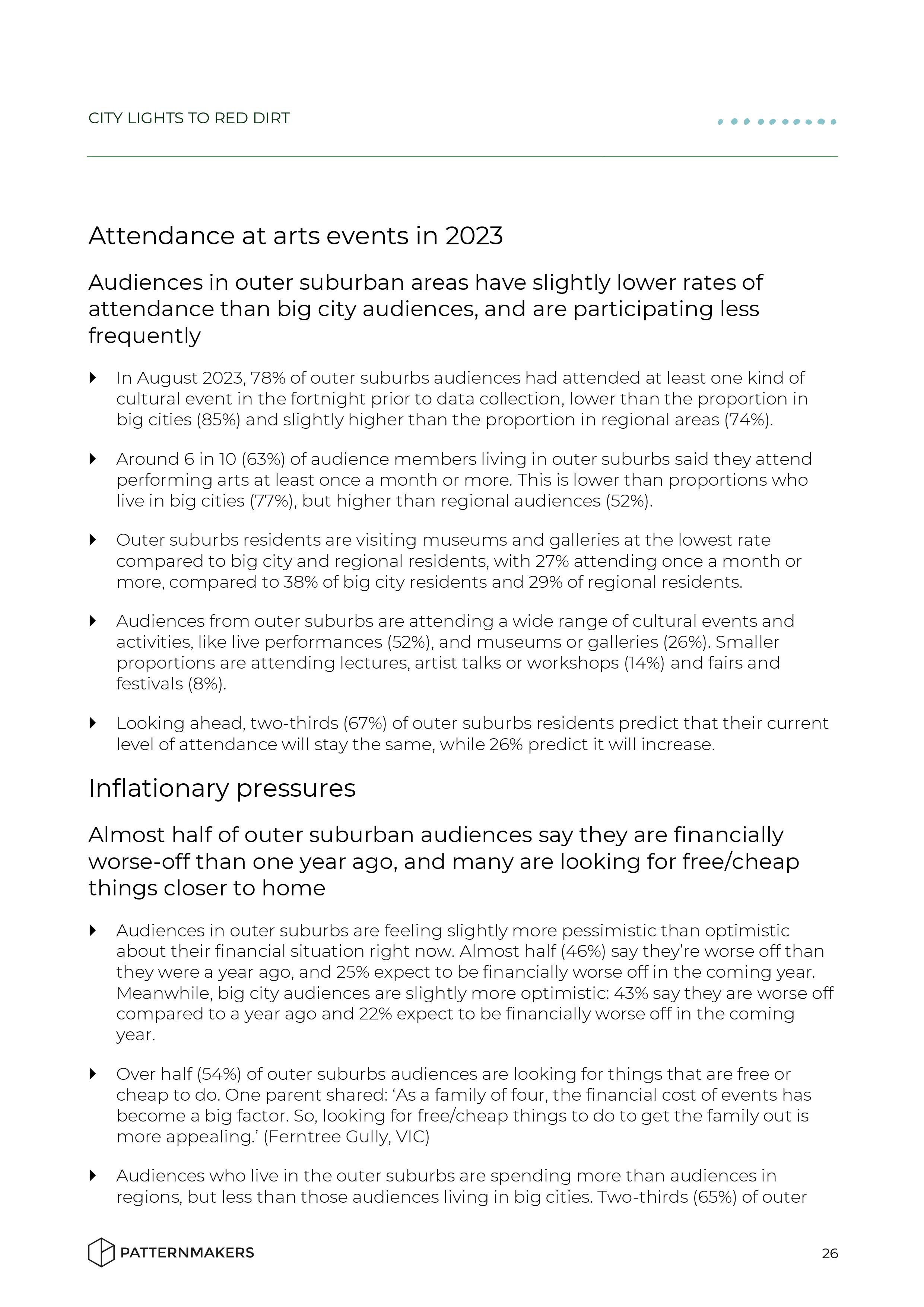


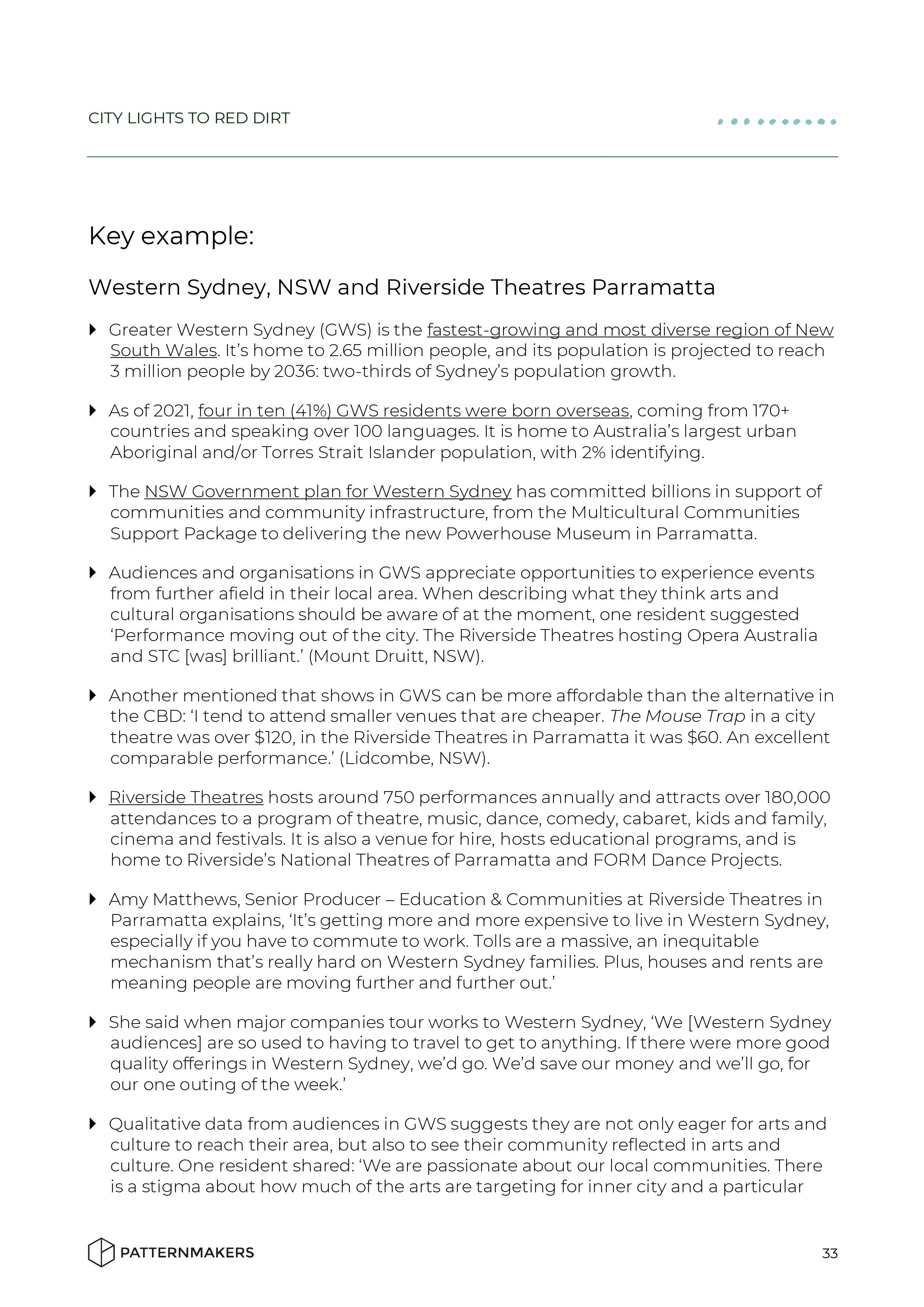

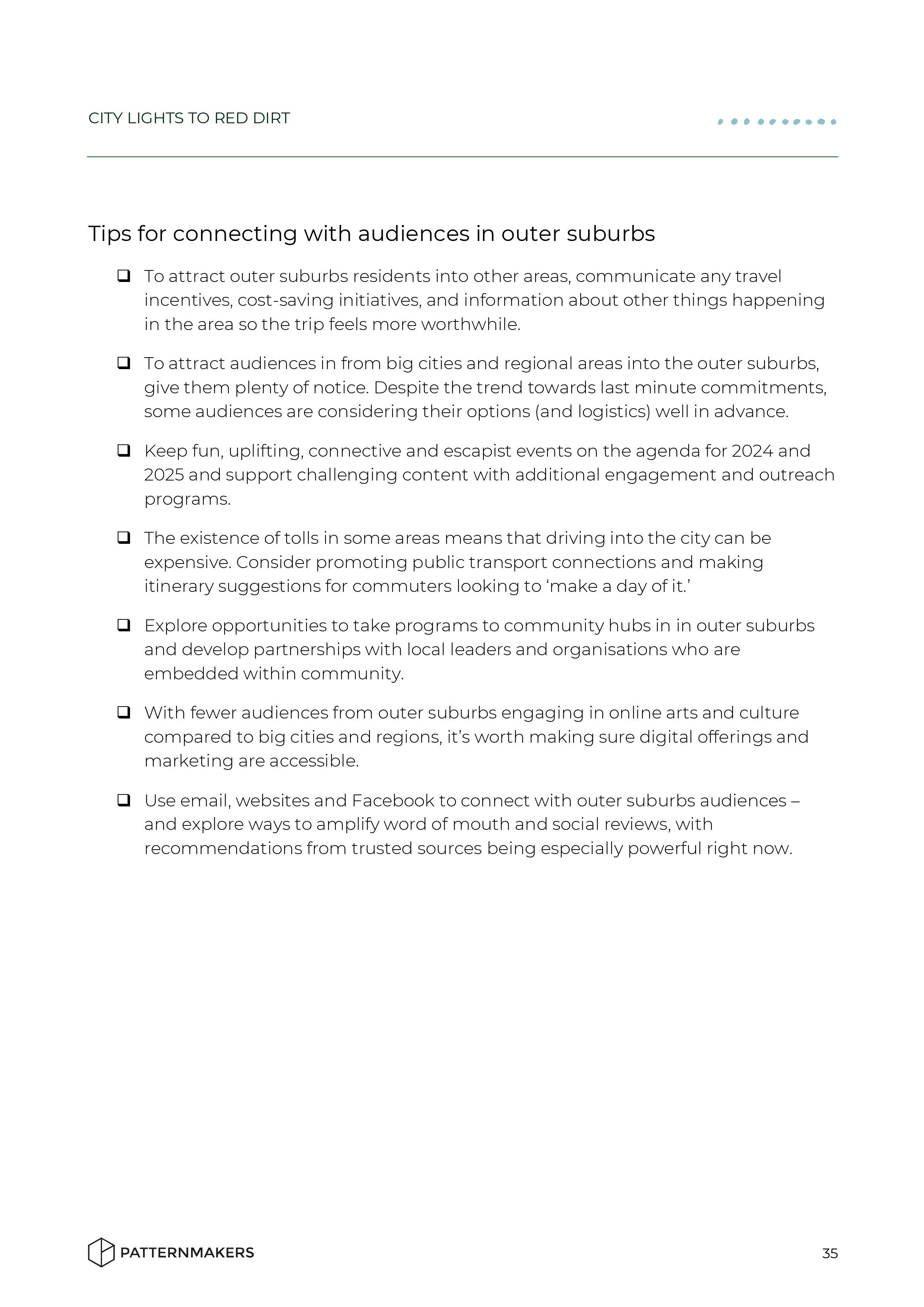
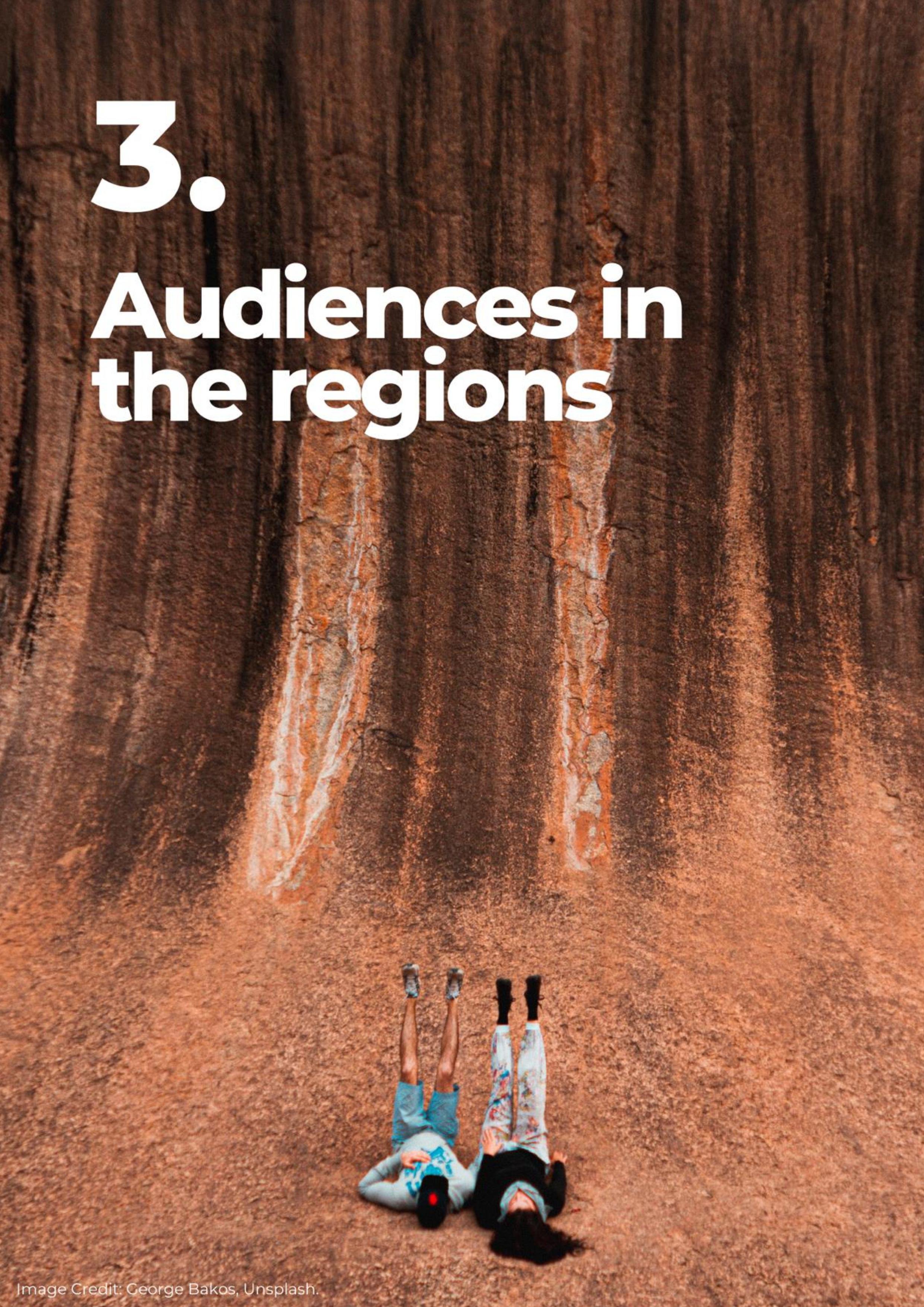
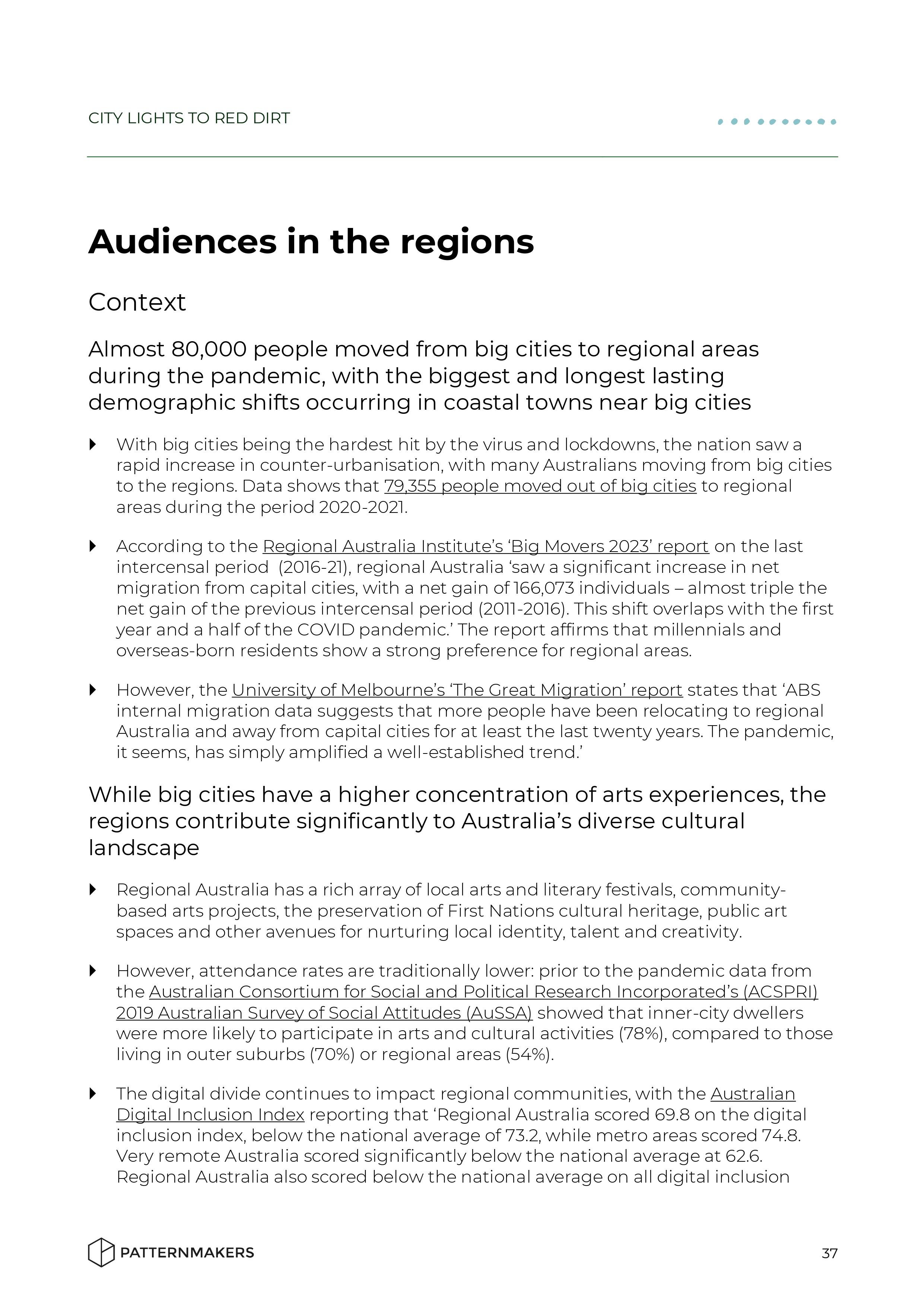
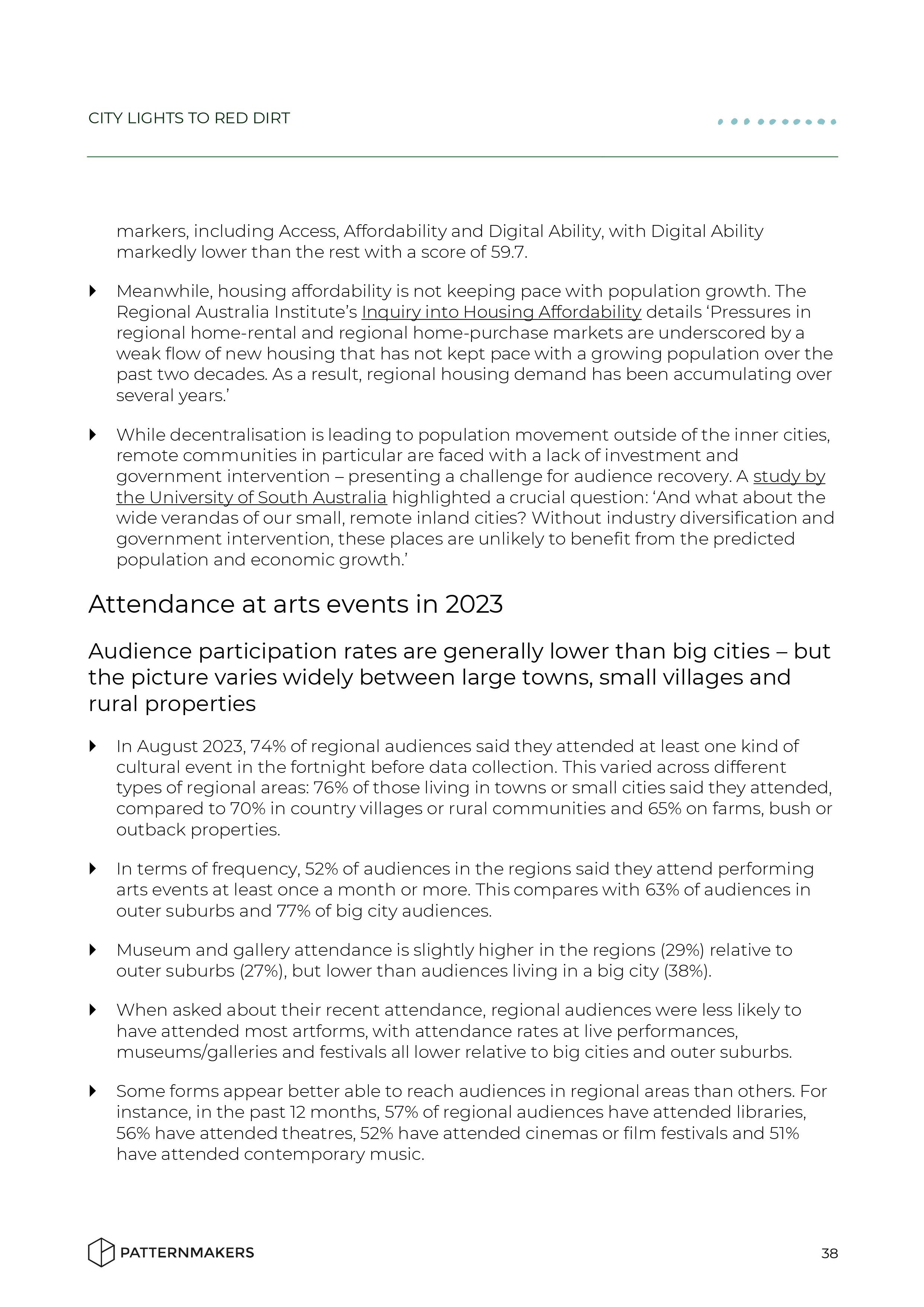
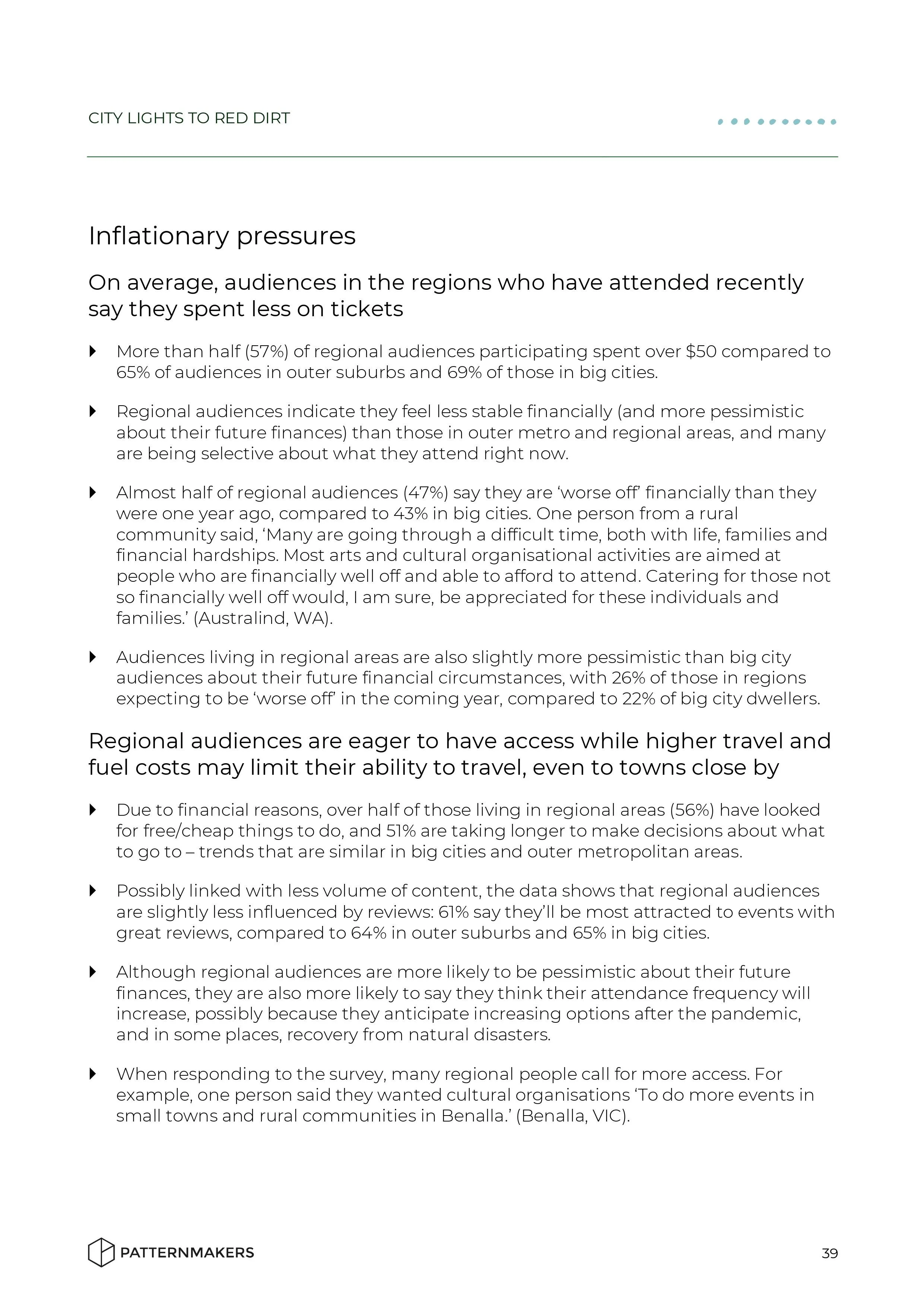
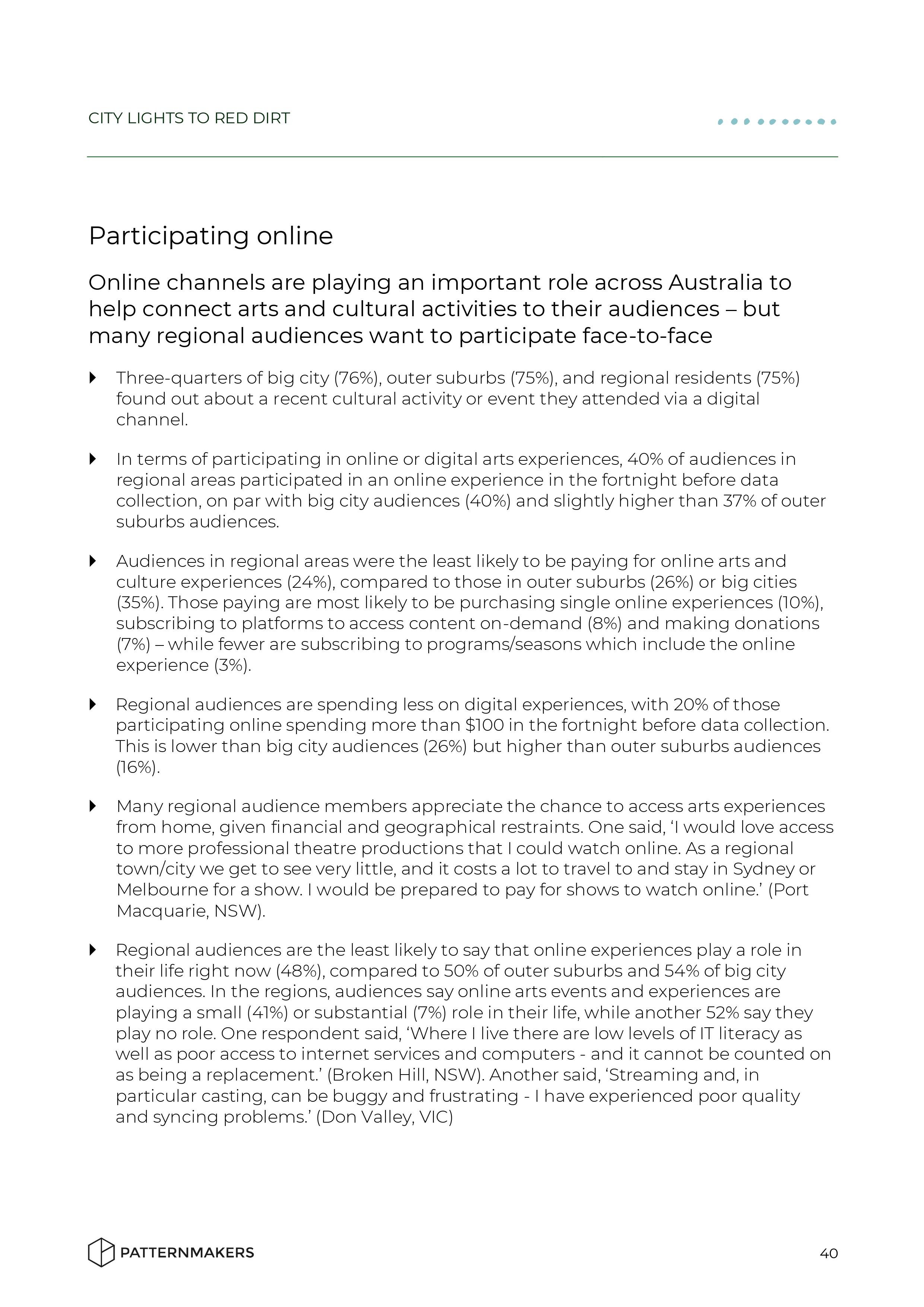
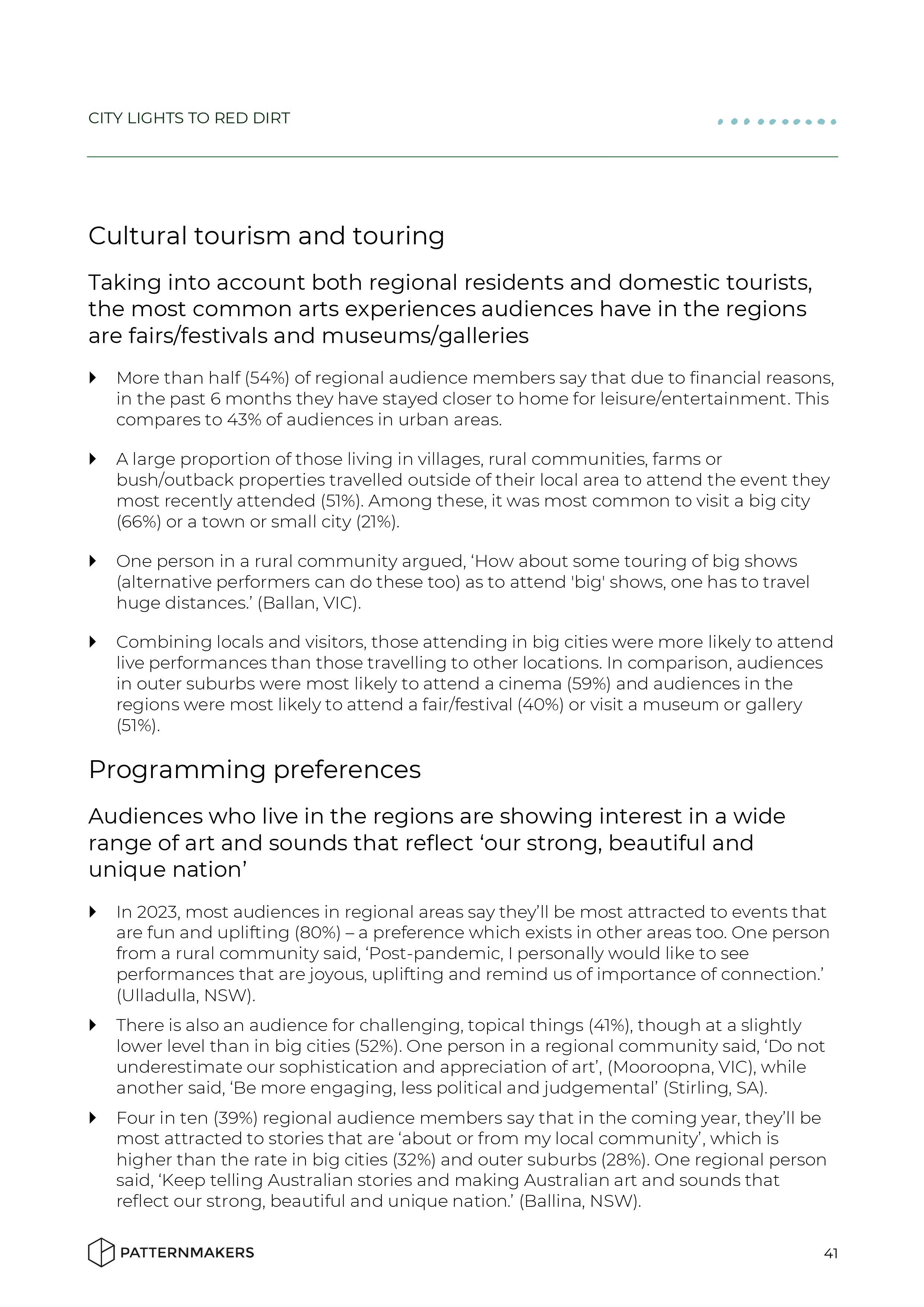


Click the buttons below to download the report, as a PDF or accessible Word version, or read on for more of the findings.
Three chapters, three geographic audience segments
The report compares audiences in three main geographic areas, providing insights for connecting people with culture where they live and the places they visit.
Download the chapters as separate fact sheets below.
Audiences in Big Cities
Arts audiences in big cities are experiencing the arts at high levels, but with market saturation and the shifting dynamics of Australia's CBDs post-pandemic, new challenges have emerged for organisations to cut through.
-
In Australia’s big cities, more people are attending arts events more often, but resident arts organisations are competing in a congested market. The data from past attendees shows that:
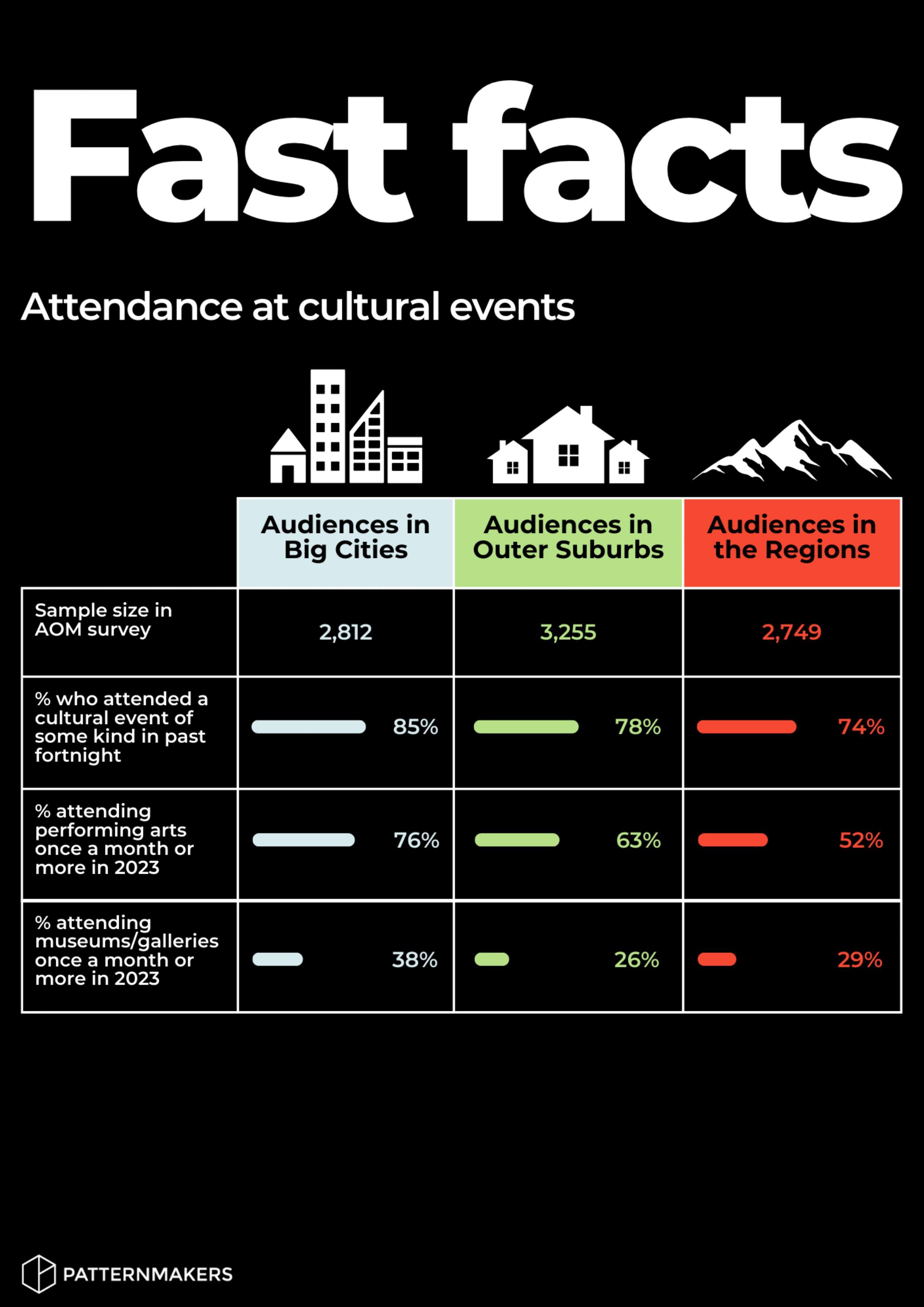
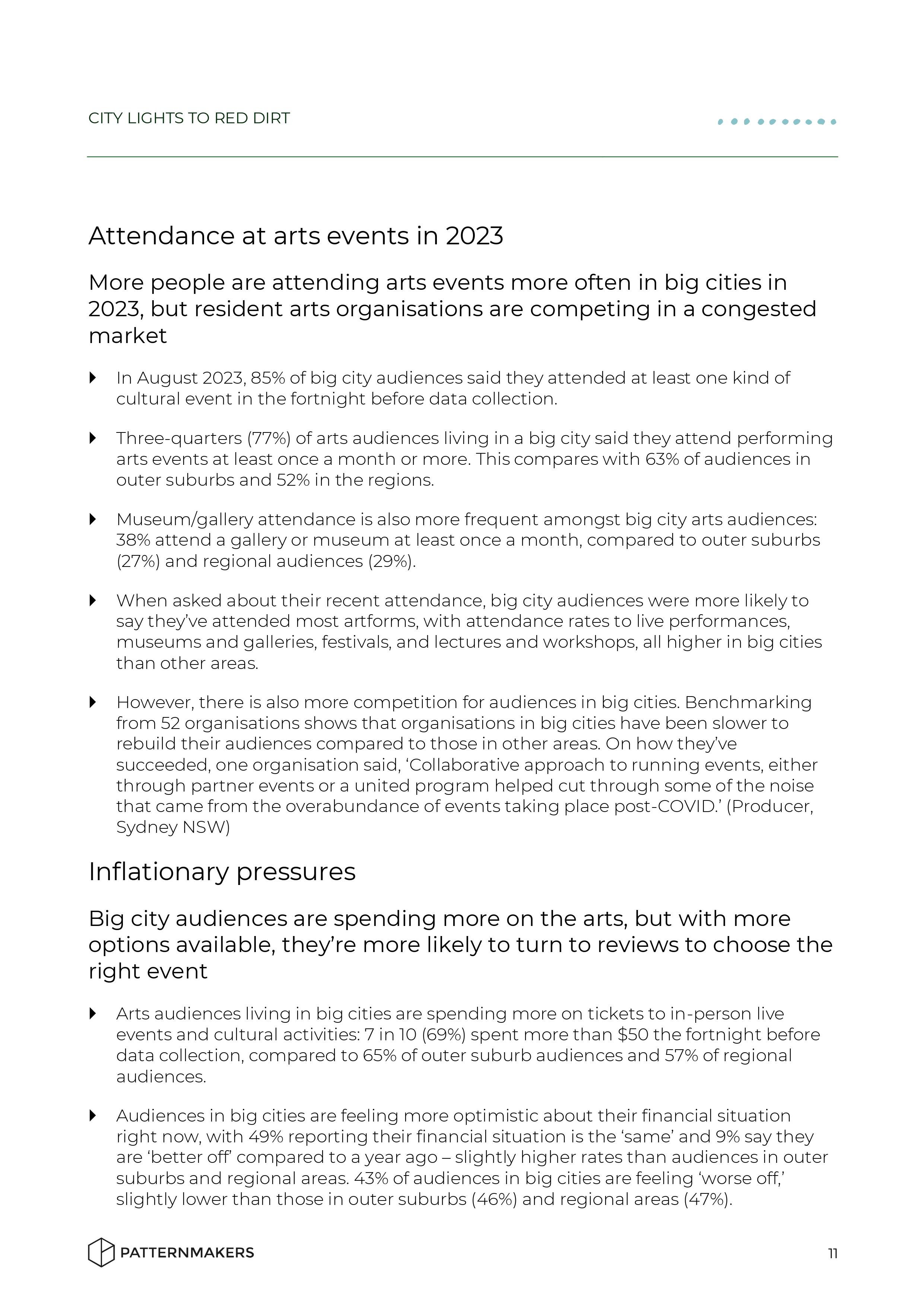
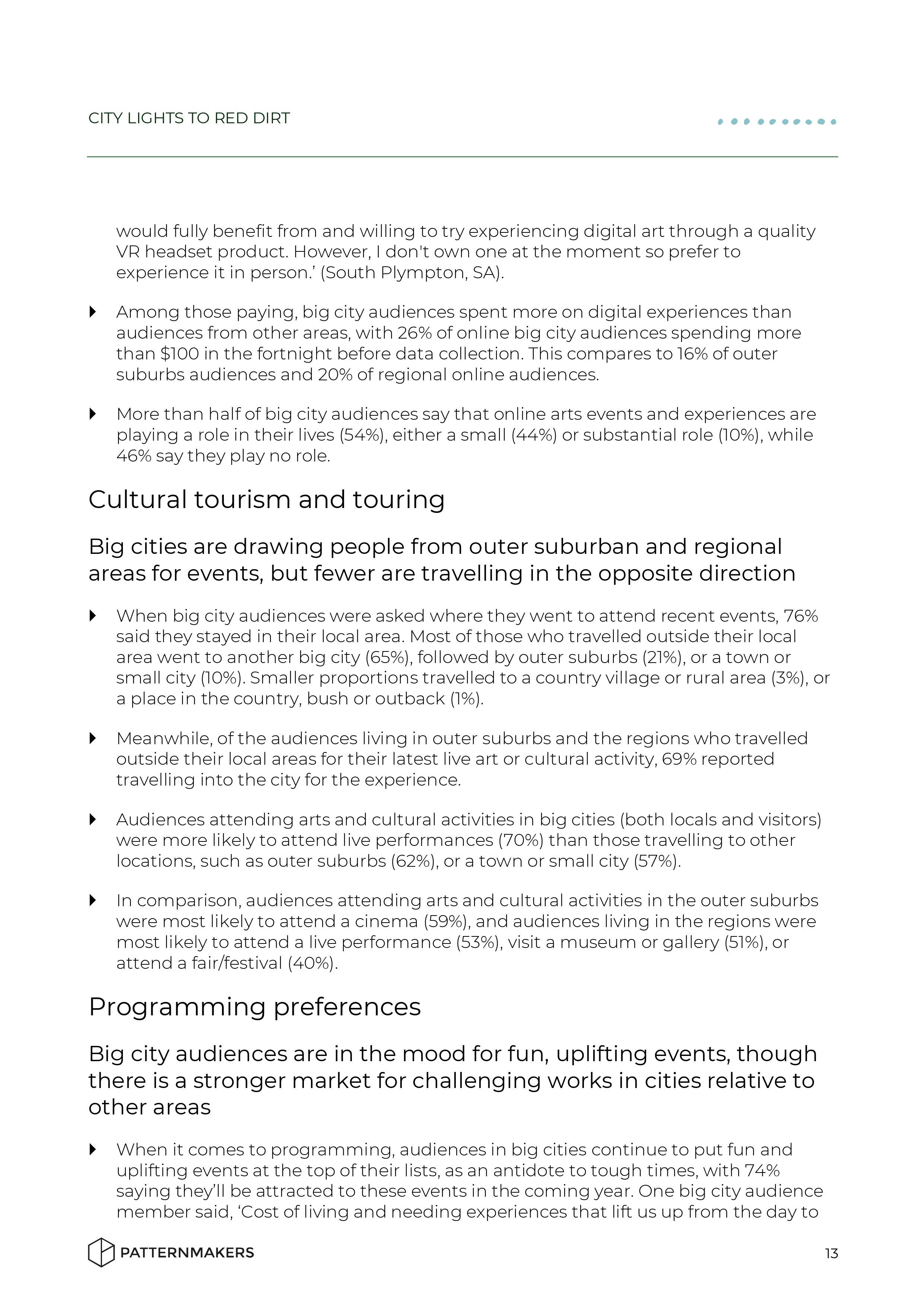
85% of big city audiences said they attended at least one kind of cultural event in the fortnight before data collection. Attendance is also more frequent amongst big city arts audiences: 38% attend a gallery or museum at least once a month, compared to outer suburbs (27%) and regional audiences (29%).
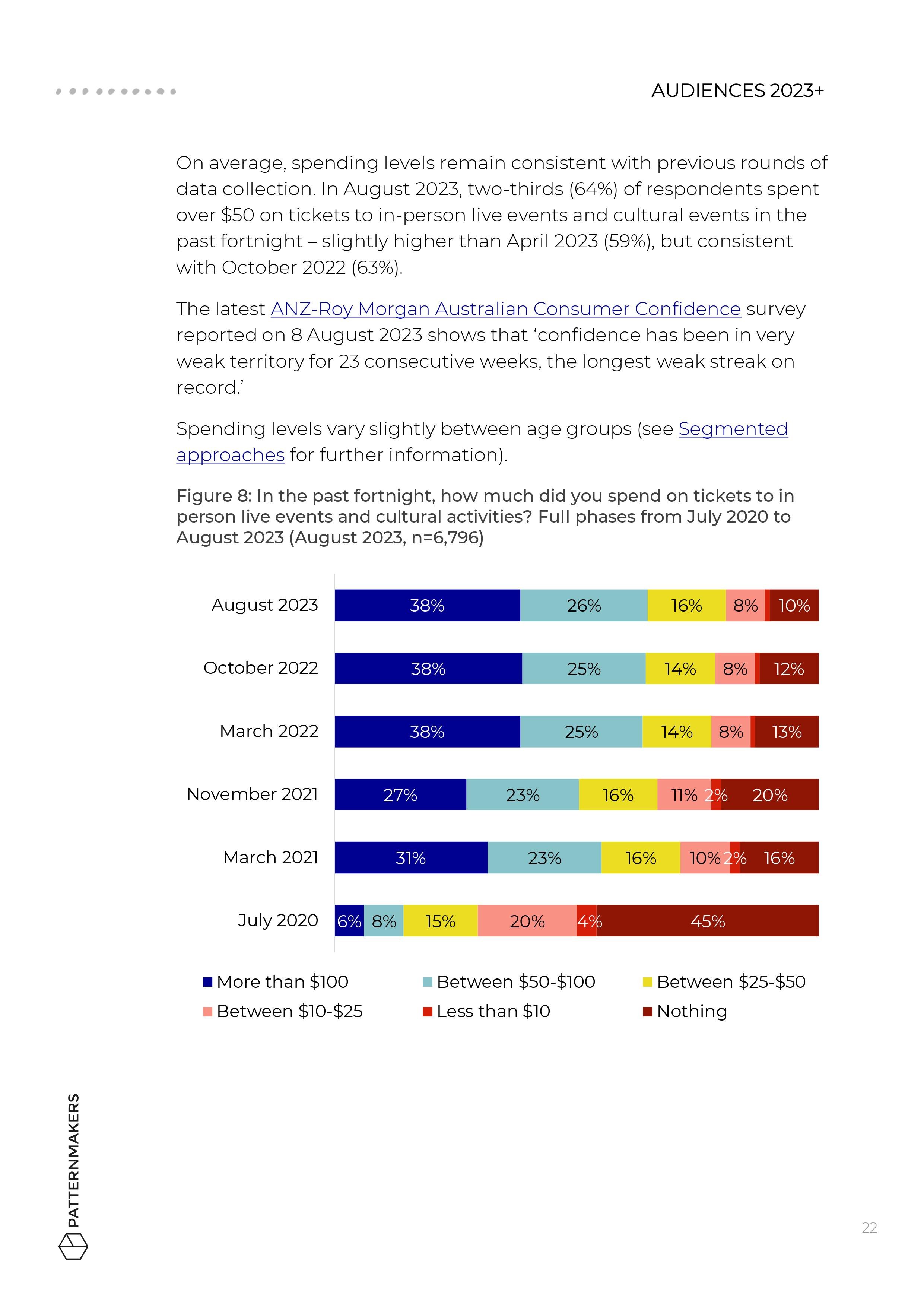
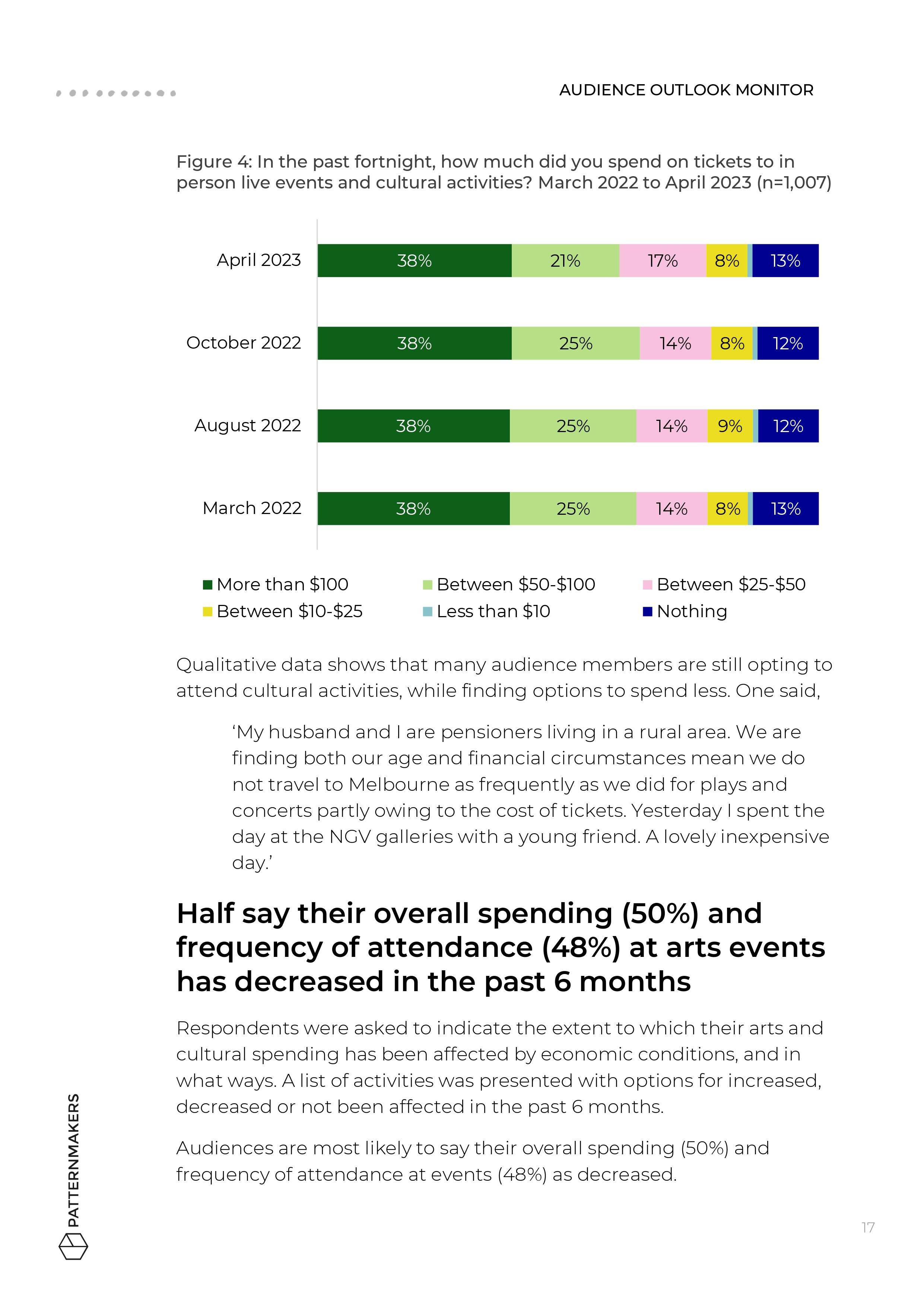
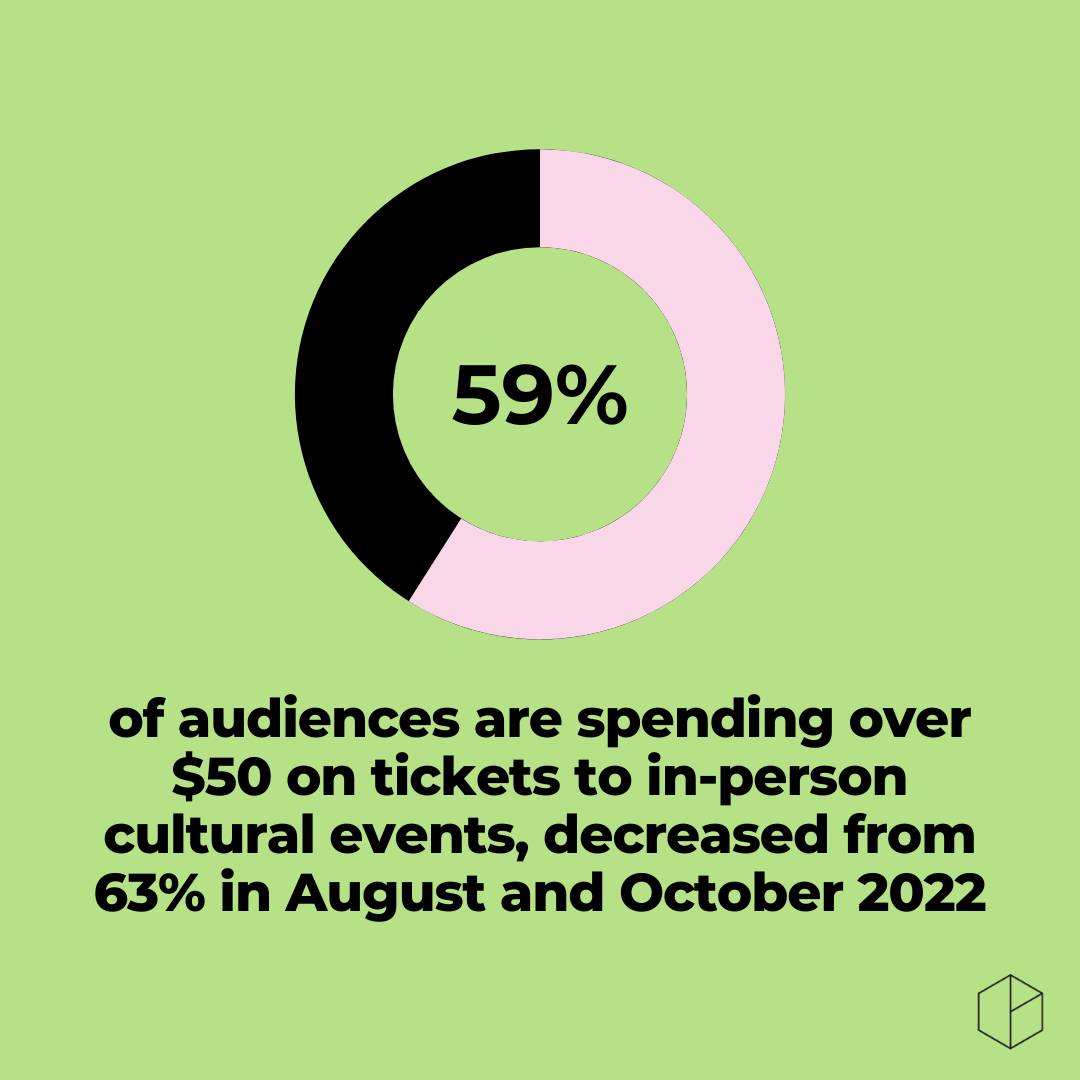
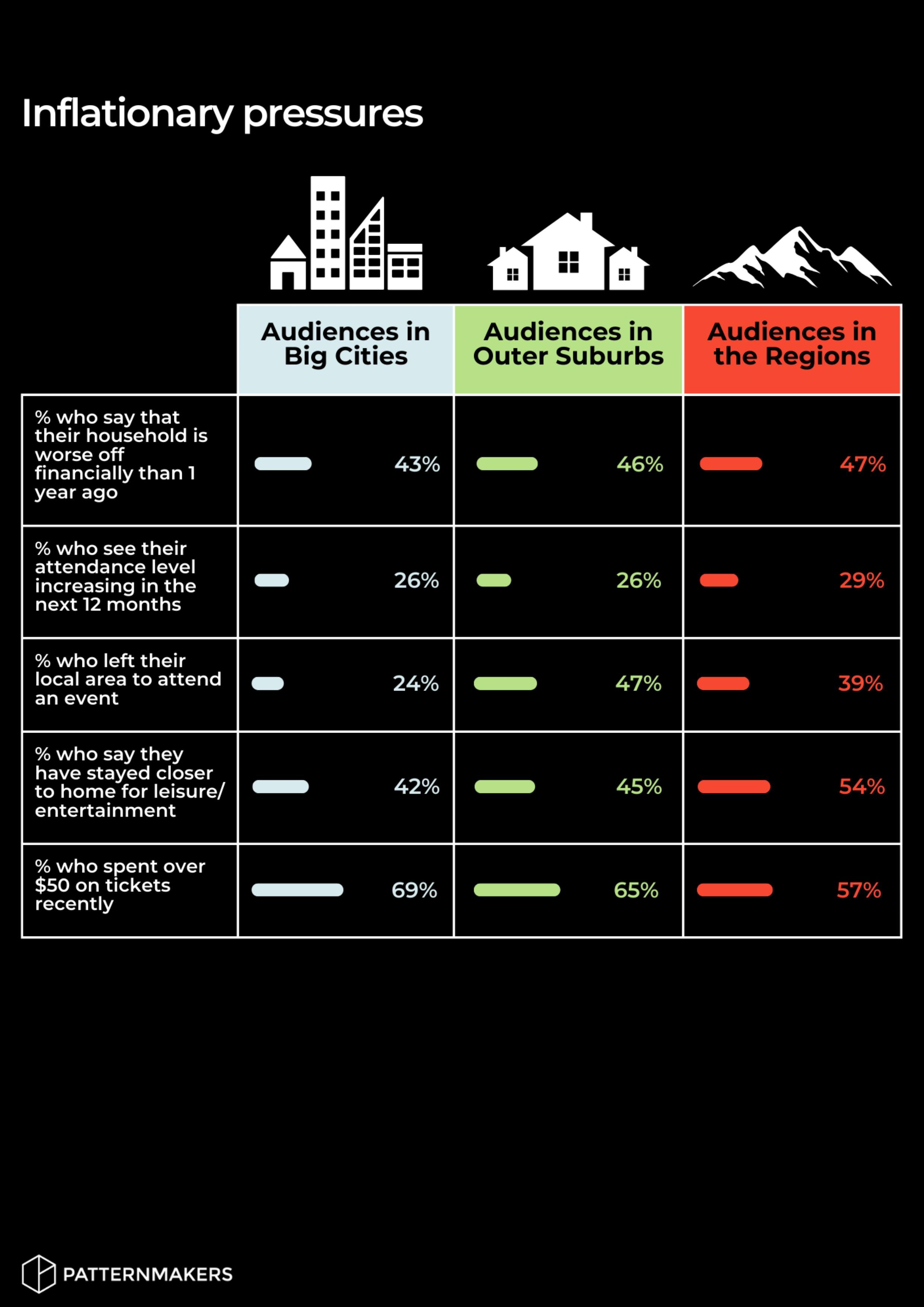
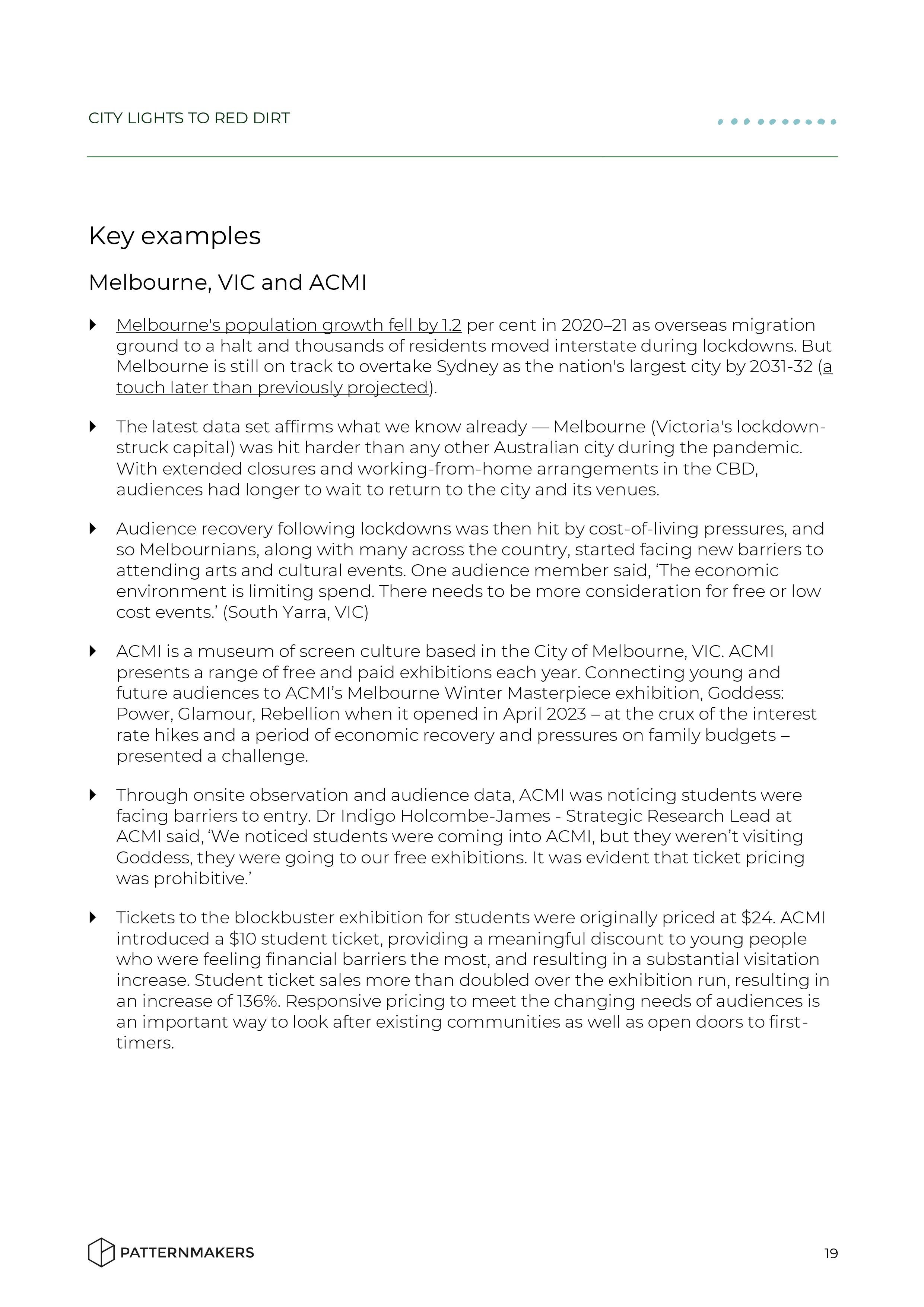
Arts audiences living in big cities are spending more on tickets to in-person live events and cultural activities: 7 in 10 spent more than $50 the fortnight before data collection (69%), compared to 65% of outer suburb audiences and 57% of regional audiences.
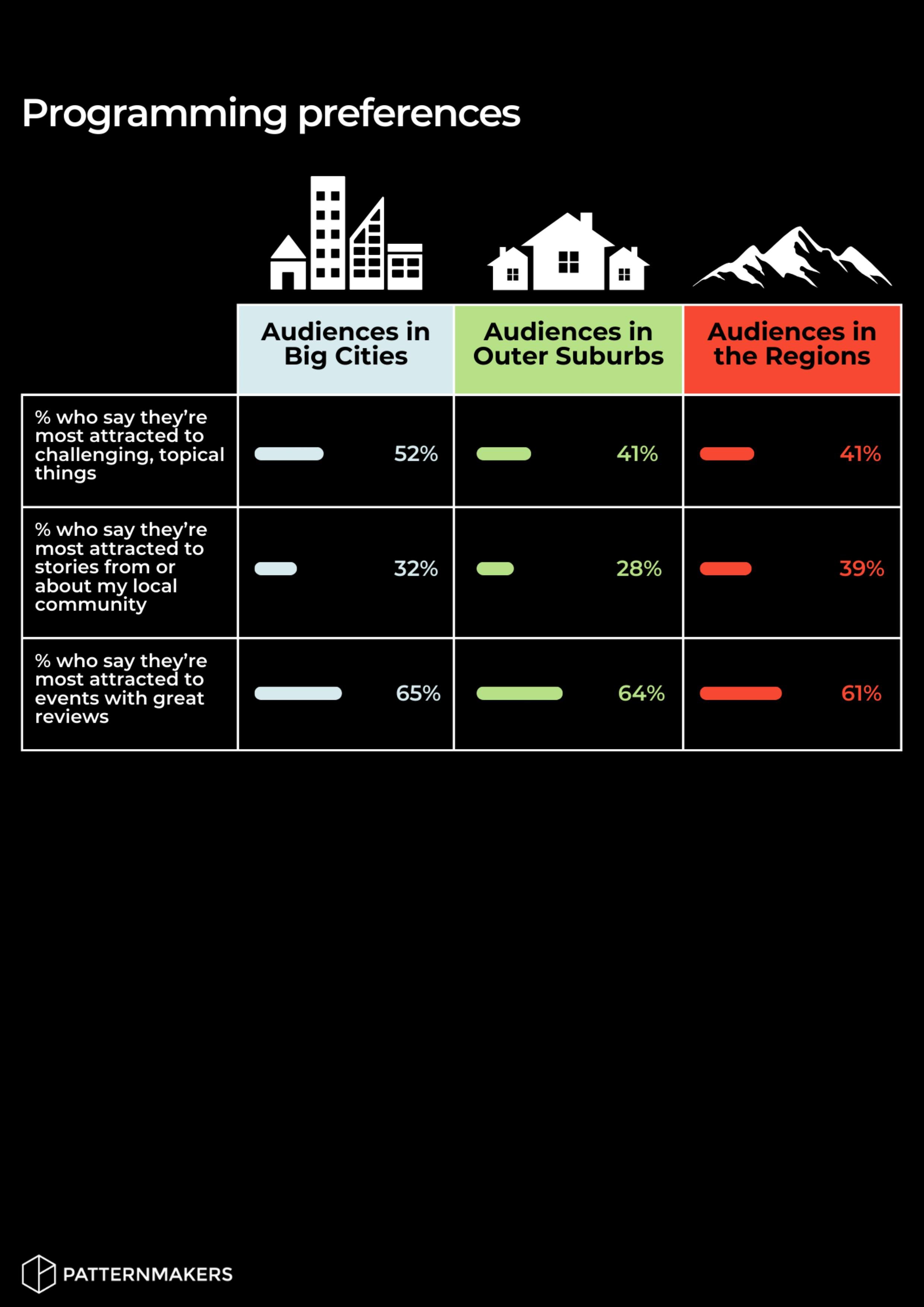
While most audiences are drawn to fun, uplifting and even escapist content right now, big city audiences are showing a greater appetite for challenging, topical content in the next 12 months (52%), compared to audiences living in outer suburbs and regional areas (both 41%). With more options on offer, they are also more likely to tune into reviews when considering what to attend.

Audiences in Outer Suburbs
Outer suburbs are the biggest growth areas in Australia right now, and have an expanding arts audience looking for more cultural experiences closer to home — but don't yet have enough venues nearby to accommodate.
-
In the outskirts and outer suburbs of big cities, the rate and frequency of attendance are slightly lower than big cities, but the market is growing, as more people move to more affordable areas where families can enjoy different lifestyles. The data from past attendees of events shows:
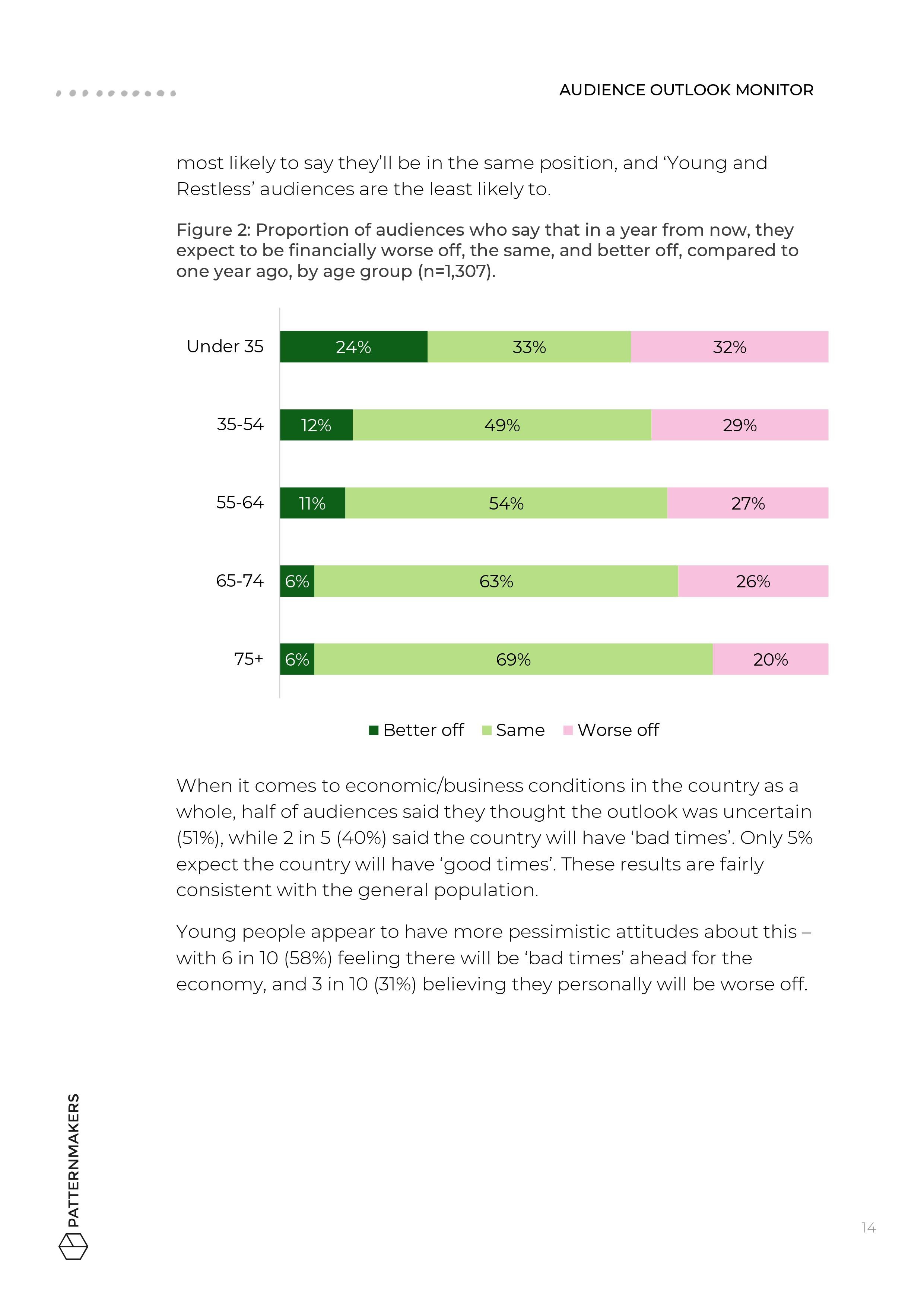
Audiences in outer suburbs are feeling slightly more pessimistic than optimistic about their financial situation, with almost half (46%) say they’re worse off than they were a year ago, and 25% expect to be financially worse off in the coming year.
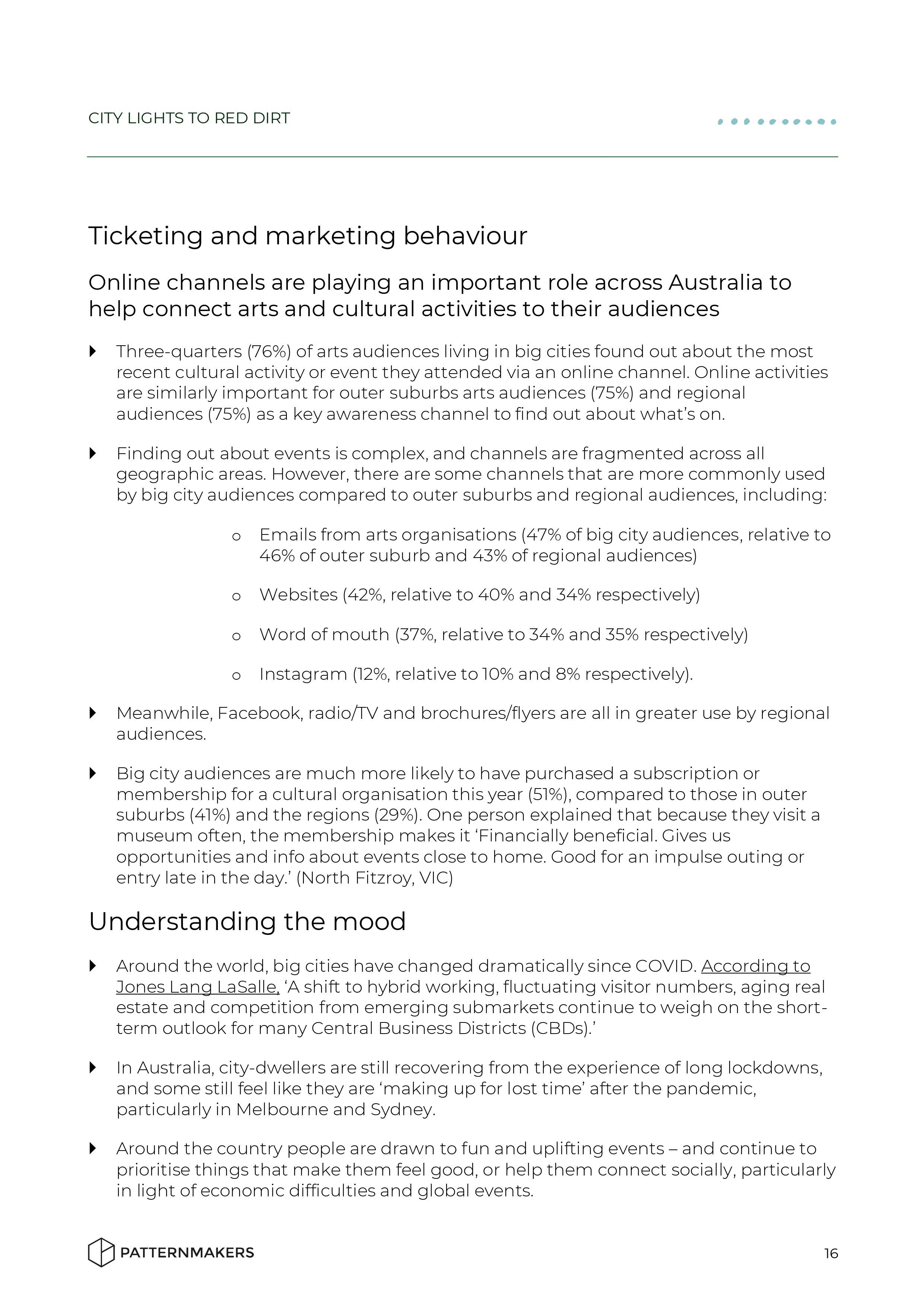
Audiences in outer suburbs (combining both residents and visitors) were most likely to attend a cinema locally (59%), whereas big city audiences were comparatively more likely to attend a local live performance. Audiences in the regions were most likely to attend a fair/festival locally (40%) or visit a museum or gallery (51%).
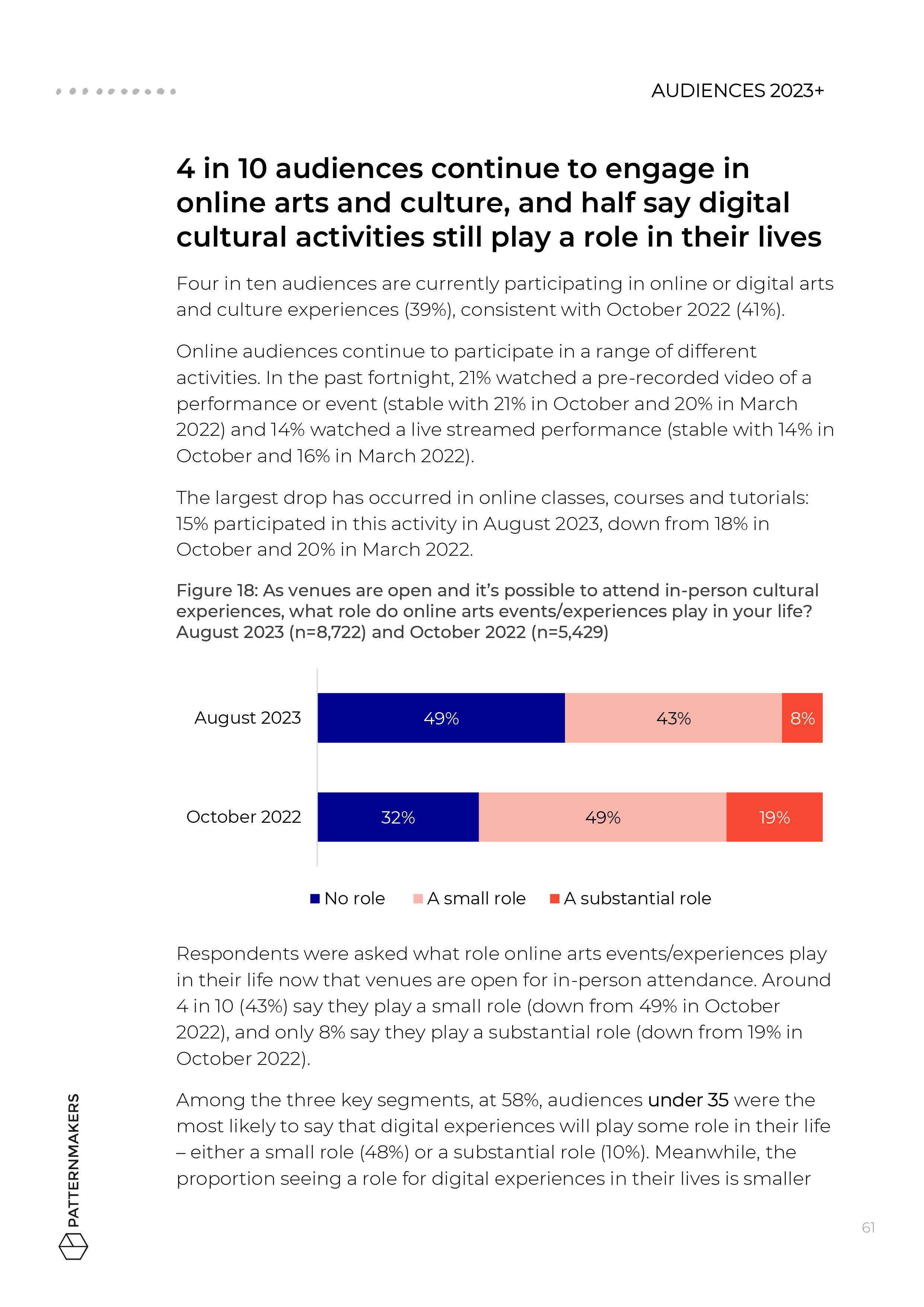
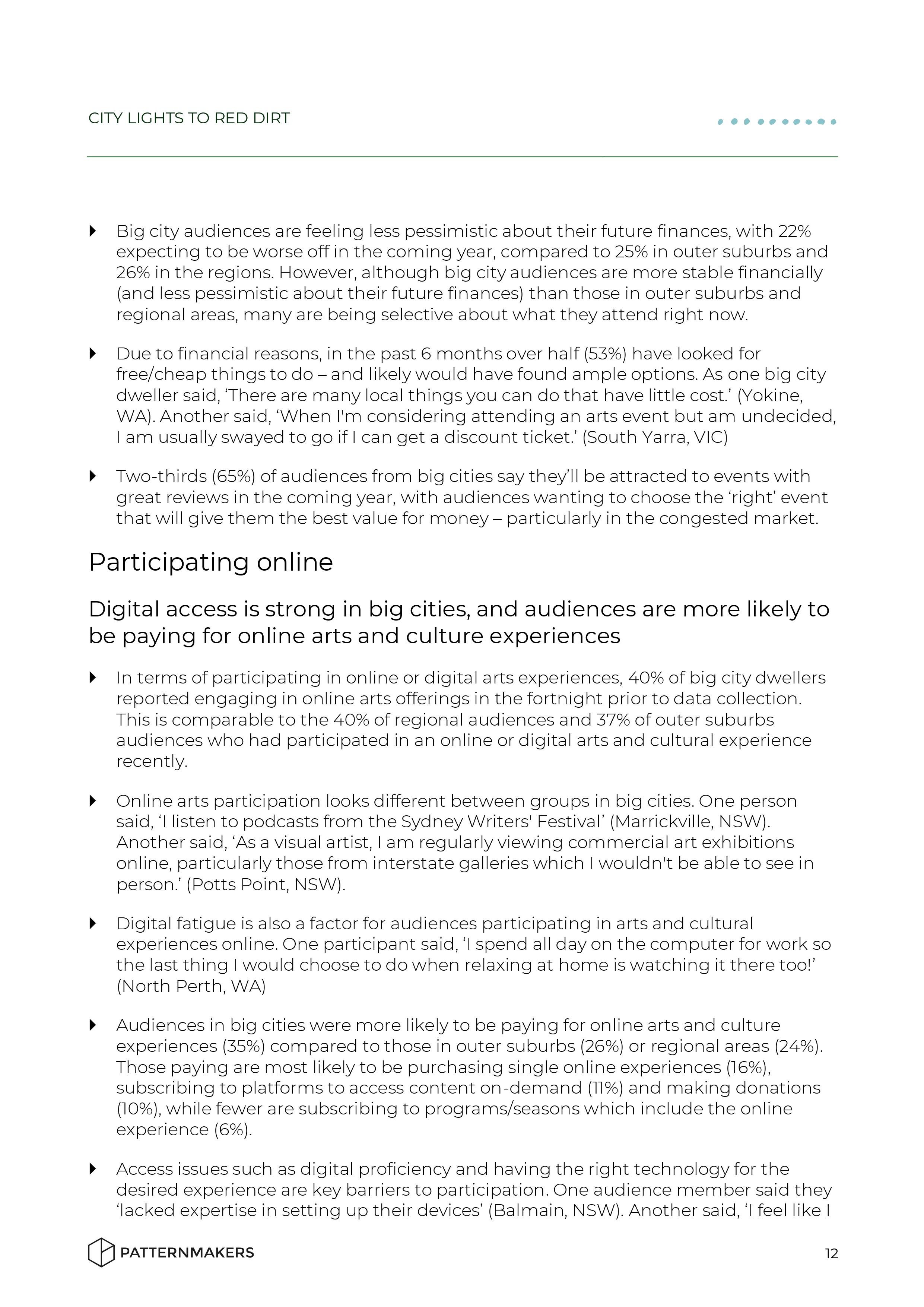
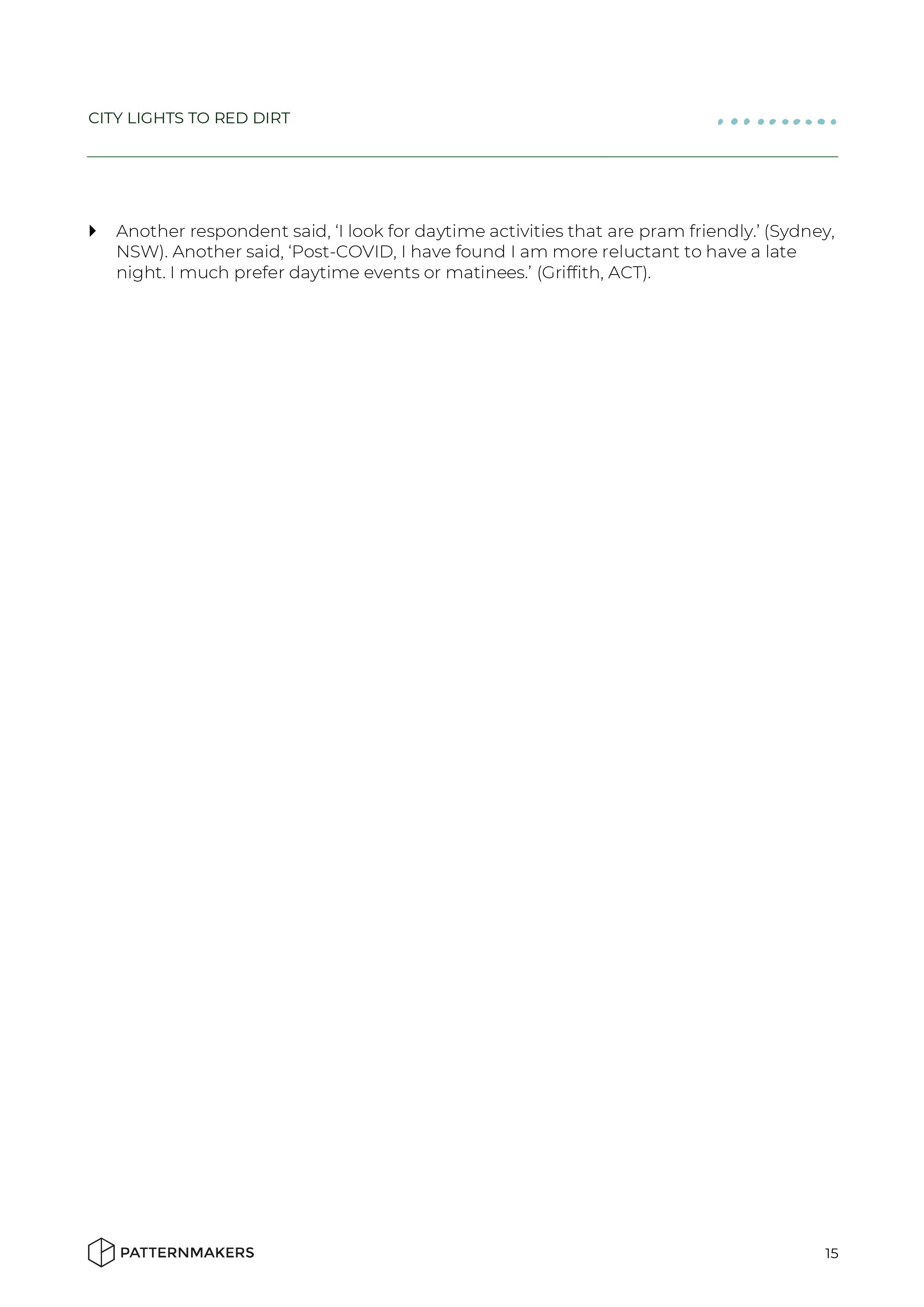
Audiences in outer suburban areas are the least likely to be participating in online events right now. Half of outer suburbs residents say online arts events and experiences are playing a small (43%) or substantial role (8%) in their life, while another 49% say they play no role.

Audiences in the Regions
Across Australia's diverse regions, audiences are experiencing access to arts and culture differently. Factoring in extra time and travel costs means heightened barriers in 2023, but with a decentralising trend, more options could be on the cards.
-
Regional Australia is changing, with demographic shifts seeing some regional places grow dramatically in recent years – but rising costs of travel are leaving some isolated. There are different patterns for large towns, smaller villages and bush or outback areas, but on average, the data shows that:
Regional audiences indicated feeling less stable financially and more pessimistic about their future finances than those in outer suburbs and big cities, and many are being selective about what they attend right now. Almost half (47%) say they are ‘worse off’ financially than they were one year ago, and 26% expect to be ‘worse off’ in the coming year.
Regional audiences have lower levels of access to some types of events, like live performances, and therefore attend less often: 52% of audiences in the regions said they attend performing arts events at least once a month or more, lower than proportions in big cities (77%) and outer suburbs (63%).
Some art forms appear to reach audiences in regional areas better than others. For instance, in the past 12 months, 51% of regional audiences have attended contemporary music and 57% have attended libraries, which are similar to attendance rates in urban areas.
Four in ten regional audience members say that in the coming year, they’ll be most attracted to stories that are ‘about or from my local community’ (39%), slightly higher than the rate in big cities (32%) and outer suburbs (28%).


Get the data at a glance
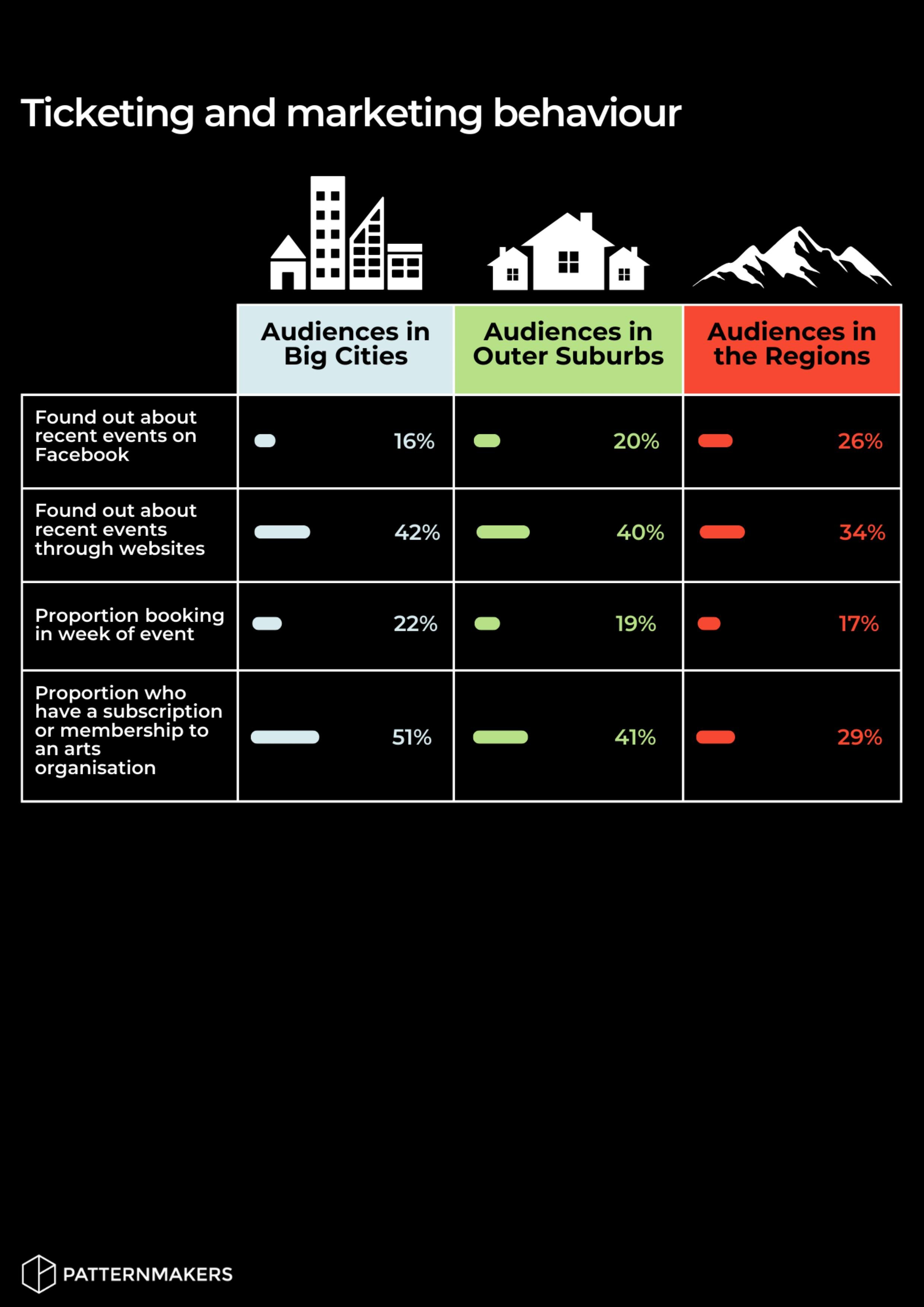
Click the button below to download our Fast Facts for attendance, inflationary pressures, programming preferences and ticketing and marketing behaviour.

Read the ‘Audiences 2023+’ report
In case you missed it, click the button below for the key insights from the August 2023 National Snapshot.
Use the dashboard to get results for your artform and region
Survey data from Phase 9, which heard from over 8,800 respondents, has been uploaded to the dashboard, which now contains insights from over 100,000 Australian participants.
You can use the dashboard to explore the findings by state/territory, artform and audience segment.
It’s freely available to access, just click the image below and use the login details provided on the dashboard page.

About the Audience Outlook Monitor
The Audience Outlook Monitor provides the results of a study that has tracked audience sentiment over the course of the COVID-19 pandemic.
Data was collected in six phases throughout 2020-2022 and is again being tracked in 2023.
Government agencies across Australia are collaborating with research agencies Patternmakers (Sydney) and WolfBrown (USA) to produce this resource. The dashboard is freely accessible and designed to help artists and cultural organisations of all kinds to make the best possible decisions.


How to find out more
To receive new releases directly into your inbox, as soon as they are available, you can opt in to receive updates below.
If you have a question, or an idea for using this data, please contact Patternmakers at info@thepatternmakers.com.au
About the Author
Peta Petrakis
Research Analyst

Programming, price and planning: What the latest research means for audiences
Do you find yourself being drawn to fun and uplifting events right now? You’re not alone.
In this article, we unpack our major Audience Outlook Monitor publication ‘Audiences 2023+’, and offer the key takeaways for audiences themselves.
Unpacking our latest audience research for audiences themselves.
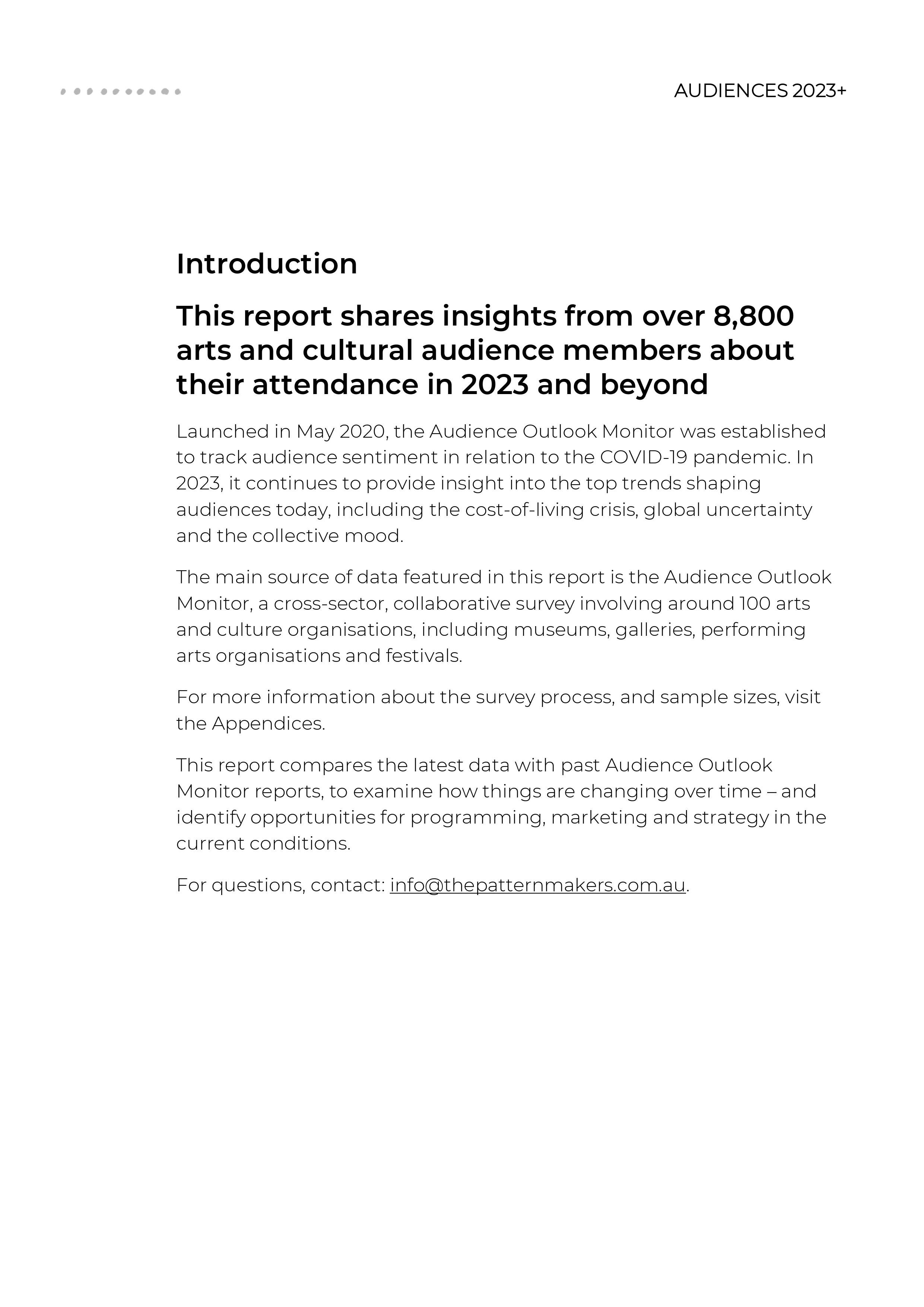
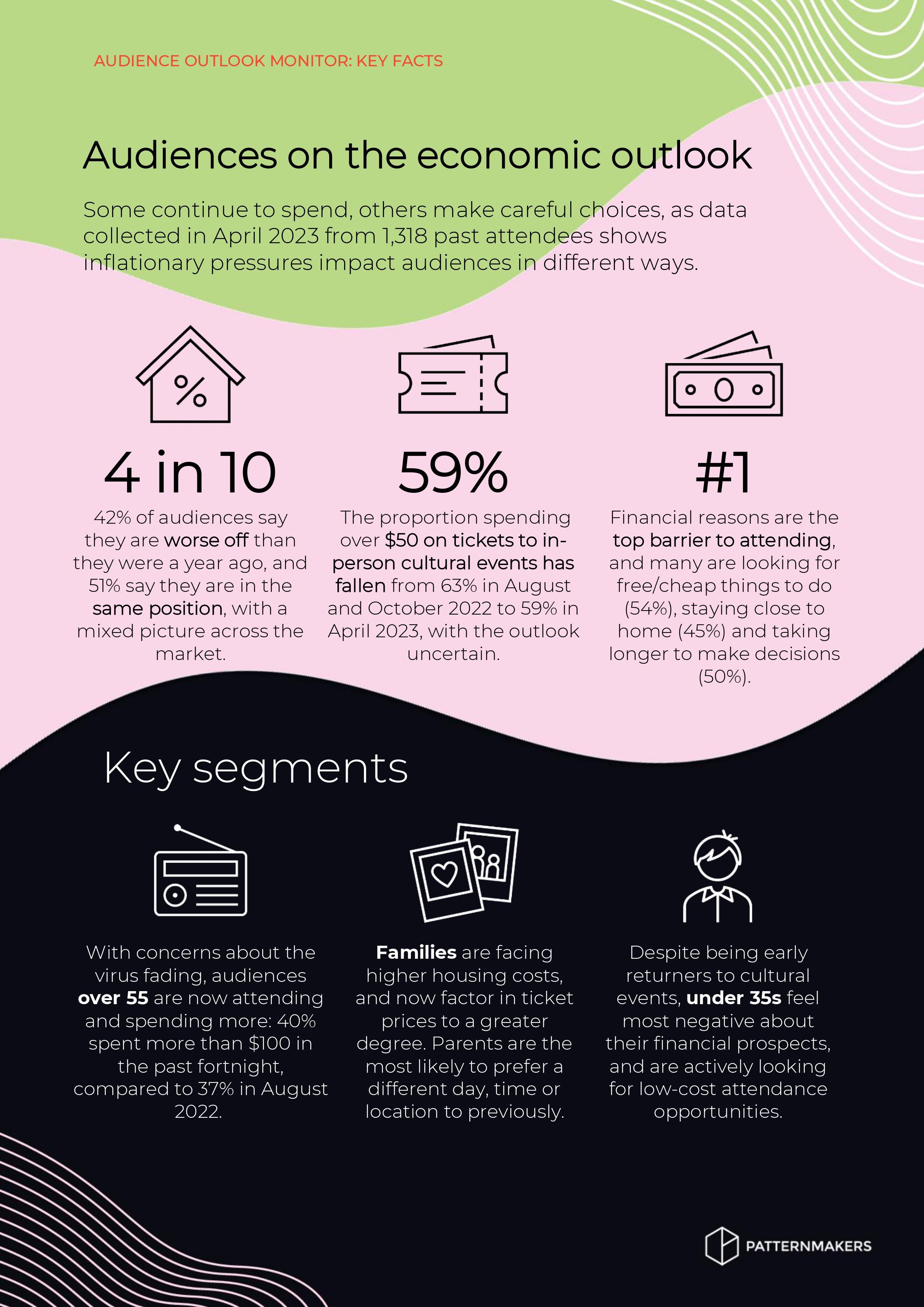
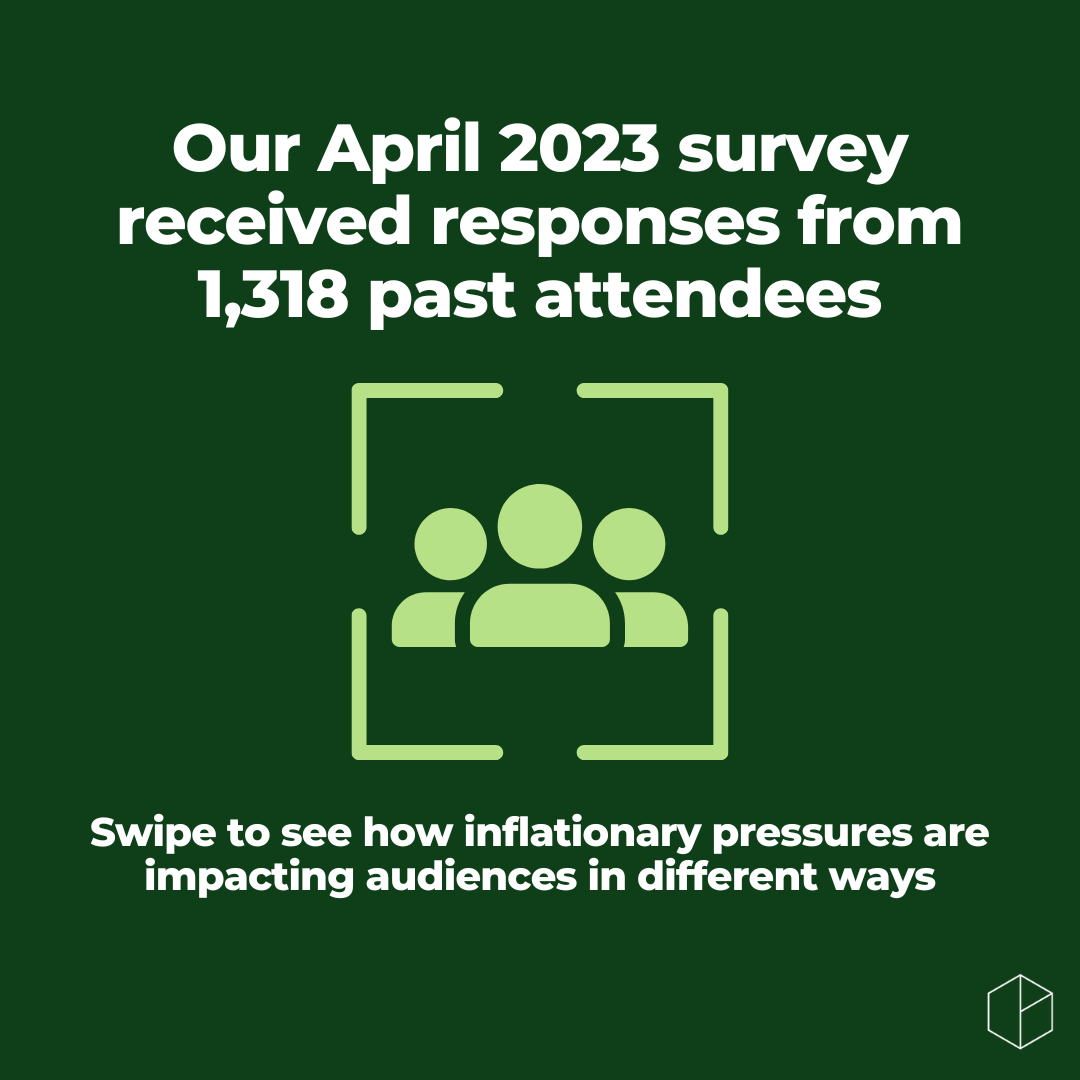
We’ve emerged from some serious analysis, made possible thanks to all 8,816 arts audience members that participated in the latest round of our Audience Outlook Monitor.
If you’re keen to get into the nitty gritty, you can read the full Audiences 2023+ report here. If you’re just looking for the key takeaways, and what the findings mean for audiences just like you, keep reading.
Let’s get into it!
In the mood for fun and uplifting events right now? You’re not alone.
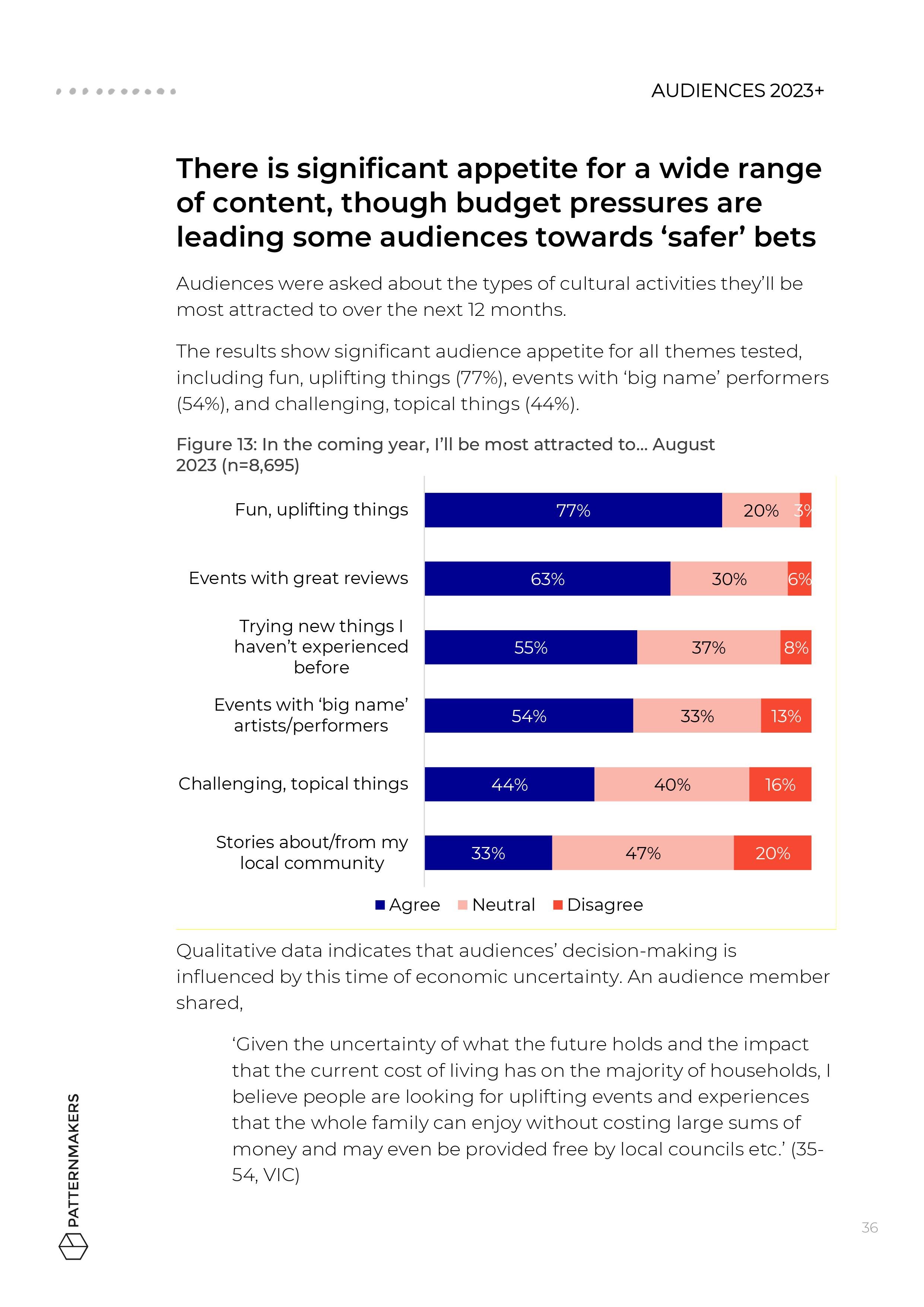
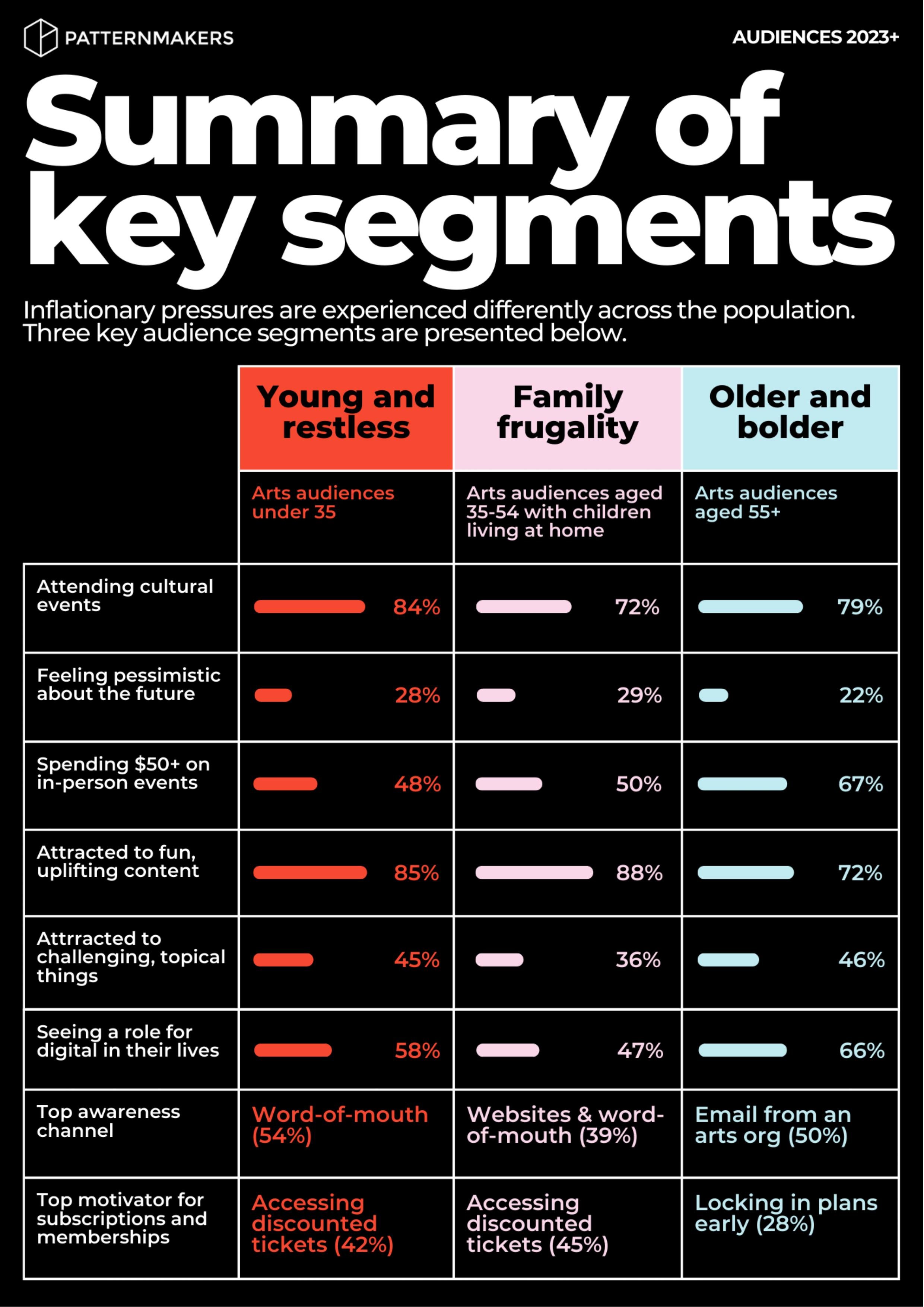
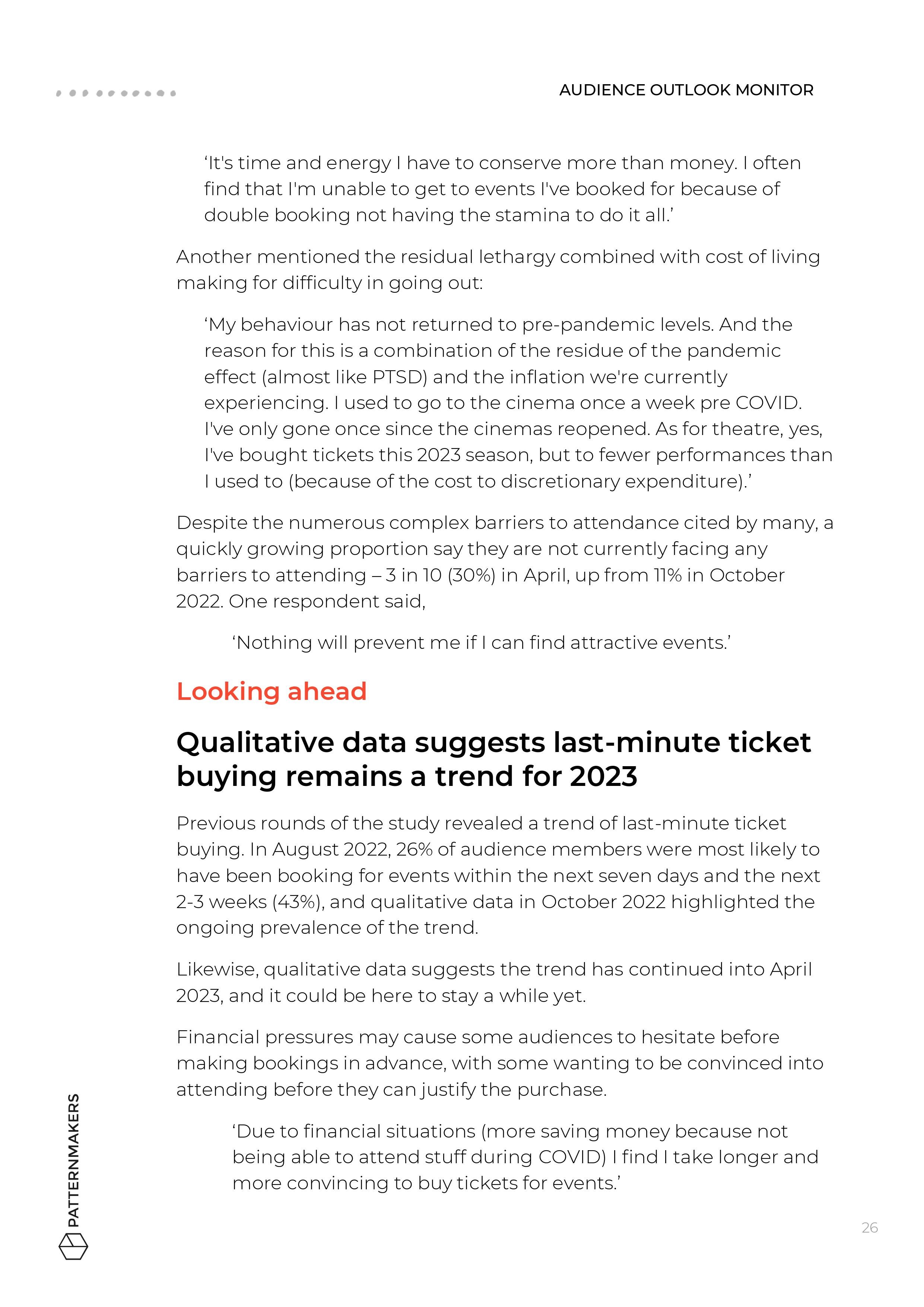
Following the past two years and current cost-of-living pressures, there’s no wonder that most arts audiences are looking for fun and uplifting things (77%), while reviews (63%) and trying new things (55%) are also key drivers.
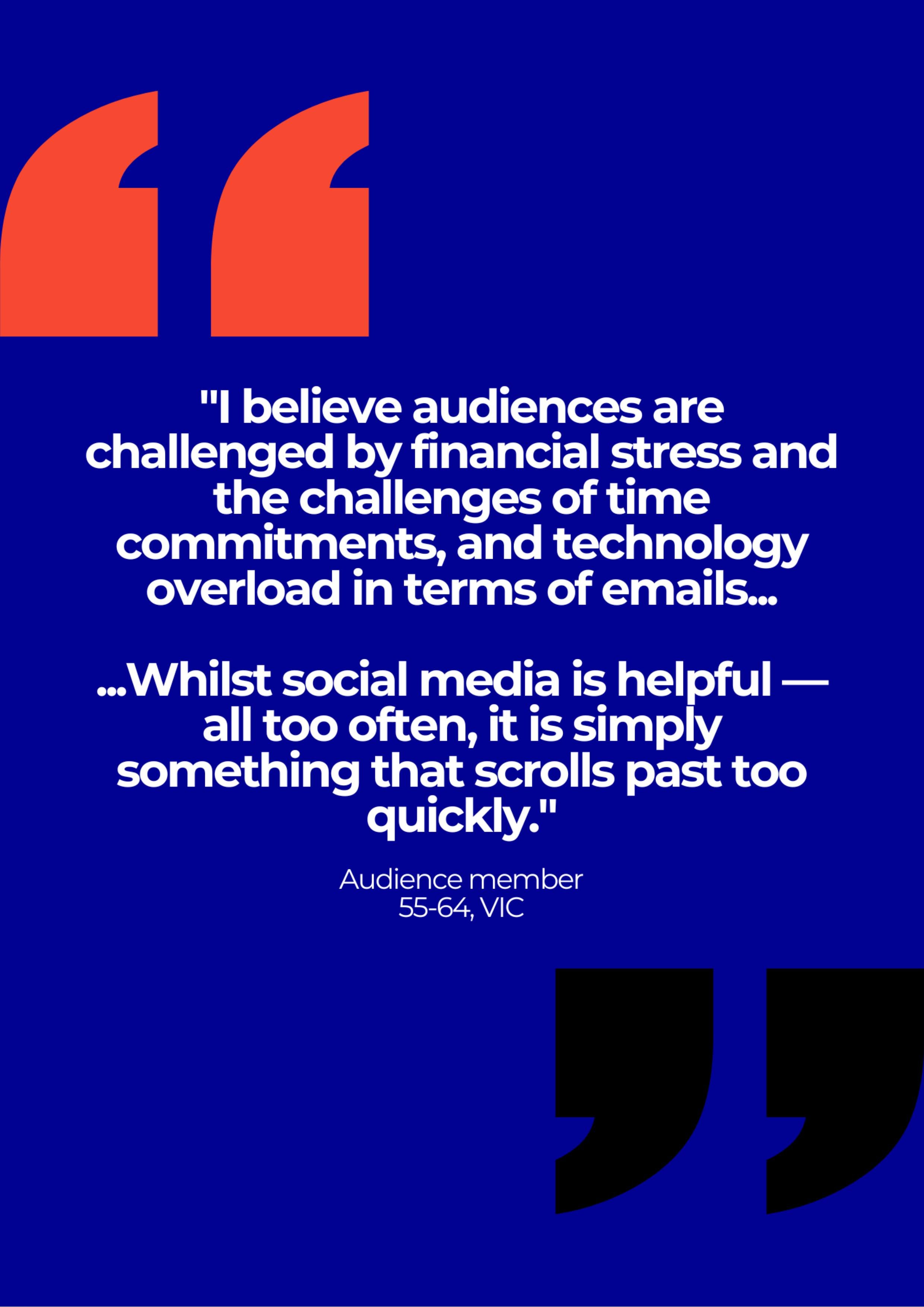
If you’re not at the stage of email fatigue (and we know many audiences are), it’s worth considering subscribing to your favourite arts venues and organisations – because we found this is really the best way to avoid missing out on programming you’re sure to love.
Arts orgs are a lot more aware of the strain of email marketing than before and are really limiting when they reach out to you – and most are waiting to for the right moment to connect when it’s necessary.
Right now, some audiences are getting their fix without spending big.
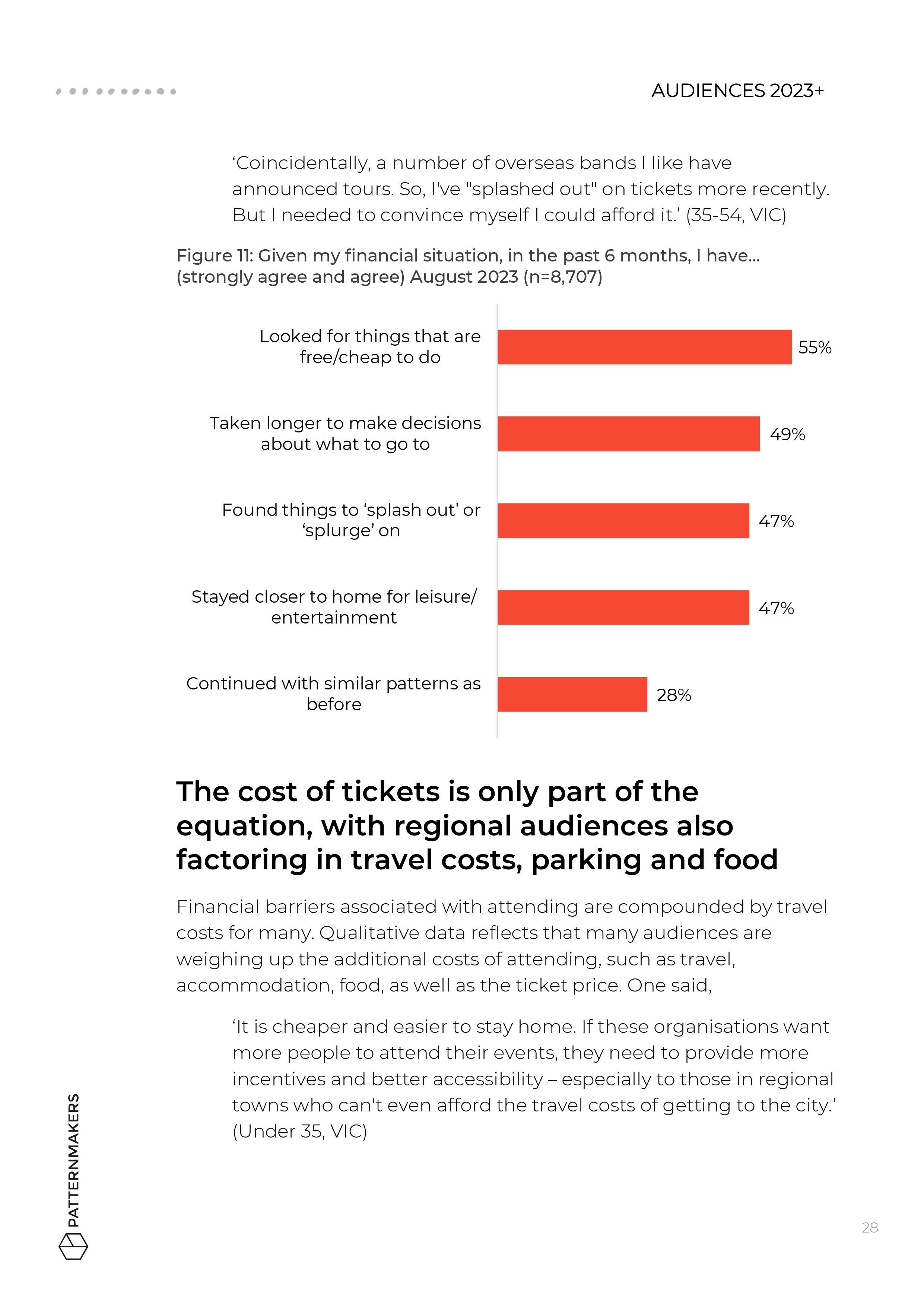
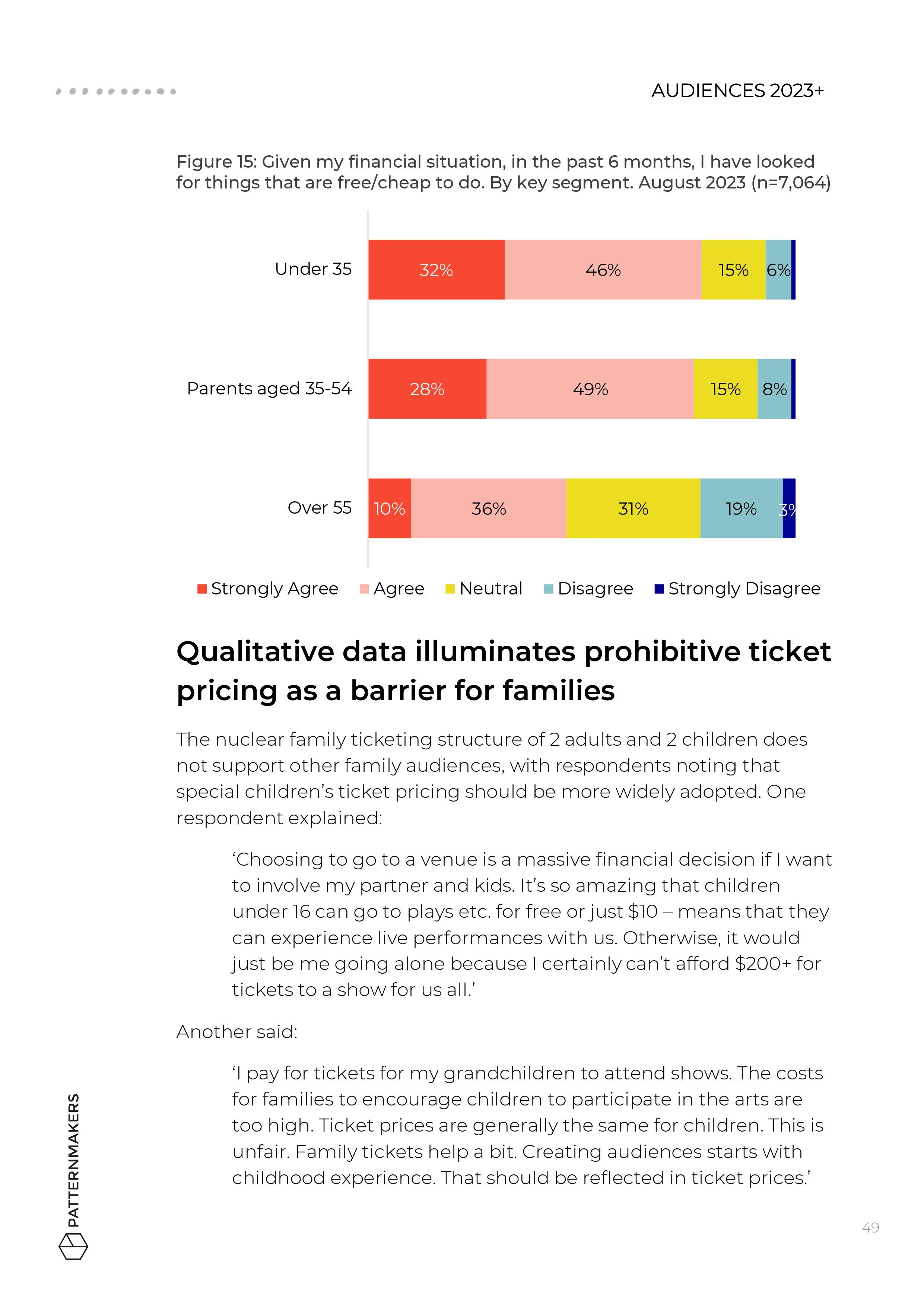
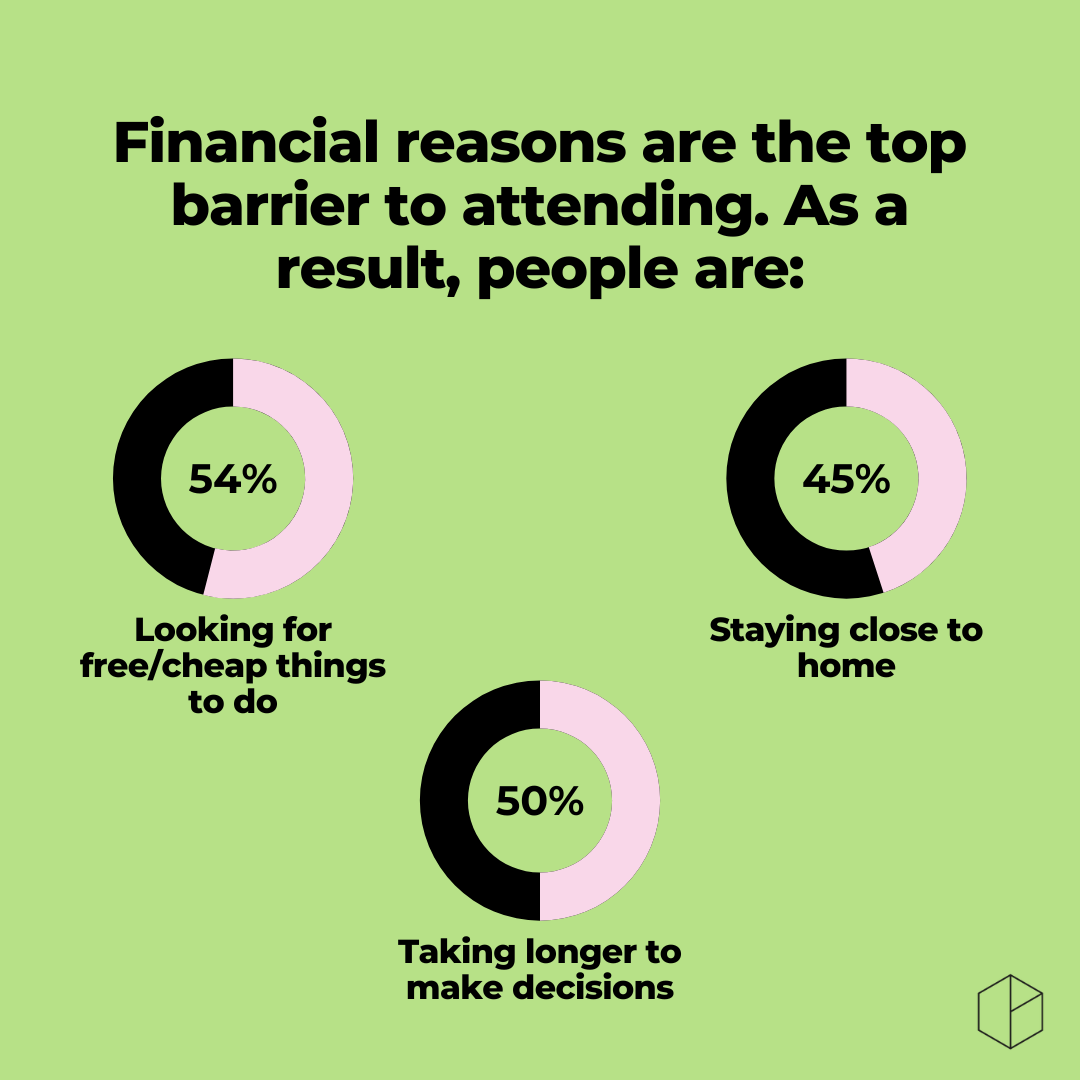
Many audiences are looking for free or cheap things to do (55%), and some are keeping it local to enjoy live arts experiences (47%) and staying closer to home to avoid paying the premium of travel and larger productions.
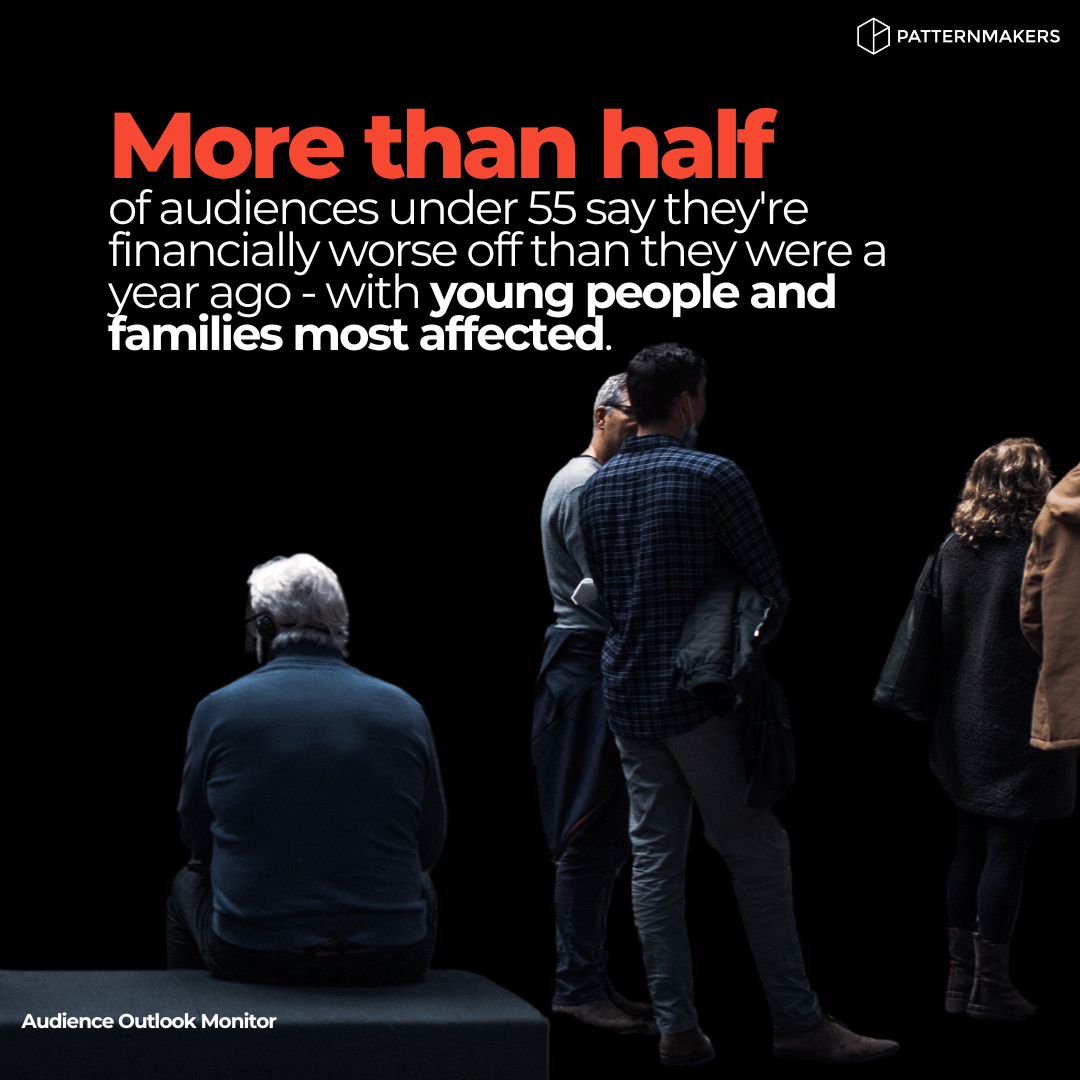
You have likely seen the many reports on Australia’s cost-of-living crisis, especially its impact on young people. Financial pressures are hitting under 35s the most, coming through in our latest Audience Outlook Monitor round, so look out for special concession offers that are likely aimed at the younger age groups.
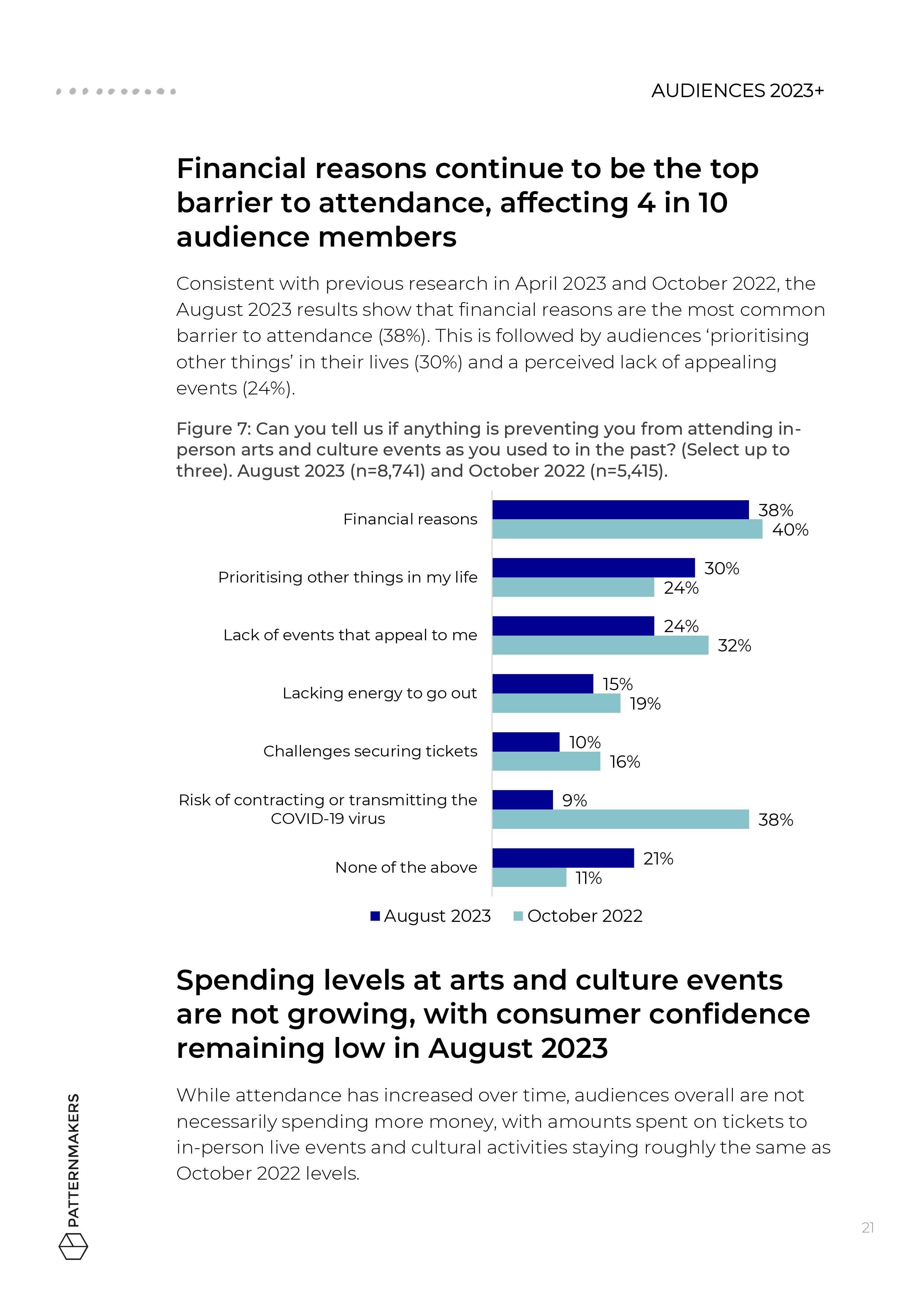
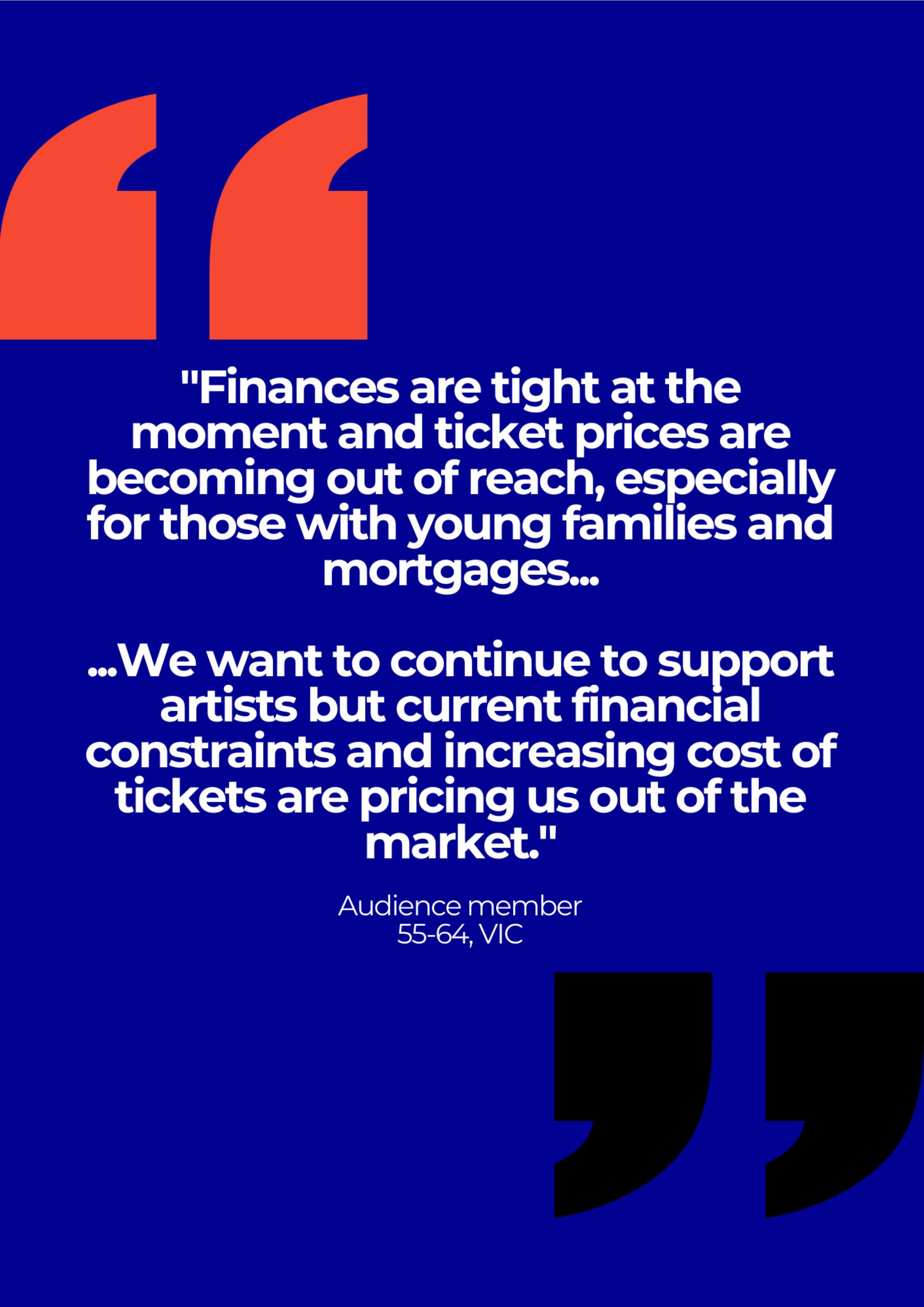
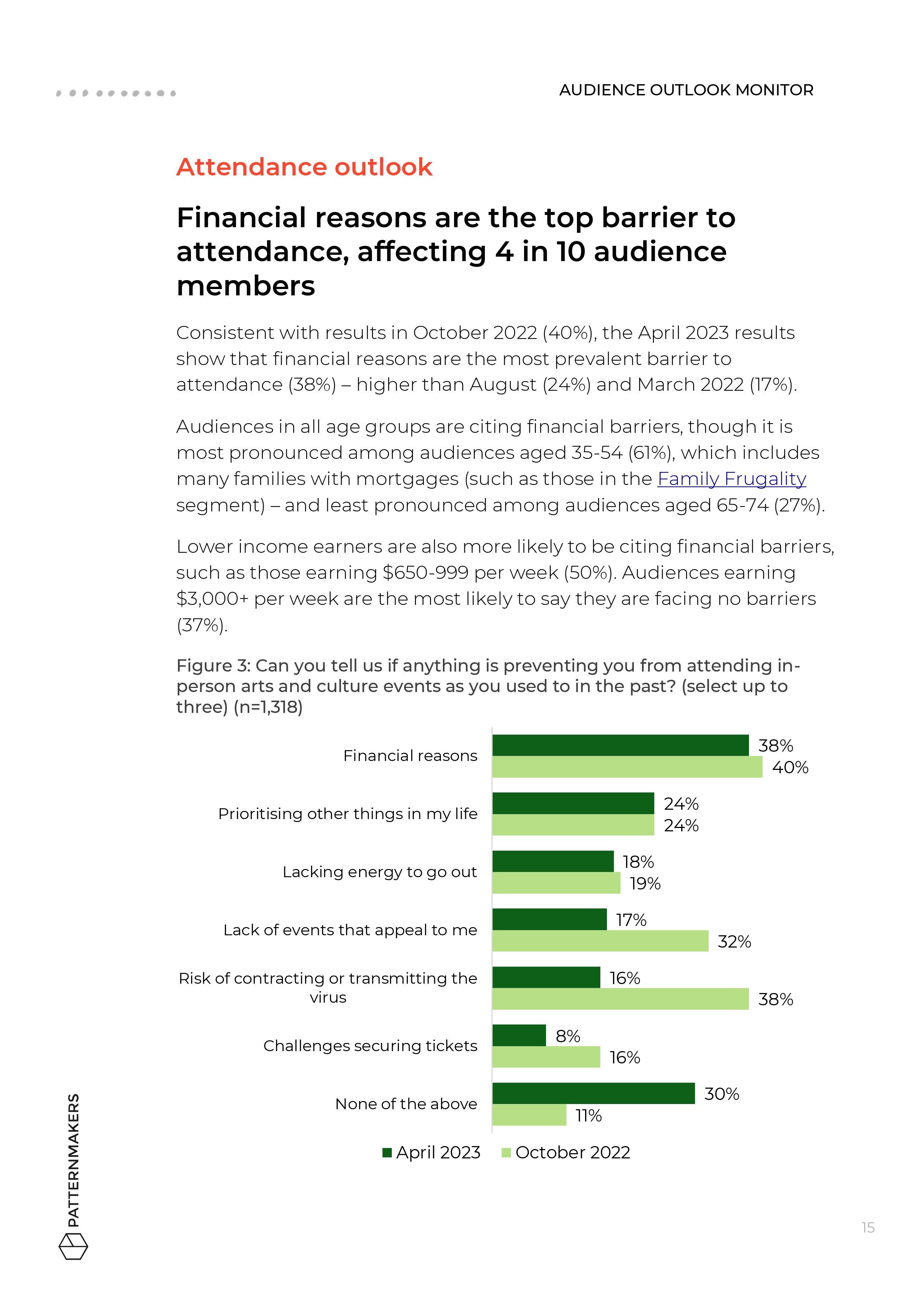
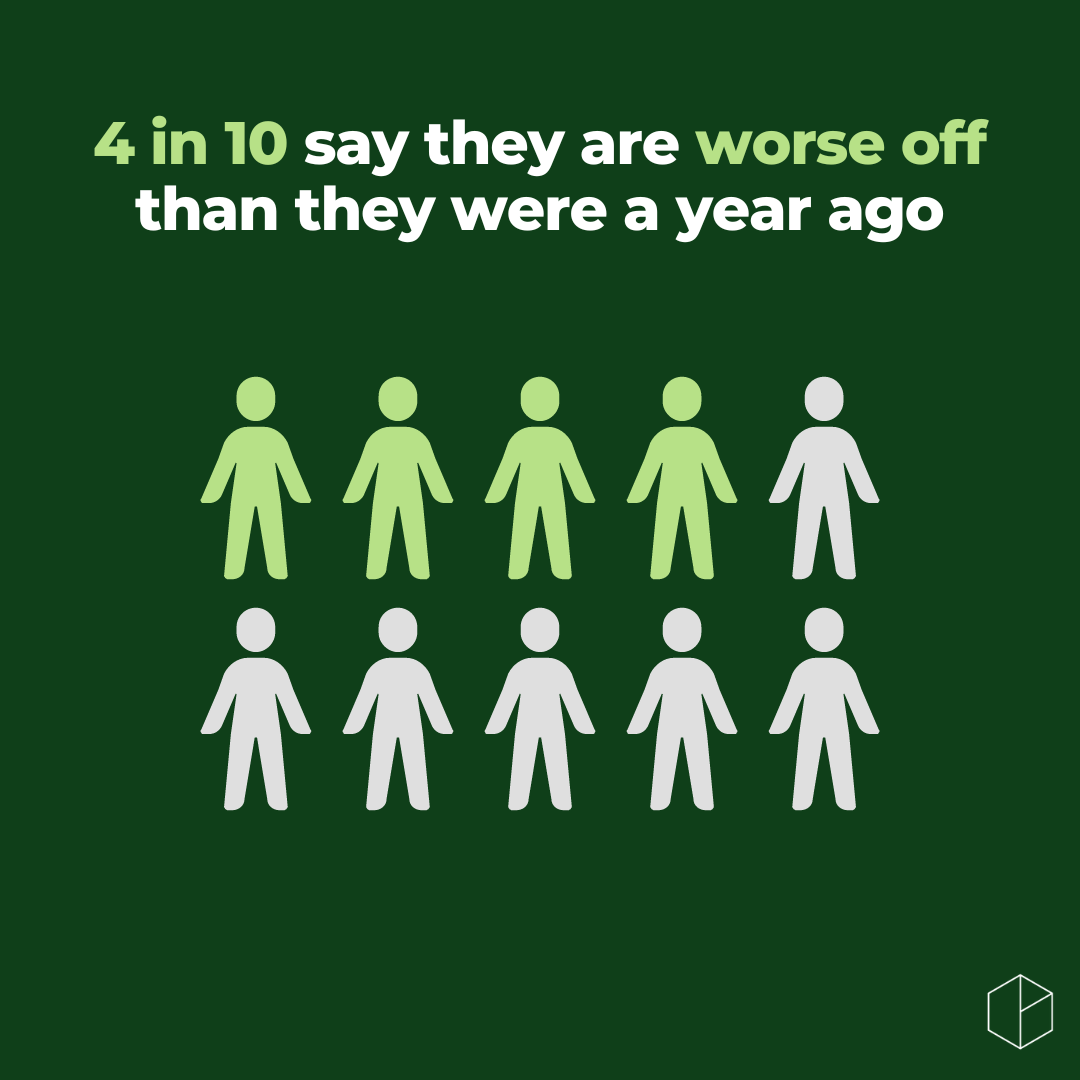
Financial reasons continue to be the top barrier for audiences to attend arts experiences, affecting 4 in 10 audience members (38%). Keep updated on the ticketing policy changes from your favourite arts organisations, as many are trying to adapt to your changing needs.
Feeling like your plans are getting a bit last minute? Here’s why booking early helps you and the organisations you care about:
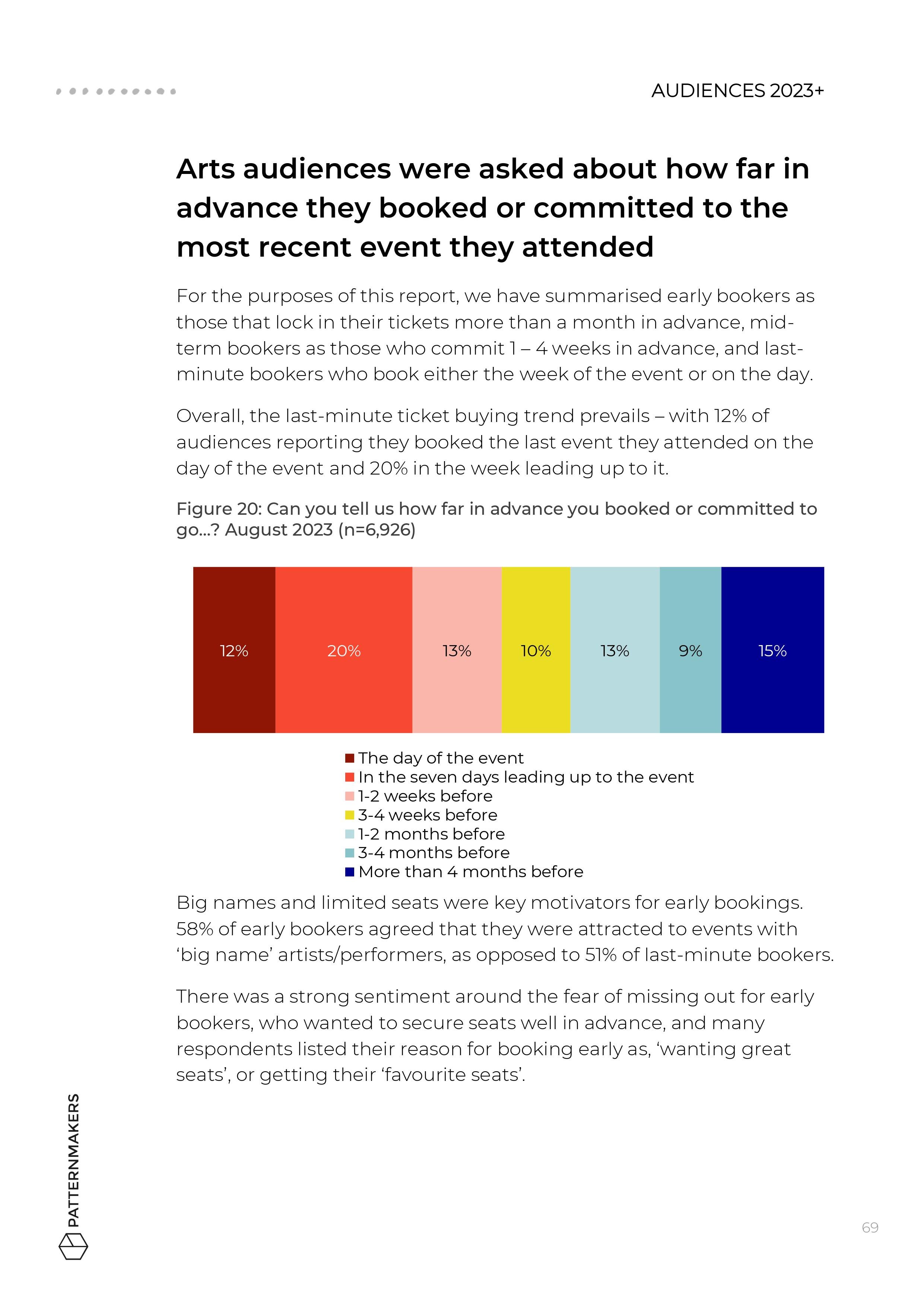
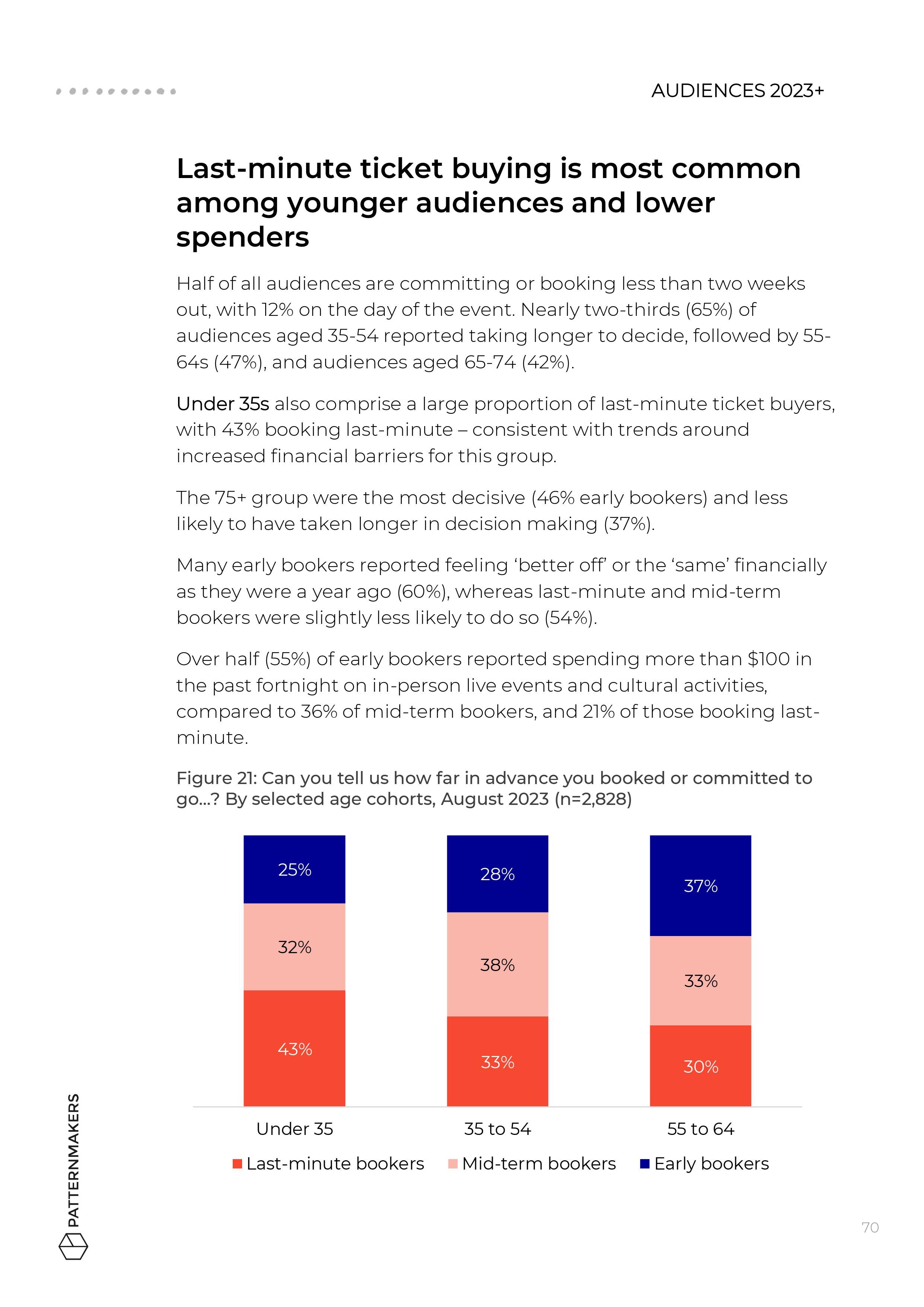
Maybe it’s you, your sister or your friend, but audiences are taking longer to make decisions as they weigh up their options. If this sounds like you, you’re likely one of our ‘last-minute bookers’ – 45% of you reported booking in the last 2 weeks before an event and 12% book on the day!
Late booking can mean missing out on tickets, risking schedule clashes with your crew, but also has got the sector a *little* extra under the pump. And the longer audiences wait, the more life gets in the way. Almost a third (30%) of arts audiences said that prioritising other things was a key barrier for them to attend arts and cultural activities.
So, if you really want to go – you should really book it in (it’s a win-win!), and if it’s flexibility you’re after, make sure you’re across the ticketing policies of your favourite venues.
P.S. Opinions matter, so share them!
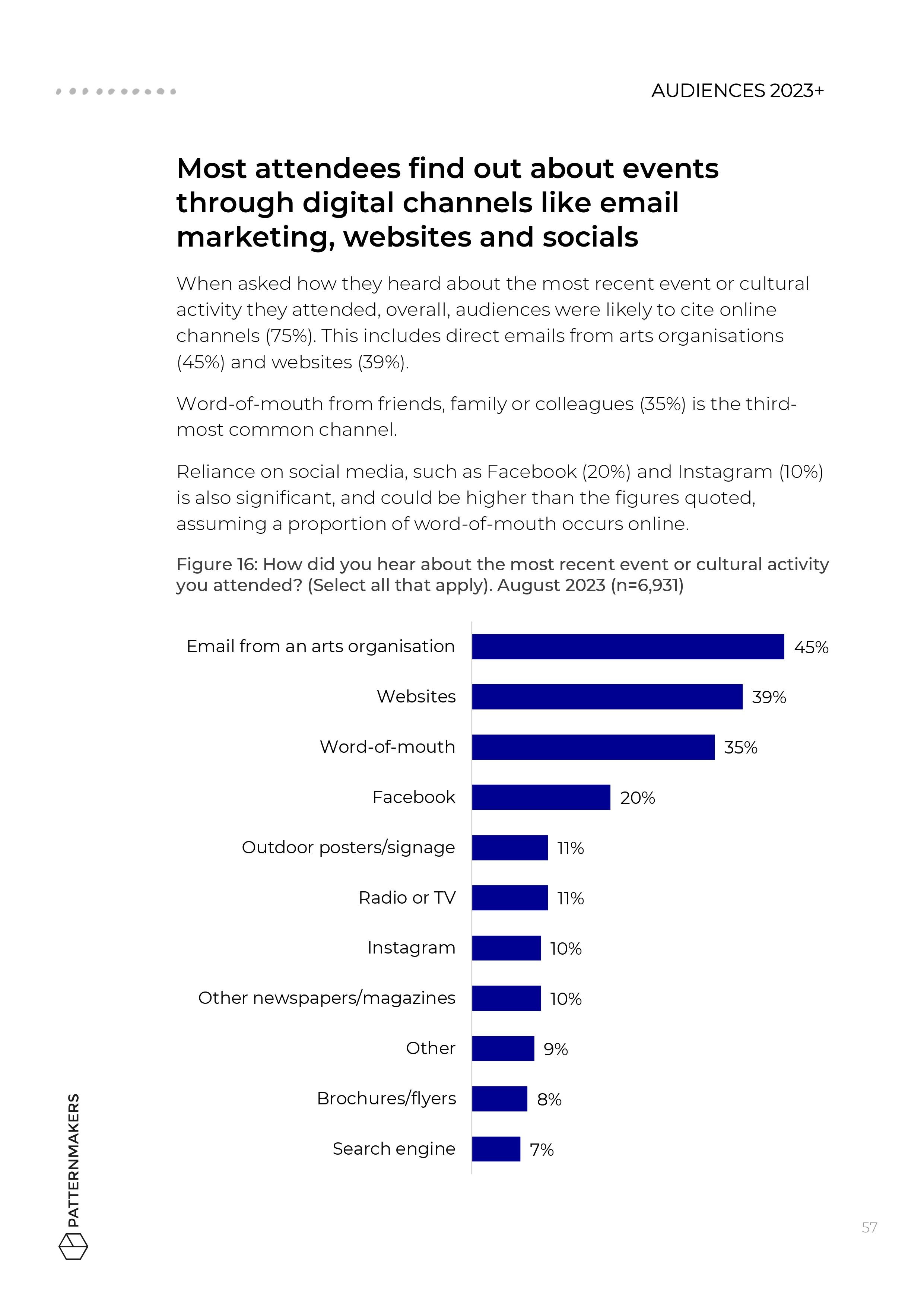
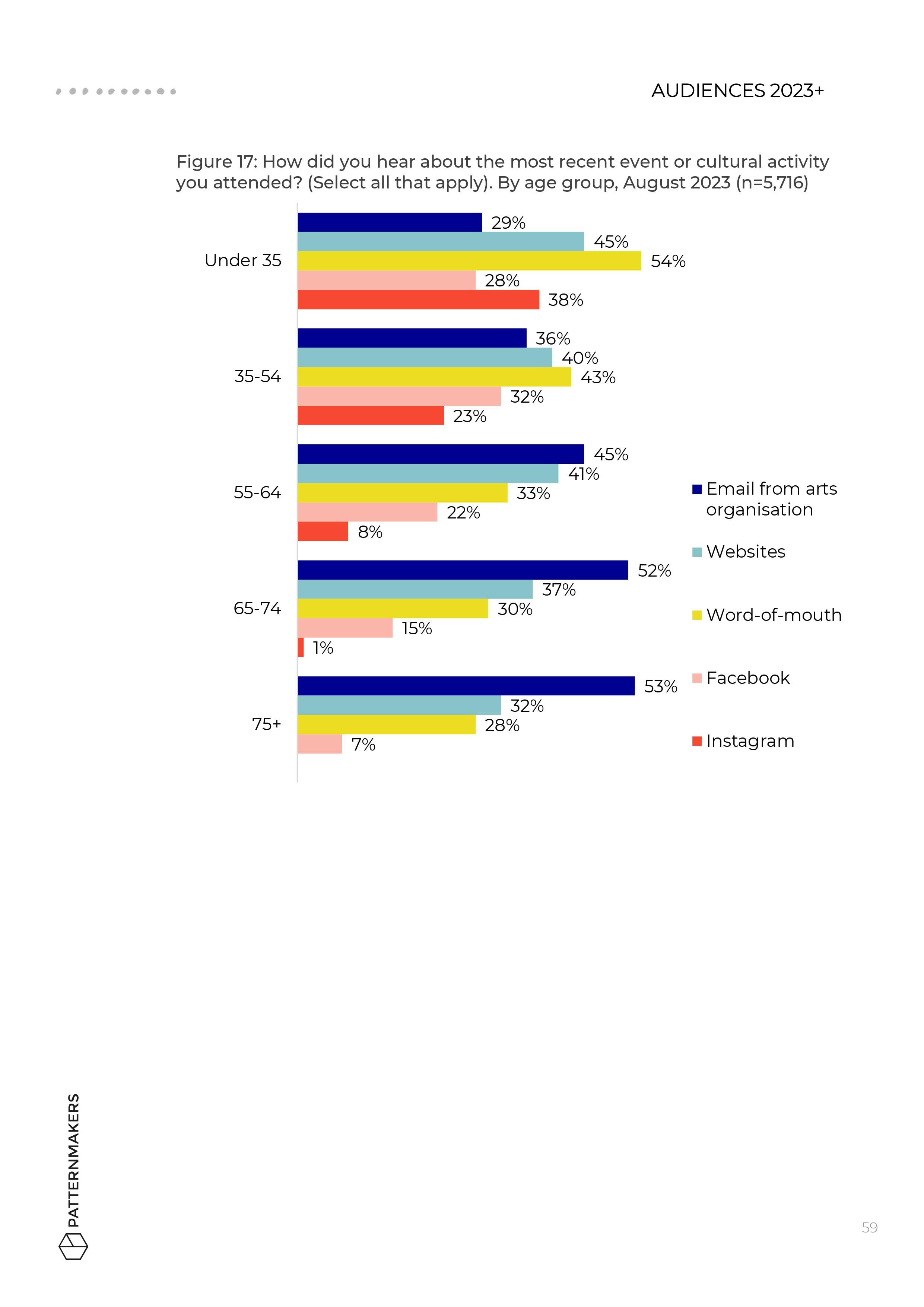
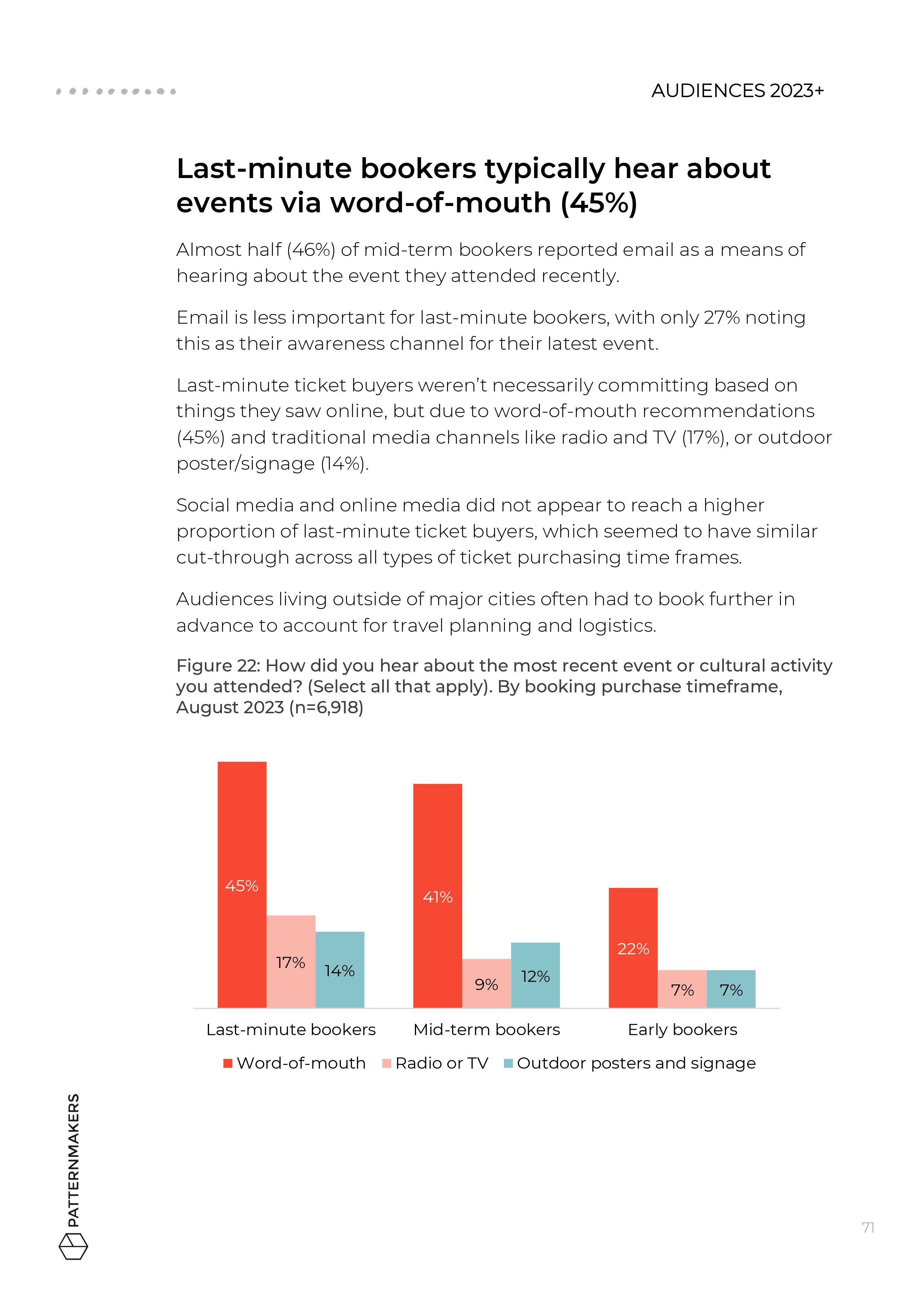
If you’re curious about the most affordable way to support your favourite arts and cultural organisations - we found that the #1 awareness channel for you arts audiences is…word of mouth! Don’t underestimate the value of talking about your experiences and sharing your thoughts to those around you (and online), because it’s a sure-fire way of supporting the arts.
If you’re interested in exploring how arts audiences are faring in different areas, be sure to keep an eye out on our website for our upcoming report ‘City light to red dirt: Connecting with audiences across Australia’ — launching November 30th.
Thank you to our partners WolfBrown, Creative Australia, and state arts agencies around the country for their support with the Audience Outlook Monitor publications.
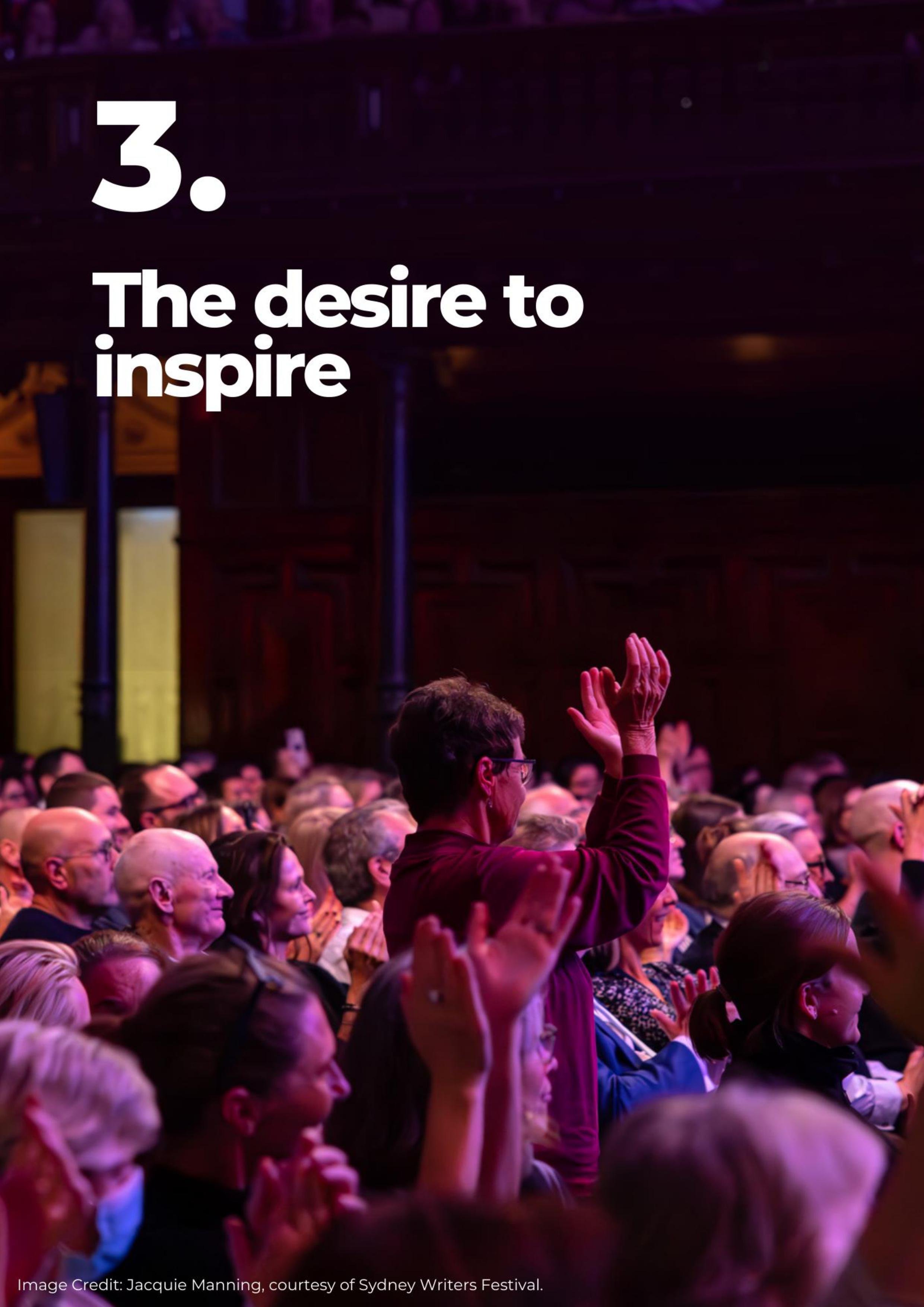
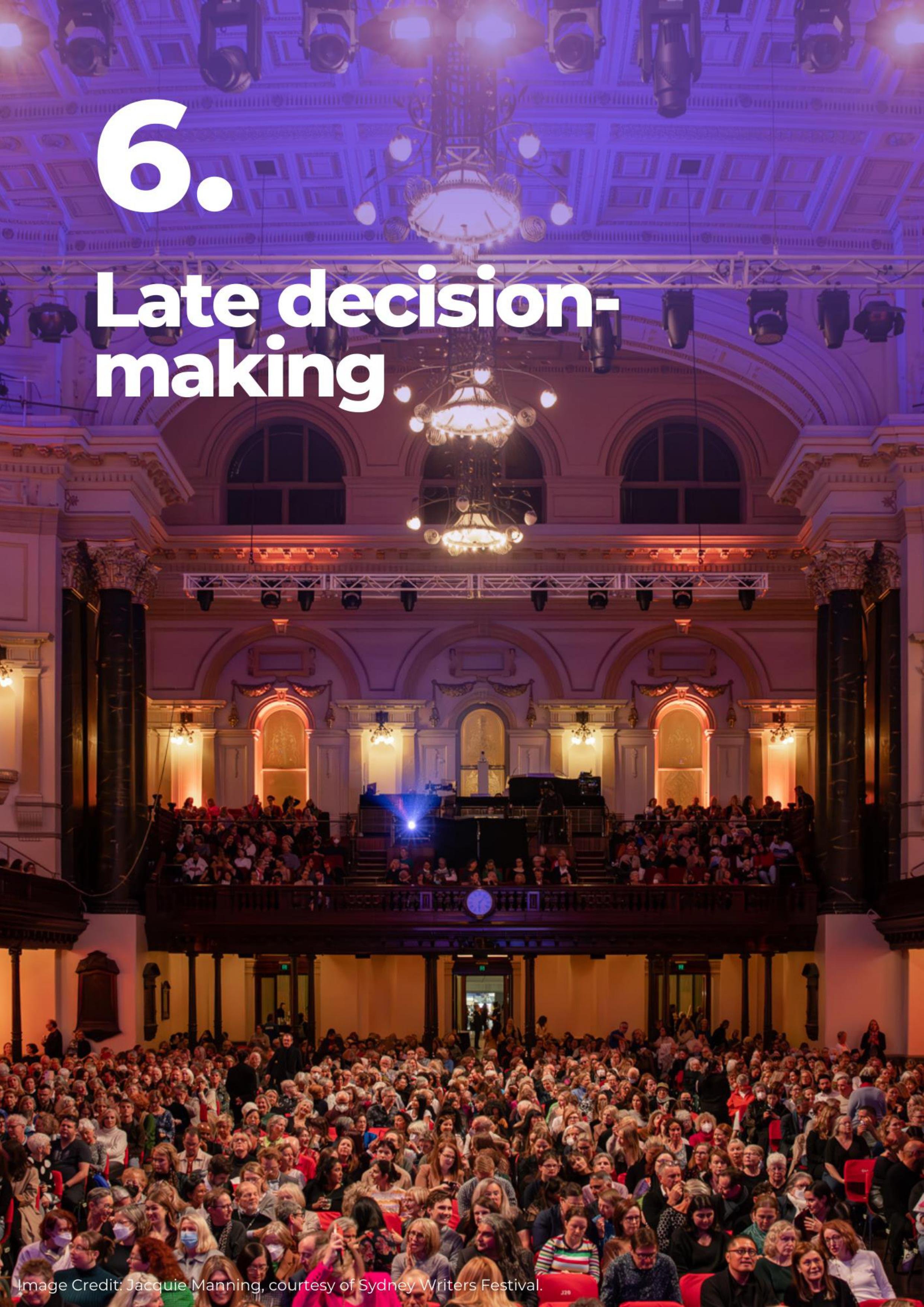
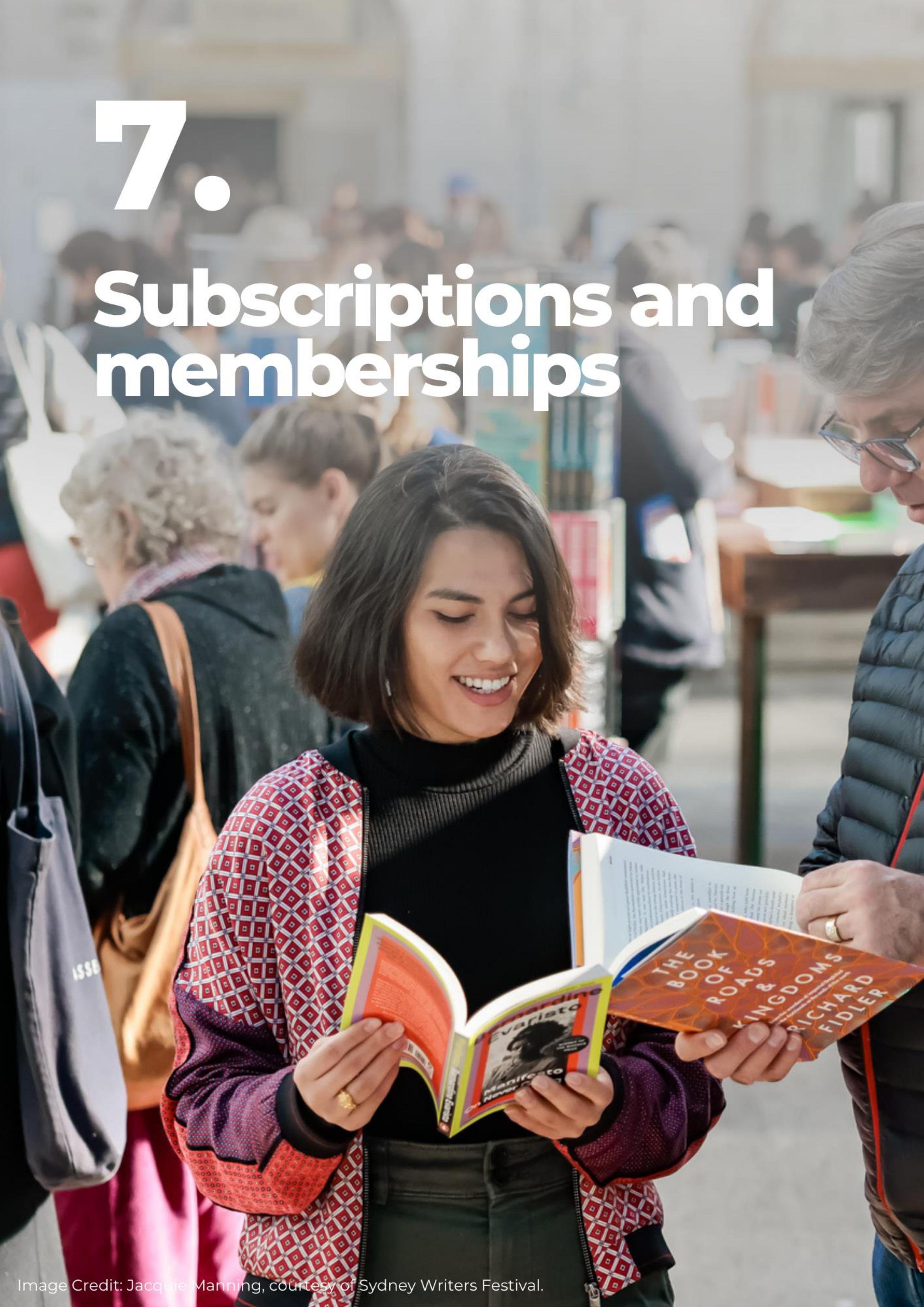
Image Credit: Jamie Williams, courtesy of Sydney Writers Festival.
About the Author
Peta Petrakis
Research Analyst
Categories
Archive
- Research 99
- Audience development 79
- Innovation 78
- Evaluation 75
- Arts 73
- Culture 72
- COVID-19 70
- Data culture 69
- About Patternmakers 35
- Project updates 25
- 2022 23
- 2023 21
- Thought leadership 16
- Tips & Tricks 13
- 2018 12
- 2019 11
- Career Advice 9
- 2017 8
- Beyond the Bio 8
- 2021 7
- Tandi Palmer Williams 7
- Privacy 6
- Resources 6
- Year in review 6
- 2016 5
- Performing Arts 5
- Strategic Planning 5
- Toolkit 5
- Accessibility 4
- Digital art 4
- Opportunities 4
- Our services 4
- Visual arts 4
- Youth 4
- 2020 3
- Capacity building 3
- Dance 3
- First Nations 3
- Interviews 3
- Touring 3
- Trends 3
- Case Studies 2
- Coronavirus 2
- Data art 2
- Education 2
- Indigenous 2
- Top 5 2
- 2024 1
- Culture Panel 1
- Manifesto 1